Open Source Pinecone Alternatives
A curated collection of the 9 best open source alternatives to Pinecone.
The best open source alternative to Pinecone is Mem0. If that doesn't suit you, we've compiled a ranked list of other open source Pinecone alternatives to help you find a suitable replacement. Other interesting open source alternatives to Pinecone are: Milvus, Qdrant, Chroma, and Typesense.
Pinecone alternatives are mainly Vector Databases but may also be AI Memory & Context or Search Engines. Browse these if you want a narrower list of alternatives or looking for a specific functionality of Pinecone.

Written by Piotr Kulpinski


Adds persistent, searchable memory to AI agents and apps, so they remember user preferences and past interactions across sessions without pipeline changes.
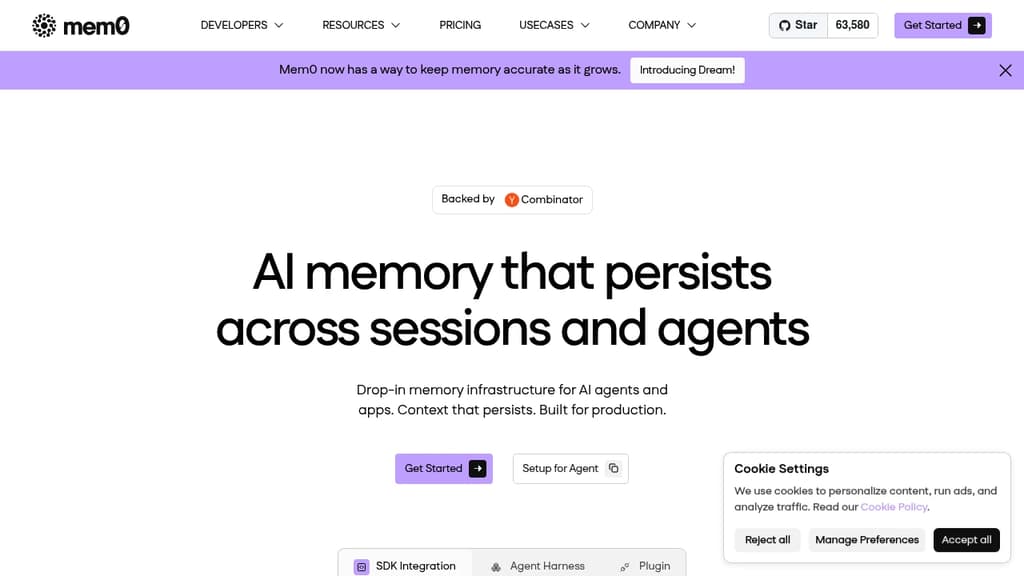
Mem0 is a memory infrastructure layer built for AI agents and applications that need to retain context across sessions. Without something like this, every conversation starts from scratch, forcing developers to stuff redundant history into prompts or lose personalization entirely. Mem0 solves that by extracting, storing, and retrieving memories automatically as users interact.
The core idea is simple: you send messages to Mem0, it learns from them, and later retrieves the relevant context when needed. No boilerplate configuration required. It fits into existing agent architectures without restructuring your pipeline.
Key capabilities include:
- Memory Compression Engine that condenses chat history into compact, token-efficient memories, cutting latency and API costs
- Multi-signal retrieval that surfaces the right memories at the right time, benchmarked on LoCoMo, LongMemEval, and BEAM datasets
- User-scoped memory so each user's preferences, history, and context stay separate and addressable by ID
- Full audit logging with visibility into every read and write, including who accessed what and when
- Flexible deployment across Kubernetes, private cloud, or air-gapped environments with a consistent API
- Compliance at the enterprise level: SOC 2 (Type 1), HIPAA, BYOK, and zero-trust architecture
Mem0 is particularly well-suited for products where personalization compounds over time: healthcare assistants that track patient history, customer support bots that remember past issues, or AI chat interfaces that need to feel consistent across sessions. It also works well as the memory backend for more complex agent frameworks that handle multi-step reasoning but lack native persistence.
Over 90,000 developers use it in production. The SDK supports Python and Node.js, and the managed API makes it easy to get started without self-hosting. For teams that need full control, self-hosted deployment is available with the same API surface.

Open-source vector database optimized for similarity search, scaling to billions of vectors with minimal performance loss
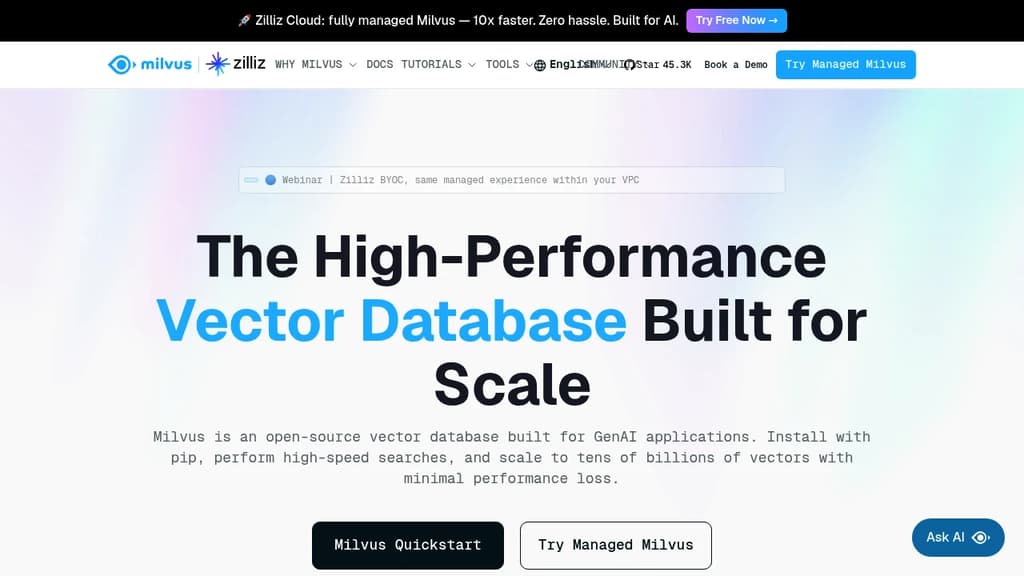
Milvus is an open-source vector database built specifically for GenAI applications. It offers high-performance similarity search capabilities and seamless scalability to handle billions of vectors.
Key features:
- Easy installation: Get started quickly with a simple pip install
- Blazing-fast searches: Perform high-speed similarity searches on massive vector datasets
- Elastic scalability: Scale effortlessly to tens of billions of vectors with minimal performance impact
- Flexible deployment: Choose from lightweight Milvus Lite for prototyping, robust Standalone for production, or fully distributed deployment for enterprise-scale workloads
- Rich ecosystem: Integrates smoothly with popular AI tools like LangChain, LlamaIndex, OpenAI, and more
- Advanced capabilities: Supports metadata filtering, hybrid search, multi-vector queries and other powerful features
Milvus empowers developers to build robust and scalable GenAI applications across various domains including image retrieval, recommendation systems, and semantic search. Its focus on performance, scalability and ease-of-use makes it a top choice for vector similarity search at any scale.

Qdrant is an open-source vector database that provides high-performance similarity search for AI and machine learning applications.
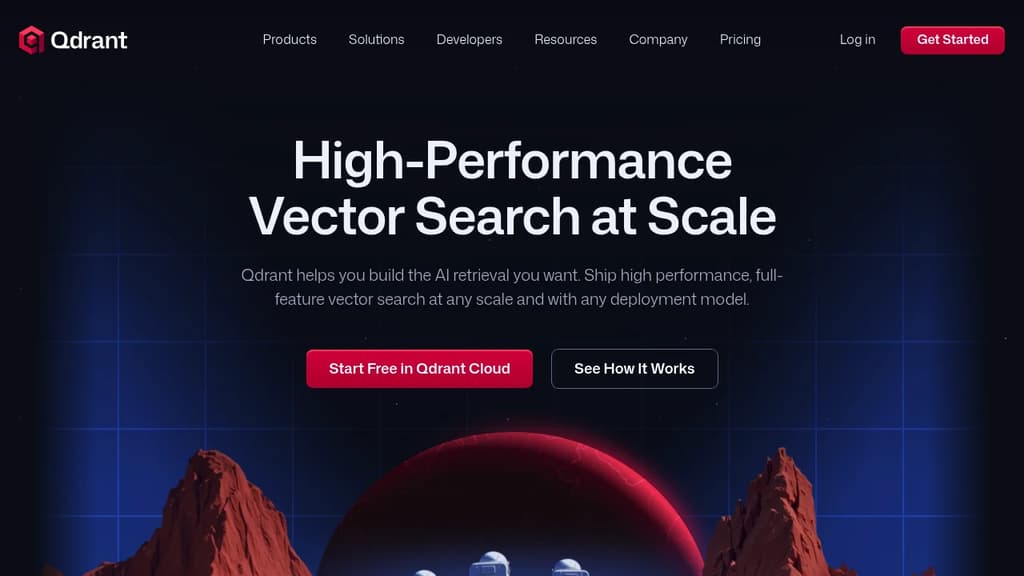
Qdrant is a powerful open-source vector database designed for high-performance similarity search in AI and machine learning applications. Built with Rust for unmatched speed and reliability, Qdrant excels at handling billions of high-dimensional vectors.
Key features:
- Cloud-native scalability: Easily scale vertically and horizontally with zero-downtime upgrades
- Flexible deployment: Quick setup with Docker for local testing or cloud deployment
- Cost-efficient storage: Built-in compression options to dramatically reduce memory usage
- Advanced search capabilities: Supports semantic search and handles multimodal data efficiently
- Easy integration: Lean API for seamless integration with existing systems
Qdrant is ideal for powering recommendation systems, advanced search applications, and retrieval augmented generation (RAG) workflows. Its ability to quickly process complex queries on large datasets makes it suitable for a wide range of AI-driven use cases.
Real-world impact: Trusted by leading companies like Bosch, Cognizant, and Bayer for enterprise-scale AI applications. Qdrant consistently outperforms alternatives in ease of use, performance, and value.
Whether you're building a cutting-edge AI product or enhancing existing applications with vector search capabilities, Qdrant provides the speed, scalability, and flexibility needed to bring your ideas to life.

Open-source vector database designed for AI applications. Store, search, and retrieve embeddings with semantic similarity matching and metadata filtering.
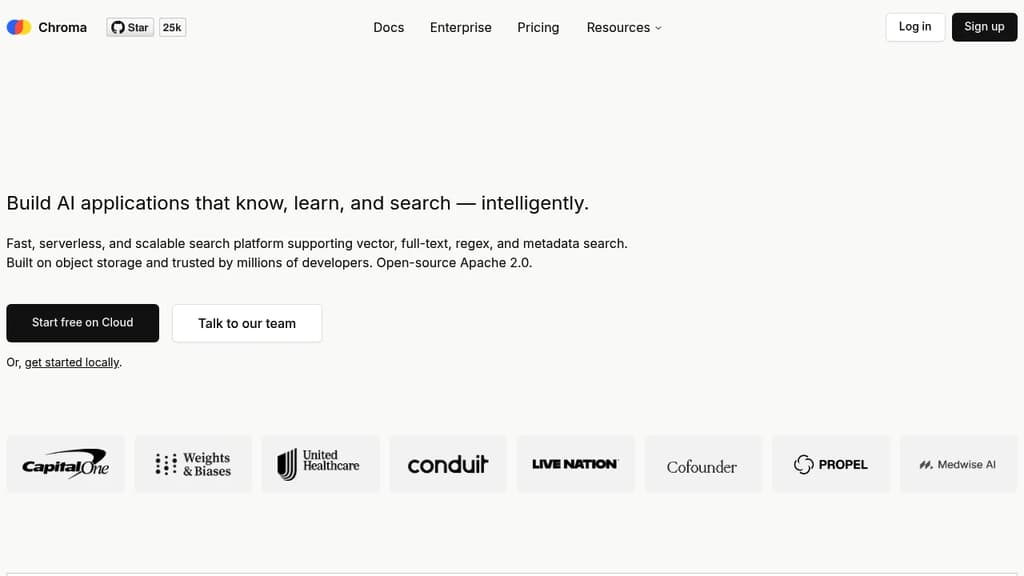
Chroma is a powerful open-source vector database specifically built for AI applications that need efficient storage and retrieval of embeddings. Perfect for developers building RAG (Retrieval-Augmented Generation) systems, semantic search engines, and AI-powered applications.
Key features include:
- Vector storage and similarity search - Store high-dimensional embeddings and perform fast semantic similarity queries
- Metadata filtering - Combine vector search with traditional filtering for precise results
- Multiple embedding models - Support for OpenAI, Sentence Transformers, and custom embedding functions
- Flexible deployment - Run locally, in-memory, or deploy to production with persistent storage
- Simple Python API - Get started quickly with intuitive methods for adding, querying, and managing collections
- Language integrations - Native support for Python and JavaScript with additional language bindings
Whether you're building a chatbot that needs to search through documents, creating a recommendation system, or developing any AI application requiring semantic search capabilities, Chroma provides the foundation you need with minimal setup and maximum flexibility.

Open-source search solution offering blazing speed, typo tolerance, and effortless scalability for developers and businesses.
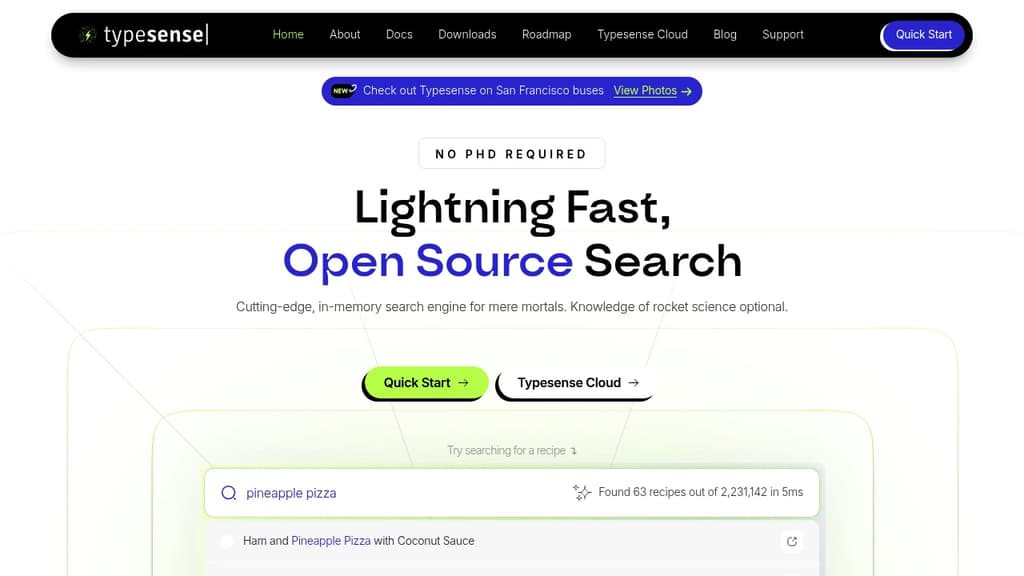
Typesense is a modern, open-source search engine designed to deliver exceptional performance and developer-friendly experiences. With its lightning-fast search capabilities and innovative features, Typesense empowers developers to create powerful search applications with ease.
Key benefits of Typesense include:
- Blazing Fast: Engineered for speed, Typesense returns results in less than 50ms, ensuring a smooth and responsive search experience for users.
- Typo Tolerance: Built-in typo tolerance automatically handles misspellings and typos, improving search accuracy and user satisfaction.
- Simple Setup: Get up and running in minutes with a single binary and minimal configuration, reducing development time and complexity.
- Language Agnostic: Seamlessly integrate Typesense with your preferred programming language using our wide range of API clients.
- Highly Scalable: Easily scale your search infrastructure horizontally to handle growing data volumes and user traffic.
- Rich Features: Enjoy out-of-the-box support for faceting, filtering, sorting, and geosearch capabilities to enhance your search functionality.
- Cloud or Self-Hosted: Choose between Typesense Cloud for hassle-free managed hosting or self-host on your own infrastructure for complete control.
Typesense combines the power of advanced search algorithms with a user-friendly interface, making it an ideal choice for developers, startups, and enterprises alike. Experience the future of search technology and unlock the full potential of your data with Typesense.

Open-source vector database designed for building powerful, production-ready AI applications with hybrid search capabilities and flexible deployment options.

Weaviate is an AI-native vector database that empowers developers to create intuitive applications with less hallucination, data leakage, and vendor lock-in. Key features include:
-
Hybrid Search: Combines vector and keyword techniques for contextual, precise results across all data modalities.
-
RAG (Retrieval-Augmented Generation): Enables building trustworthy generative AI applications using your own data, with privacy and security in mind.
-
Generative Feedback Loops: Enrich datasets with AI-generated answers, improving personalization and reducing manual data cleaning.
-
Flexible Deployment: Available as an open-source platform, managed service, or within your VPC to adapt to your business needs.
-
Pluggable ML Models: Built-in modules for popular machine learning models and frameworks, allowing easy integration.
-
Cost-Efficient Scaling: Advanced multi-tenancy, data compression, and filtering for confident and efficient scaling.
-
Strong Community Support: Open-source with a vibrant community and resources for developers of all levels.
-
Integrations: Supports various neural search frameworks and vectorization modules, including OpenAI, Hugging Face, Cohere, and more.
Weaviate is designed to handle lightning-fast pure vector similarity searches over raw vectors or data objects, even with filters. It's more than just a database – it's a flexible platform for building powerful, production-ready AI applications that can adapt to the evolving needs of businesses in the AI landscape.

Deep Lake is an open-source database for storing, querying and managing complex AI data like images, audio, and embeddings.
Deep Lake is an open-source tensor database designed specifically for AI and machine learning workflows. It allows you to efficiently store, query, and manage complex unstructured data like images, audio, video, and embeddings.
Some key features of Deep Lake:
- Tensor storage: Store data as tensors for fast streaming to ML models
- Vector search: Built-in vector similarity search for embeddings and other high-dimensional data
- Querying: SQL-like querying capabilities for complex data filtering
- Versioning: Git-like versioning to track changes to datasets over time
- Visualization: Visualize datasets and embeddings directly in notebooks or browser
- Streaming: Stream data directly to ML frameworks like PyTorch and TensorFlow
- Cloud integration: Seamlessly work with data stored in cloud object stores
Deep Lake aims to simplify ML data management and accelerate the development of AI applications. It provides a standardized way to work with unstructured data across the ML lifecycle - from data preparation to model training to deployment.
The open-source nature allows for customization and integration into existing ML workflows. Deep Lake can significantly reduce data preparation time and enable faster experimentation and iteration on ML models.

Rust-built native graph-vector database combining vector similarity search and graph traversals. 10x faster development with unified architecture, sub-1ms queries.
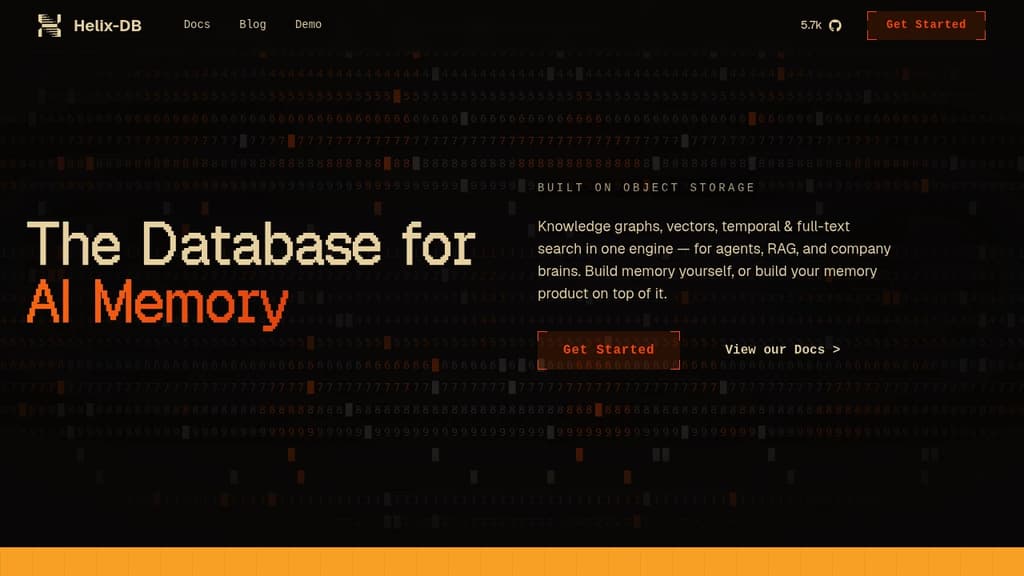
HelixDB is a groundbreaking native graph-vector database that eliminates the need for multiple databases by unifying vector similarity search and graph traversal operations in a single, high-performance engine. Built in Rust and backed by Y Combinator and NVIDIA, it's specifically designed for AI agents, RAG systems, and applications requiring advanced contextual retrieval.
Key performance advantages:
- Vector similarity search: ~2ms average response time
- Graph traversals: Sub-1ms execution speed
- Cost reduction: Up to 50% lower operational costs by eliminating architectural complexity
- Type-safe queries: Advanced static analysis with real-time feedback and autocomplete
Developer-friendly features:
- Simple CLI installation with
curl -sSL "https://install.helix-db.com" | bash - Hybrid query traversals combining vector and graph operations seamlessly
- Comprehensive SDKs and extensive documentation
- Local deployment or managed cloud service options
Enterprise support includes:
- 24/7 expert monitoring and support
- Enterprise-grade security and compliance
- Automatic scaling for traffic spikes
- 99.99% uptime guarantee
Perfect for teams building next-generation AI applications who want to reduce database complexity while achieving industry-leading performance. The growing developer community and active support channels make it easy to get started and scale efficiently.

Laminar is an open-source platform that helps collect, understand, and utilize data for building high-quality LLM applications.
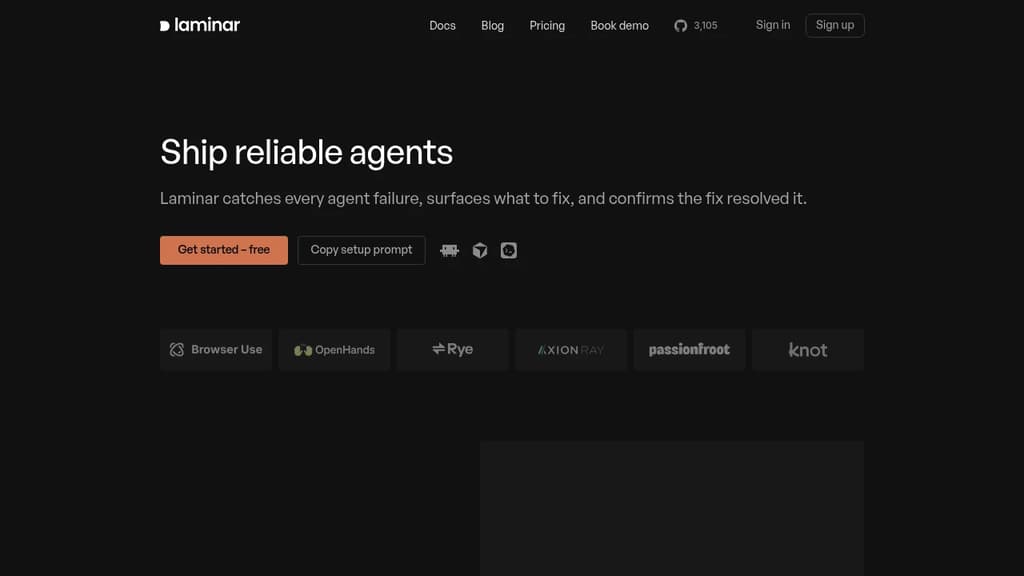
Laminar is an innovative, open-source platform designed to revolutionize the development of Large Language Model (LLM) products. It offers a comprehensive suite of tools for engineering best-in-class AI applications from first principles.
Key features and benefits:
-
Traces: Laminar provides powerful tracing capabilities, allowing developers to gain a clear picture of every step in their LLM application's execution. This feature simultaneously collects invaluable data that can be used for:
- Setting up better evaluations
- Creating dynamic few-shot examples
- Fine-tuning models
-
Zero-overhead observability: All traces are sent in the background via gRPC, ensuring minimal impact on performance. The platform supports tracing for both text and image models, with audio model support coming soon.
-
Online evaluations: Laminar enables the setup of LLM-as-a-judge or Python script evaluators to run on each received span. This approach to evaluation is more scalable than human labeling and particularly beneficial for smaller teams.
-
Dataset creation: Users can build datasets from their traces, which can be utilized in evaluations, fine-tuning, and prompt engineering.
-
Prompt chain management: Laminar goes beyond single prompts, allowing users to build and host complex chains, including mixtures of agents or self-reflecting LLM pipelines.
-
Open-source and self-hostable: The platform is fully open-source and easy to self-host, giving users complete control over their data and infrastructure.
Laminar empowers developers to create more robust, efficient, and effective LLM applications by providing a data-centric approach to AI engineering. Whether you're working on improving model performance, optimizing prompts, or scaling your AI solutions, Laminar offers the tools and insights needed to excel in the rapidly evolving field of AI engineering.

People are looking for alternatives to...
View all alternatives
Claude Code

Spotify

CapCut

Claude

Notion

Lovable
 Postiz – The All-in-One agentic social media scheduling tool

 Docmost