Open Source Paperclip Alternatives
A curated collection of the 3 best open source alternatives to Paperclip.
The best open source alternative to Paperclip is Multica. If that doesn't suit you, we've compiled a ranked list of other open source Paperclip alternatives to help you find a suitable replacement. Other interesting open source alternatives to Paperclip are: Omnigent and Omnara.
Paperclip alternatives are mainly AI Agent Platforms but may also be AI Coding Agent Orchestrators. Browse these if you want a narrower list of alternatives or looking for a specific functionality of Paperclip.

Written by Piotr Kulpinski


Open-source platform that manages coding agents as team members, with task queues, skill libraries, runtime monitoring, and a unified activity feed.
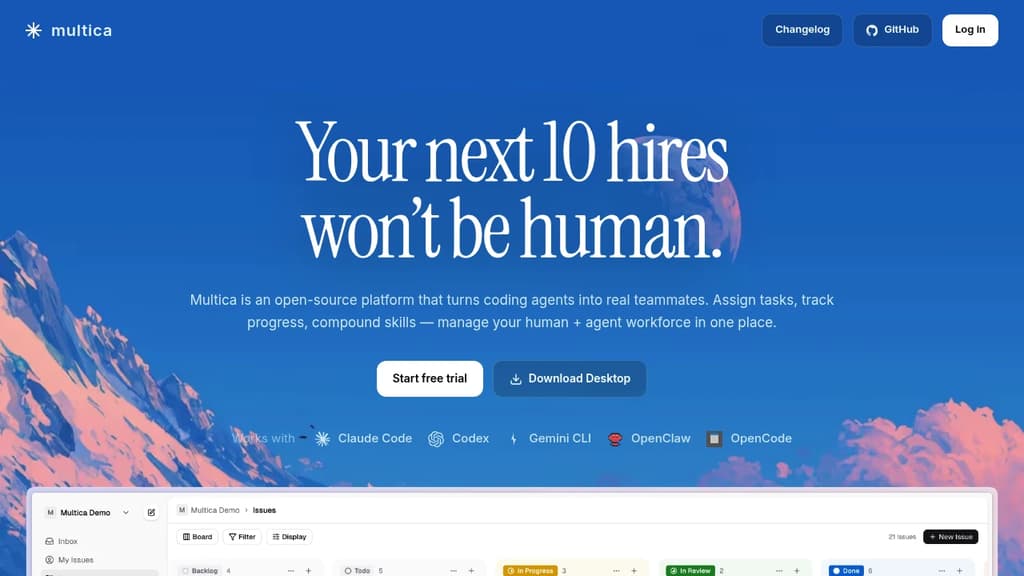
Multica is a project management platform built for teams that run coding agents alongside human developers. Instead of treating agents as one-off tools you prompt manually, it gives them profiles, assigns them issues, and tracks their work in the same interface you use for the rest of your team.
The core idea is that agents should participate like colleagues. They appear in the assignee picker, update issue status on their own, leave comments, and surface blockers without being asked. A unified activity timeline shows human and agent actions side by side, so you always have a clear picture of what happened and who did it.
Key capabilities:
- Full task lifecycle tracking – tasks flow through enqueue, claim, start, and complete/fail states. No silent failures; every transition is recorded and broadcast via WebSocket.
- Skills library – package repeatable work (deploy to staging, write migrations, review PRs) into reusable skill definitions. Any agent on the team can run a skill once it's defined, so the team's capabilities compound over time.
- Runtime dashboard – manage local daemons and cloud runtimes from one panel with real-time online/offline status, usage charts, and activity heatmaps. Auto-detects 12 supported coding tools including Codex, Claude Code, Cursor, Copilot, Gemini, Kiro, and others.
- Proactive block reporting – when an agent gets stuck, it flags the issue immediately rather than silently stalling.
- Self-hostable – run on your own infrastructure with Docker Compose or Kubernetes. Agent execution happens on your machine or your own cloud; code never passes through Multica's servers.
For teams already using tools like OpenHands or Plandex for autonomous coding work, Multica adds the coordination layer those tools don't provide: task queues, team-wide skill sharing, multi-runtime monitoring, and a shared view of everything agents are doing across a project.
The open-source version has no artificial caps on agent count. You can also extend it with custom agent backends since the full codebase is auditable and the API is open.

Meta-harness that sits above Claude Code, Codex, and other AI agents to add policy enforcement, sandboxing, and real-time collaborative sessions.
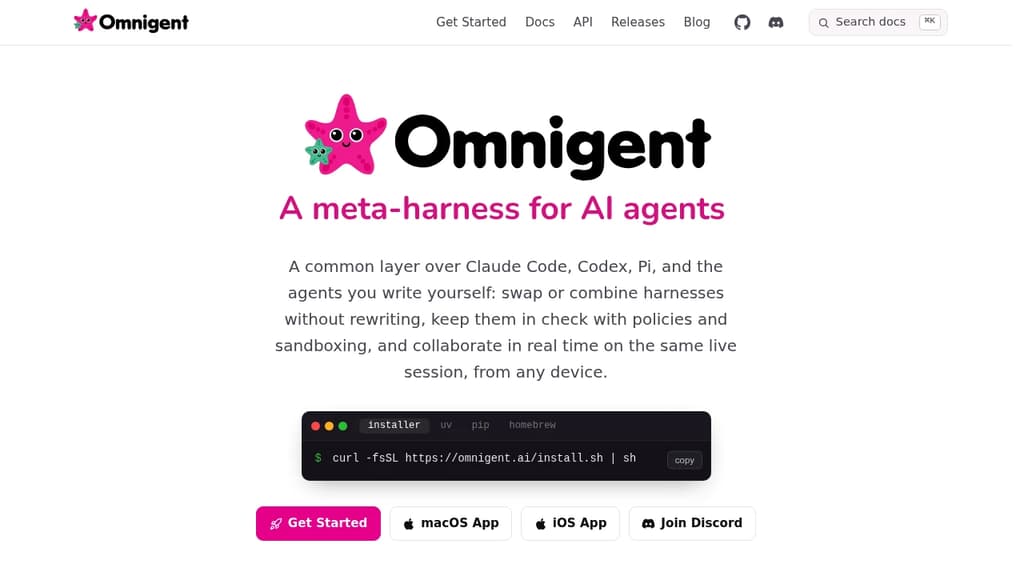
Omnigent sits between you and the AI agents you already use. Instead of locking you into one harness, it wraps tools like Claude Code, Codex, and agents you write yourself inside a uniform session layer. Swap or combine them with minimal changes, no rewriting.
It's aimed at developers and teams who want more control over how agents behave, what they can access, and how much they spend. The core value is governance at the meta-layer rather than through prompts.
Key capabilities:
- Composition: Mix multiple models, harnesses, and techniques in a single workflow. Built-in agents include a coding orchestrator and a model debate setup; you can define your own in YAML.
- Policy enforcement: Stateful spend caps, model routing, and risk-based escalation. Policies track agent actions over time rather than relying on per-prompt instructions.
- Sandboxing: Restrict filesystem and network access. Credentials are hidden from the agent and brokered through Omnigent, so you can run aggressive "YOLO mode" without exposing sensitive data.
- Collaboration: Share a live agent session via URL. Teammates can review history, comment, and steer the session together in real time from any device, including mobile.
The architecture splits into two parts: a runner that wraps any agent in a sandboxed, uniform session, and a server that adds policies and shared history. Sessions are accessible through the terminal, a web interface, a native app, mobile, and a REST API.
For teams using tools like OpenHands or Cline alongside proprietary agents, Omnigent offers a single control plane rather than managing each harness separately. Licensed under Apache 2.0.

Production-ready agent infrastructure that handles state, machines, permissions, and history so you don't have to build the platform yourself.
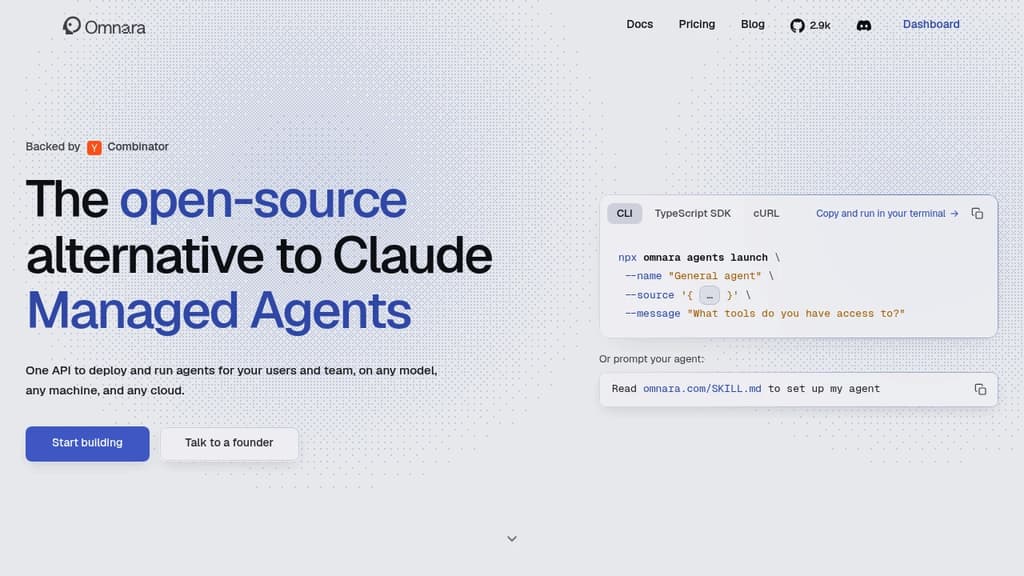
Building a prototype agent takes an afternoon. Getting it to production is where teams burn months. Omnara is an open-source agent platform that handles the hard parts: durable state, machine management, access controls, and audit history. It's aimed at teams that want the speed of a managed agent platform without handing over control of their models, data, or cloud.
Agents in Omnara are durable API objects, not just library calls baked into your app. You launch, steer, and observe them through a REST API, TypeScript SDK, or CLI. That means your application owns the whole experience, and you can run many agents without redeploying code every time something changes.
Key capabilities:
- Durable execution: Agent state survives failures. If a machine dies mid-run, Omnara restores state and continues from where it left off.
- Any machine: Run agents on Omnara-managed sandboxes, your own Blaxel, Daytona, or Unikraft Cloud account, or any laptop, VM, or container running the Omnara daemon. The daemon connects outbound, so no ports need to be opened.
- Any model: OpenAI, Anthropic, OpenRouter, LiteLLM, or any compatible endpoint you host yourself. Switch providers without rebuilding anything.
- Access controls: Require human approval before risky tool calls, store credentials as encrypted scoped secrets, assign role-based access, and keep an append-only audit trail of every action.
- MCP integrations: Connect MCP servers and reusable skills to reach your data, plus a first-party Slack integration so agents meet your team where it already works.
- Agent-ready APIs: Embed agents inside your own product rather than routing users through someone else's interface.
The comparison to building in-house is stark. Several engineering teams have publicly described spending four months and roughly 100,000 lines of code to ship a single internal agent. Omnara provides that substrate on day one: session management, durable event logs, credential proxying, and observability, without a dedicated platform team.
Unlike Amazon Bedrock AgentCore or similar managed platforms, Omnara doesn't lock you to one vendor's models, sandboxes, or pricing. The platform itself is free. You bring your own model keys and machines at no charge, or pay as you go for Omnara-managed resources at provider token rates. Self-hosting under the Apache 2.0 license is fully supported.

People are looking for alternatives to...
View all alternatives
Spotify

Claude Code

Claude

CapCut

Notion

Lovable
 Capture – Capture screenshots, generate PDFs, scrape content, extract metadata, and automate browsers with one API.
 Sent
Sent