Open Source Amazon Bedrock AgentCore Alternatives
A curated collection of the 4 best open source alternatives to Amazon Bedrock AgentCore.
The best open source alternative to Amazon Bedrock AgentCore is Agno. If that doesn't suit you, we've compiled a ranked list of other open source Amazon Bedrock AgentCore alternatives to help you find a suitable replacement. Other interesting open source alternatives to Amazon Bedrock AgentCore are: Trigger, IronClaw, and Omnara.
Amazon Bedrock AgentCore alternatives are mainly AI Agent Platforms but may also be LLM Application Frameworks or Durable Execution Tools. Browse these if you want a narrower list of alternatives or looking for a specific functionality of Amazon Bedrock AgentCore.

Written by Piotr Kulpinski


Open-source platform that enables developers to create, deploy and monitor AI agents with built-in memory, knowledge integration, and external tool connectivity.
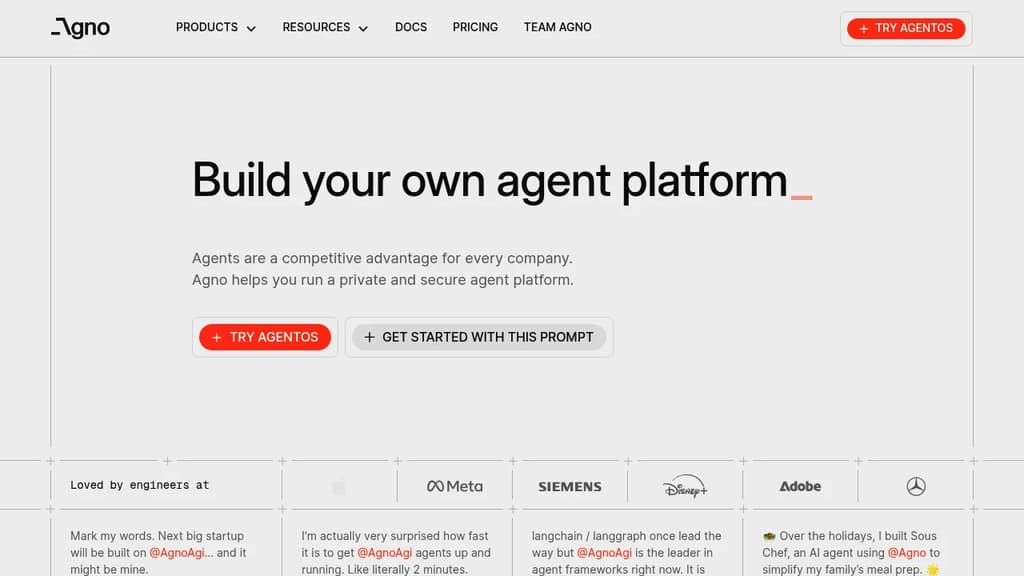
Agno is a powerful open-source platform for building production-ready AI agents. The platform stands out with its model-agnostic approach, allowing developers to use any LLM from providers like OpenAI, Anthropic, or open-source alternatives.
Key capabilities include:
- Built-in memory system for enabling long-term personalized conversations
- Knowledge integration to provide domain-specific information
- Tool connectivity for external system integration
- Minimal memory footprint for running thousands of agents
- Comprehensive monitoring of runs, tokens and quality
- Deployment flexibility with cloud or self-hosted options
The platform is designed for high performance and scalability, making it ideal for production environments. With Agno workspaces, teams can go from development to production quickly while maintaining full control over their infrastructure.

Open source TypeScript platform for building and deploying AI agents and background workflows with retries, queues, observability, and elastic scaling.
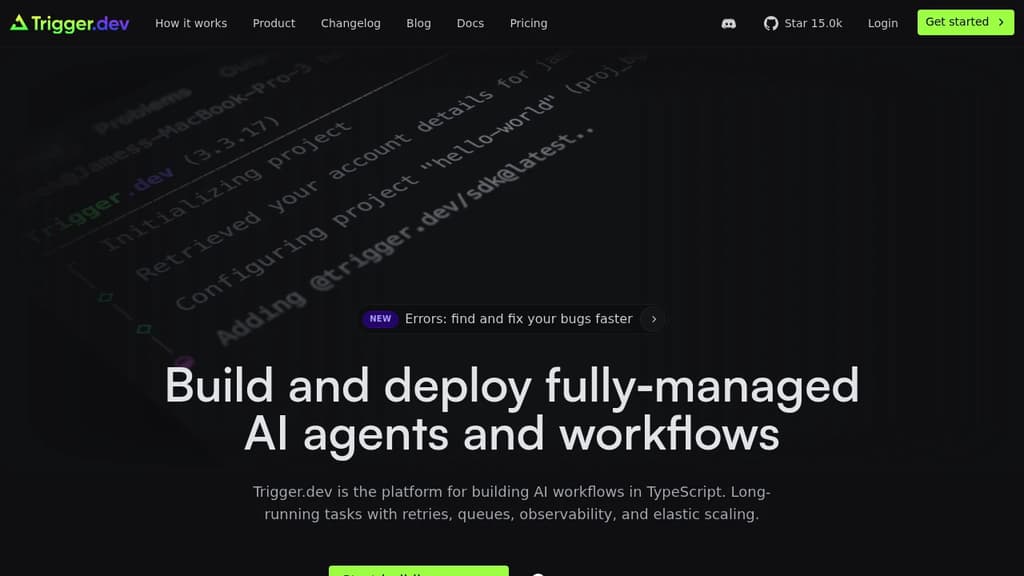
Trigger.dev is a managed platform for running long-running TypeScript tasks in production. It handles the infrastructure so you can write straightforward async code without worrying about timeouts, server provisioning, or queue management.
The core use case is AI workflows and agents. You define tasks that can call LLMs, use tools, process files, or chain multiple steps together. Tasks run with automatic retries, configurable backoff, and full execution logs. If something fails, you can replay individual runs from the dashboard.
Beyond AI, it covers scheduled jobs, media processing, browser automation, email sequences, and ETL pipelines. You can run Python scripts alongside your TypeScript code, add system packages, use FFmpeg for video tasks, or automate browsers with Puppeteer.
Realtime lets you stream task status and LLM responses directly to your frontend as tasks progress, without polling. If you want tracing and observability across LLM calls specifically, tools like OpenLIT or OpenLLMetry cover that layer.
Every run is logged with its inputs, outputs, attempt history, and timing. You can filter runs, apply bulk actions, and set up alerts via email, Slack, or webhooks when tasks fail. Each deploy is versioned atomically, so in-flight tasks aren't disrupted by new code.
Pricing is usage-based. You only pay for actual execution time. It's also Apache 2.0 licensed and self-hostable if you prefer to run it on your own infrastructure. For teams comparing workflow orchestration options, Temporal is a common alternative with a different approach to durability and state.

Runs AI agents inside Trusted Execution Environments on NEAR AI Cloud, keeping credentials encrypted and invisible to the model at all times.
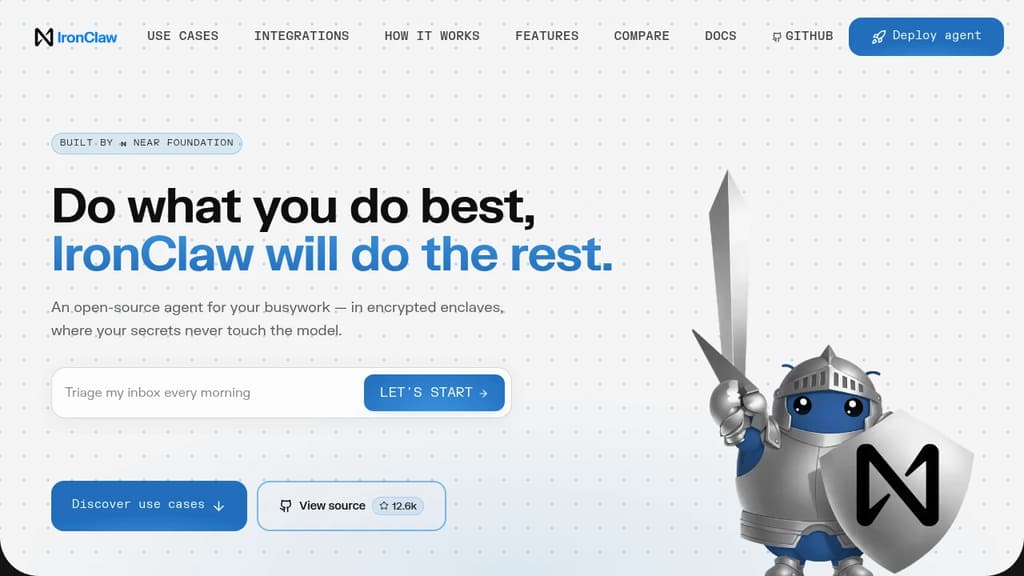
IronClaw is a secure AI agent runtime built for people who want to hand off real work to an AI agent without handing over their passwords, API keys, and tokens along with it. It runs on NEAR AI Cloud inside Trusted Execution Environments, meaning credentials are encrypted in memory from boot to shutdown. The AI model never sees the raw values.
The core problem it solves is real. Tools like OpenClaw give agents broad system access, but that access cuts both ways. A crafted prompt can trick the model into leaking every secret it holds. Malicious community skills have been found specifically designed to exfiltrate credentials. IronClaw's answer isn't a policy or a warning prompt; it's architecture.
Key security layers:
- Encrypted vault: Credentials are stored encrypted at rest and injected into outbound requests only at the host boundary, only for endpoints you've pre-approved.
- Per-tool Wasm sandboxes: Every skill runs in its own WebAssembly container with capability-based permissions. A compromised tool can't reach anything outside its sandbox.
- Network allowlisting: Tools can only contact endpoints you've explicitly approved. No silent phone-home, no unknown destinations.
- Real-time leak detection: Outbound traffic is scanned continuously. Anything resembling a secret heading out gets blocked before it leaves.
- Built in Rust: Memory safety is enforced at compile time. No garbage collector, no buffer overflows, no use-after-free vulnerabilities.
On the practical side, IronClaw handles the kind of recurring busywork that eats time. Inbox triage, daily briefings, meeting prep, deployment health checks, release tracking, invoice parsing, KPI reporting. It connects to Gmail, Google Calendar, Slack, Telegram, GitHub, Linear, Google Sheets, and anything else with an API. Missing an integration? It builds the connector itself from a plain-language description.
It's model-agnostic, compatible with Anthropic, OpenAI, Gemini, Mistral, Ollama, and several others. Deployment is one click on NEAR AI Cloud, with a free starter tier and paid plans scaling up to five concurrent agent instances.

Production-ready agent infrastructure that handles state, machines, permissions, and history so you don't have to build the platform yourself.
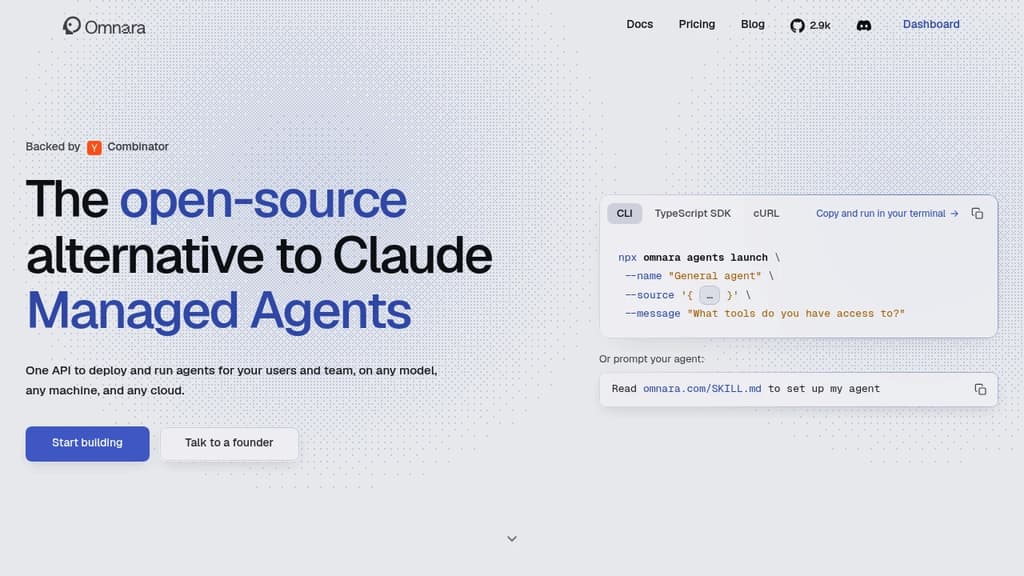
Building a prototype agent takes an afternoon. Getting it to production is where teams burn months. Omnara is an open-source agent platform that handles the hard parts: durable state, machine management, access controls, and audit history. It's aimed at teams that want the speed of a managed agent platform without handing over control of their models, data, or cloud.
Agents in Omnara are durable API objects, not just library calls baked into your app. You launch, steer, and observe them through a REST API, TypeScript SDK, or CLI. That means your application owns the whole experience, and you can run many agents without redeploying code every time something changes.
Key capabilities:
- Durable execution: Agent state survives failures. If a machine dies mid-run, Omnara restores state and continues from where it left off.
- Any machine: Run agents on Omnara-managed sandboxes, your own Blaxel, Daytona, or Unikraft Cloud account, or any laptop, VM, or container running the Omnara daemon. The daemon connects outbound, so no ports need to be opened.
- Any model: OpenAI, Anthropic, OpenRouter, LiteLLM, or any compatible endpoint you host yourself. Switch providers without rebuilding anything.
- Access controls: Require human approval before risky tool calls, store credentials as encrypted scoped secrets, assign role-based access, and keep an append-only audit trail of every action.
- MCP integrations: Connect MCP servers and reusable skills to reach your data, plus a first-party Slack integration so agents meet your team where it already works.
- Agent-ready APIs: Embed agents inside your own product rather than routing users through someone else's interface.
The comparison to building in-house is stark. Several engineering teams have publicly described spending four months and roughly 100,000 lines of code to ship a single internal agent. Omnara provides that substrate on day one: session management, durable event logs, credential proxying, and observability, without a dedicated platform team.
Unlike Amazon Bedrock AgentCore or similar managed platforms, Omnara doesn't lock you to one vendor's models, sandboxes, or pricing. The platform itself is free. You bring your own model keys and machines at no charge, or pay as you go for Omnara-managed resources at provider token rates. Self-hosting under the Apache 2.0 license is fully supported.

People are looking for alternatives to...
View all alternatives
Spotify

Claude Code

Claude

CapCut

Notion

Lovable
 Windshift – The self-hosted platform that replaces Jira.

 Postiz