Open Source OpenStack Alternatives
A curated collection of the 4 best open source alternatives to OpenStack.
The best open source alternative to OpenStack is Spinifex. If that doesn't suit you, we've compiled a ranked list of other open source OpenStack alternatives to help you find a suitable replacement. Other interesting open source alternatives to OpenStack are: Ubicloud, Cozystack, and Superphenix.
OpenStack alternatives are mainly Cloud Computing Services but may also be Virtualization Management Tools. Browse these if you want a narrower list of alternatives or looking for a specific functionality of OpenStack.

Written by Piotr Kulpinski


Spinifex recreates EC2, S3, EBS, VPC, IAM, and more on your own hardware, so AWS-built software runs unchanged without touching a hyperscaler.
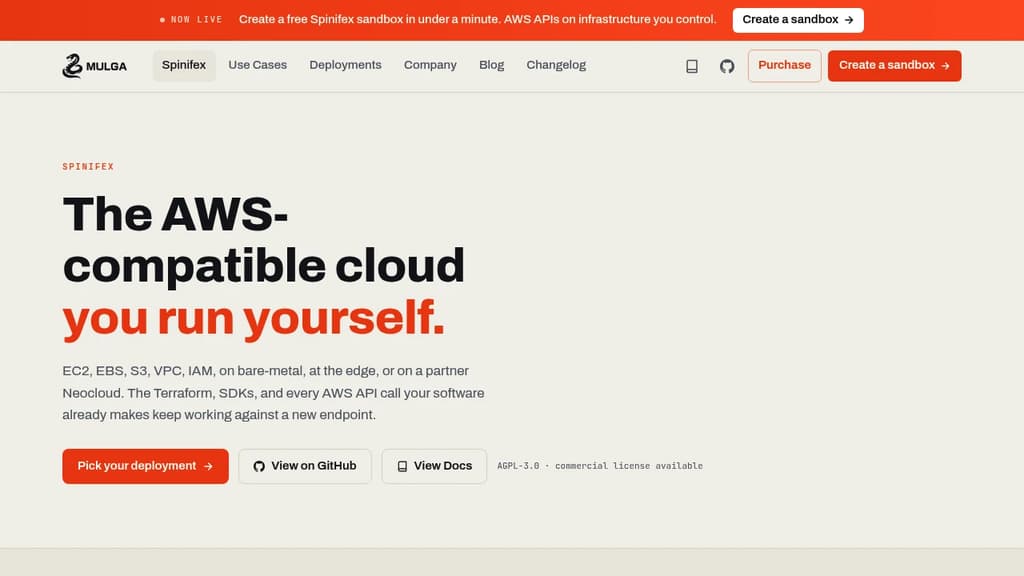
Spinifex is an open-source platform that runs AWS-compatible APIs on infrastructure you own. If your software already talks to EC2, S3, EBS, VPC, or IAM, it keeps working on Spinifex without any code changes. Same AWS SDKs, same Terraform configs, same CLI. You change where the workload runs, not what it is.
The core use case is straightforward: move workloads off hyperscalers, run them on your own racks, at the edge, or on a Neocloud partner, without re-platforming. It's particularly relevant for sectors where data sovereignty, air-gapped deployments, or cost control matter most: defence, healthcare, financial services, energy, and AI/ML teams paying GPU rates to a hyperscaler.
Spinifex didn't just wrap an existing API layer. The engineering underneath was rebuilt from scratch:
- Object storage (S3-compatible): Reed-Solomon erasure coding across nodes for durability without triple-replication costs.
- Block storage (EBS-compatible): Volumes that keep serving when a node drops. Snapshots, attach/detach, and growable volumes included.
- Compute (EC2-compatible): QEMU/KVM on bare metal you own. No hypervisor tax eating into performance.
- Networking (VPC): Built on OVN/OVS.
- Identity (IAM): SigV4 authentication and policy enforcement.
- Kubernetes (EKS): Conformant K8s included in the same stack.
- Container registry and service (ECR/ECS): Available alongside load balancing (ALB/NLB) and managed databases (RDS).
Deployment shapes are flexible. Spinifex runs on a single node, a cluster, an edge box, or an air-gapped rack. The API surface stays the same across all three.
Licensed under AGPL-3.0, the core is auditable and self-hostable. You're not dependent on a vendor's continued goodwill to keep running your own infrastructure.

Self-hostable cloud platform offering elastic compute, managed Postgres, block storage, networking, and GitHub Actions runners on bare metal providers.
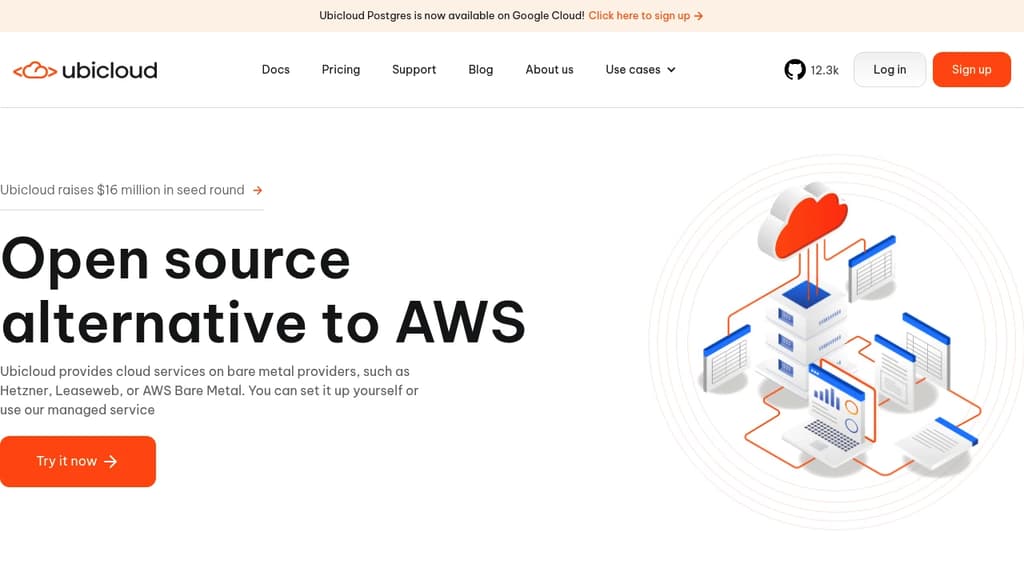
Ubicloud brings cloud infrastructure to bare metal providers like Hetzner, Leaseweb, and AWS Bare Metal, giving you the convenience of a public cloud without the vendor lock-in or the pricing. It's a direct alternative to AWS and similar platforms, built entirely in the open so you can inspect, modify, and self-host the entire stack.
The core pitch is cost and control. Public clouds charge a steep premium for managed services. Ubicloud runs the same workloads on bare metal at a fraction of the price, typically 3-10x cheaper depending on the service.
What it covers:
- Elastic compute: Provision isolated VMs on demand, with encryption at rest and in transit. Suited for compute or memory-heavy workloads.
- Managed Postgres: Managed PostgreSQL with automatic backups, point-in-time restore, high availability, and pricing roughly 3x below comparable managed database services.
- GitHub Actions runners: Swap in Ubicloud runners with a one-line change to your workflow file. Each job gets a clean, ephemeral VM. Ubicloud says its runners cost 10x less than hosted ones.
- Virtual networking: Public and private networking, IPv4 and IPv6, flexible firewall rules, and a network load balancer.
- Block storage: Non-replicated block devices with encryption at rest.
- Access control: Attribute-based access control (ABAC) lets you define roles and set fine-grained permissions across your team.
You can use the managed service if you want a hands-off experience, or self-host the software on your own bare metal. Either way, you're not locked into a single provider's ecosystem. Infrastructure provisioning tools like Pulumi can complement it if you need higher-level orchestration.
Real-world numbers from users include $300k in annual savings from eliminating IOPS bottlenecks and CI pipelines running on newer CPUs at a fraction of prior costs. The self-hostable path also makes it a credible option for teams that need data residency or regulatory control over where workloads actually run.

Transform bare metal servers into a complete cloud platform with REST API for Kubernetes clusters, databases, VMs, and load balancers. Build your own cloud.
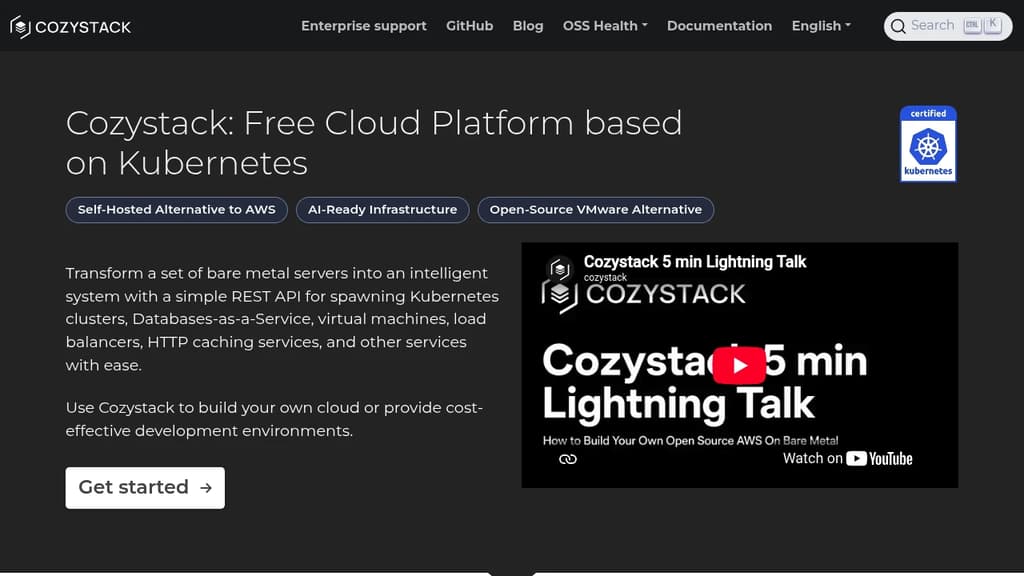
Transform bare metal servers into a complete cloud platform with a simple REST API for deploying Kubernetes clusters, databases-as-a-service, virtual machines, load balancers, and HTTP caching services. Build your own cost-effective cloud infrastructure or development environments.
Key advantages:
- API-first approach - Built on Kubernetes with standard interfaces, avoiding vendor lock-in
- Easy installation - Bootstrap using PXE or ISO methods with immutable OS for consistency
- Native Kubernetes integration - Use declarative YAML manifests with RESTful API
- High performance, low overhead - Efficient resource allocation with unique tenant model
- Built-in monitoring - Pre-configured dashboards and alerts for every service instance
- Extensible platform - Modify or expand using familiar Kubernetes primitives and FluxCD
Perfect for:
- Organizations wanting to build private clouds
- Development teams needing cost-effective environments
- Companies seeking alternatives to expensive cloud providers
- Teams requiring standardized, open-source infrastructure solutions
The platform emphasizes standardization and collaboration, using proven open-source tools and contributing improvements back to upstream projects rather than creating proprietary solutions.

Cloud platform built on Kubernetes that turns your hardware into VMs, storage, networking and managed services, run from a console or through GitOps.
Superphenix turns your own hardware into a complete cloud platform. It covers virtualization, networking, storage and managed services, all operated from a console or through GitOps. It started inside a cloud service provider that was leaving a proprietary stack, and it's aimed at teams that want sovereign infrastructure without VMware-style lock-in.
Kubernetes sits underneath as the control plane, so one API manages compute, storage and network. VMs run next to containers in the same network domains and are managed declaratively.
- Hypervisor: VMs, live migration, snapshots and node autoscaling
- Storage: block, file and S3 storage with replication and disaster recovery
- Software-defined network: VPCs, NAT gateways, BGP, load balancing, QoS and firewalling
- PaaS: Kubernetes as a Service for tenant clusters, with managed databases coming soon
- GitOps and observability: install, upgrade and provision through declarative pipelines, with metrics, logs, traces and health signals across layers
Two deployment topologies are supported. Hyperconverged shares compute and storage nodes, which suits single-AZ setups and proof of concepts. Decoupled separates storage and virtualization so each scales on its own, which fits performance-focused and multi-AZ deployments. A management cluster outside the workload zones can run several AZs from one neutral control plane.
The project is open, auditable and self-hostable by default. Rayshift offers optional enterprise support, including advanced multi-tenancy, IAM, SLA-backed support and migration paths from VMware and other legacy virtualization stacks.

People are looking for alternatives to...
View all alternatives
Spotify

Claude

Claude Code

CapCut

Lovable

Notion
 InfluxDB – The purpose-built time series platform for high-velocity ingestion and real-time queries at scale.

 Postiz