Open Source Langfuse Alternatives
A curated collection of the 8 best open source alternatives to Langfuse.
The best open source alternative to Langfuse is Arize Phoenix. If that doesn't suit you, we've compiled a ranked list of other open source Langfuse alternatives to help you find a suitable replacement. Other interesting open source alternatives to Langfuse are: Helicone, Latitude, LangWatch, and Laminar.
Langfuse alternatives are mainly LLM Observability & Evaluation. Browse these if you want a narrower list of alternatives or looking for a specific functionality of Langfuse.

Written by Piotr Kulpinski


Open-source platform for LLM tracing, evaluation, and optimization. Features automatic instrumentation, prompt playground, and real-time AI application monitoring.
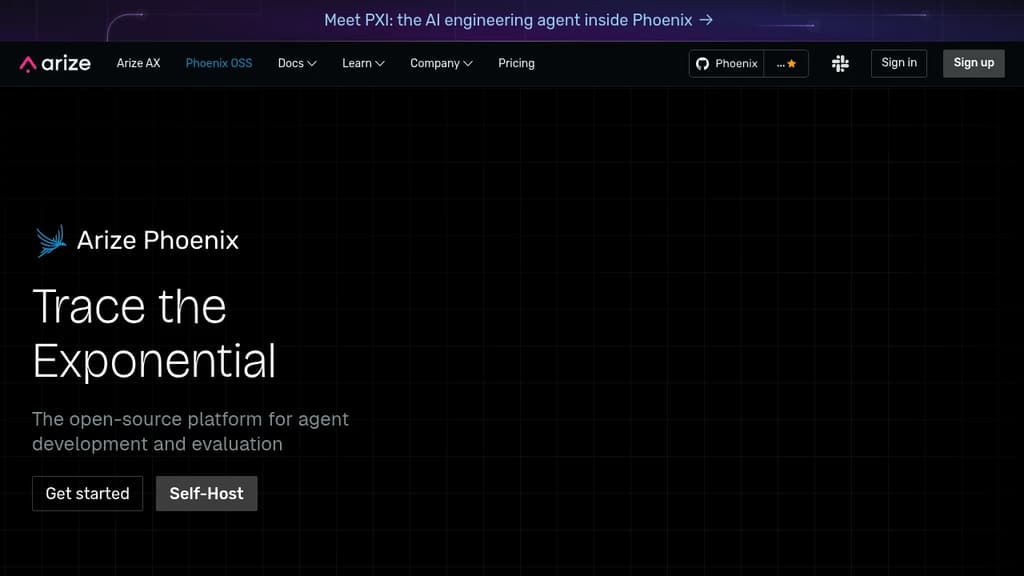
Open-source LLM tracing and evaluation platform designed for AI teams who need complete visibility into their applications. Built on OpenTelemetry standards, this platform offers vendor-agnostic monitoring without lock-in restrictions.
Key capabilities include:
- Automatic application tracing - Collect LLM app data with seamless instrumentation or manual control for detailed monitoring
- Interactive prompt playground - Fast sandbox environment for prompt iteration, model comparison, and debugging workflows
- Advanced evaluation tools - Pre-built templates with customization options plus human feedback integration
- Dataset clustering & visualization - Identify semantically similar content using embeddings to isolate performance issues
- Framework flexibility - Works with all major LLM tools and integrates into existing data science workflows
The platform has gained significant traction with 2.5M+ monthly downloads, 8k+ GitHub stars, and adoption by top AI teams. Users praise its ability to identify root causes of problematic responses, debug LLM workflows, and integrate observability directly into development processes.
Completely self-hostable with no feature restrictions, making it ideal for teams requiring full control over their AI monitoring infrastructure while maintaining transparency in model decision-making.

Open-source platform for logging, monitoring, and debugging LLM applications. Route, debug, and analyze AI apps with comprehensive observability tools.
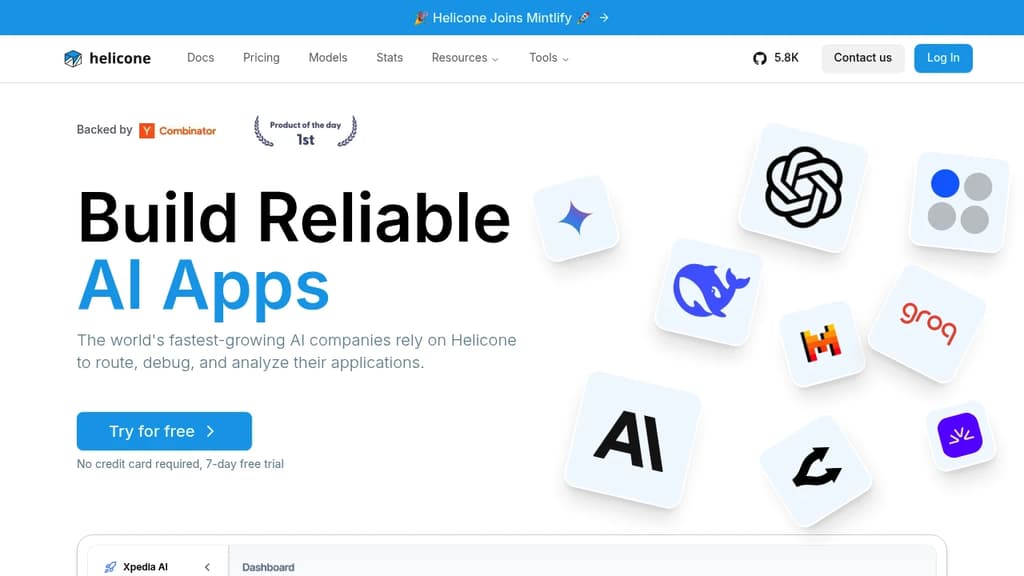
Helicone is the open-source platform that helps developers build reliable AI applications through comprehensive observability. Trusted by the world's fastest-growing AI companies, it provides essential tools for routing, debugging, and analyzing LLM applications.
Key Features:
- Universal Integration: Access 100+ models with a single integration (beta)
- Complete Observability: Log, monitor, and debug your AI applications
- Advanced Analytics: Track requests, segments, sessions, and user properties
- Developer Tools: Prompts playground, experiments, evaluators, and datasets
- Enterprise Ready: Scalable solution for growing AI companies
The platform offers a comprehensive dashboard for monitoring AI application performance, with detailed request tracking and user analytics. Developers can experiment with prompts, run evaluations, and manage datasets all within one unified interface.
Getting Started: No credit card required with a 7-day free trial. The platform is designed to help developers quickly identify issues, optimize performance, and ensure their AI applications run reliably at scale.

Open-source platform for monitoring AI agents: captures traces, surfaces failure patterns, alerts on issues, and helps you verify fixes with automated evals.
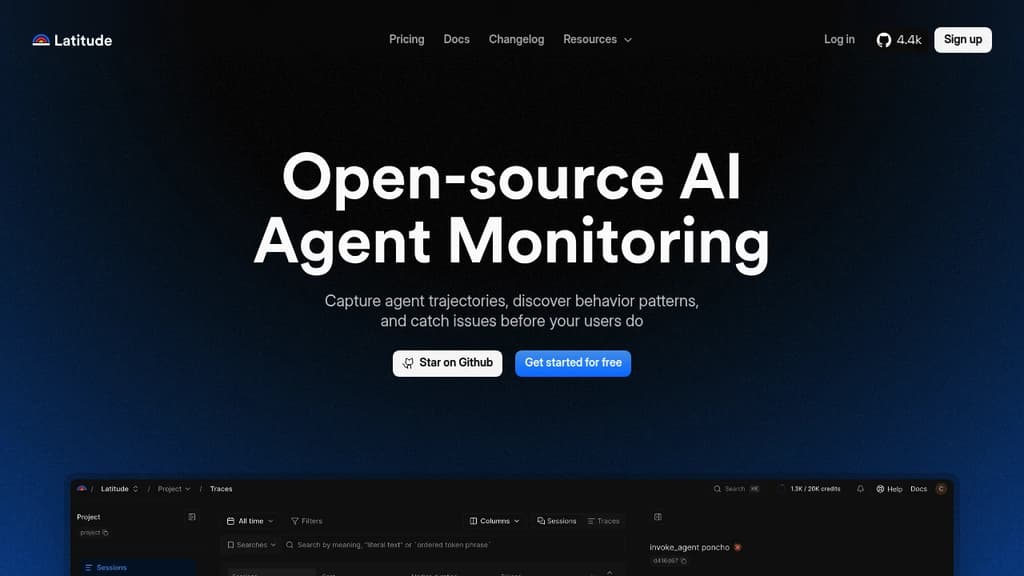
Latitude is an open-source monitoring platform built specifically for AI agents. It captures everything happening in production, including messages, tool calls, costs, and errors, then helps you understand what's actually going wrong and why. It's aimed at teams building AI agent platforms who need more than raw logs to debug production behavior.
The core idea is full-coverage observability. Latitude runs semantic search across 100% of your traces, no sampling, so you never miss a cohort of failing users. Combine that with exact text search and metadata filters to go from a broad hunch to a focused set of real examples fast.
Key capabilities:
- Conversation intelligence analyzes completed sessions to extract what happened: escalations, trust breaks, tool failures, retries, and abandonments, then surfaces them as patterns rather than individual log lines.
- Failure mode clustering groups similar failing traces into a single issue with examples, trends, affected users, and lifecycle. You triage patterns, not one-off events.
- Automated evals turn any discovered issue into an evaluation that runs on every new trace, generated from real examples so it stays grounded in your actual failure mode.
- Dataset management builds golden datasets automatically from validated production traces, versioned and ready for regression tests.
- Alerts via Slack, email, or webhooks notify your team when a new issue appears or an existing one escalates.
- Human annotations let your team leave inline feedback on any trace, span, or output, turning judgment into structured signal you can search and cluster.
Latitude is OpenTelemetry compatible, so you can point an existing OTEL pipeline at it without adopting a proprietary format. It also exposes an MCP server so coding agents can manage projects, traces, annotations, and datasets without touching the UI. Tools like Helicone and Arize Phoenix cover similar ground, but Latitude's automatic issue discovery and eval generation from production failures is a distinct angle.
It's SOC 2 Type II certified, GDPR compliant, and supports SSO with SAML 2.0, end-to-end encryption, data residency options, and audit logs.

Tests AI agents through multi-turn simulations, LLM-based scoring, and production tracing so teams can ship reliable agents with confidence.
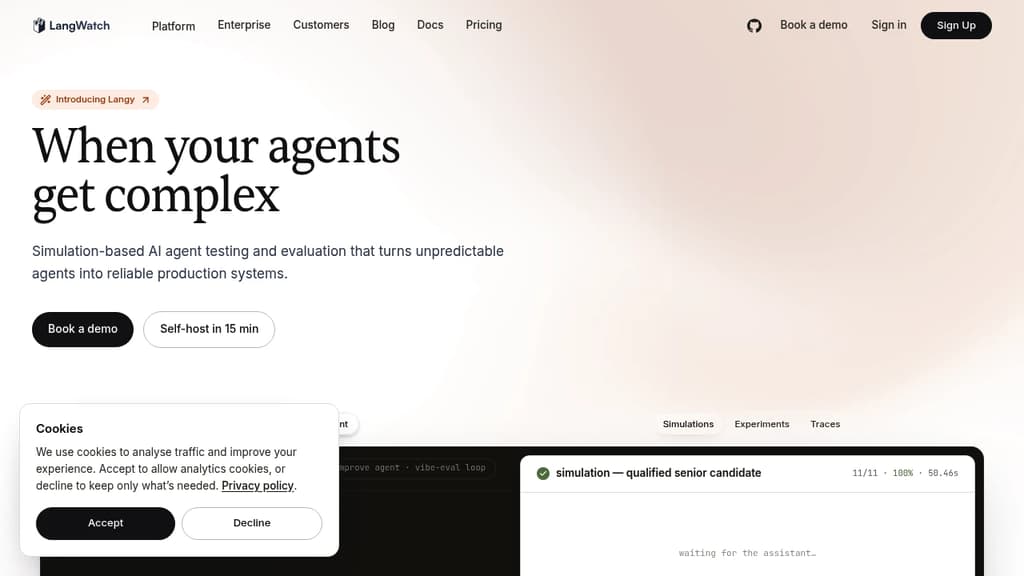
LangWatch is a testing, evaluation, and observability platform for AI agents. It's built for engineering teams that have moved past simple chatbots and are running agents that take dozens of steps, call external tools, and can fail in ways that are hard to reproduce. The core problem it solves: agents have too many possible paths to test by hand, and bugs that slip through tend to surface in production at the worst time.
The platform centers on simulation-based testing, where synthetic users run multi-turn text or voice conversations against your agent before any code ships. You write scenarios in plain language, and the same tests run locally and in CI without extra setup. Adversarial red-teaming is built in, probing for jailbreaks, policy violations, and unsafe tool calls.
Evaluation goes beyond single-turn output scoring:
- LLM-as-a-judge reads the full trace, step by step, and returns a verdict with reasoning
- Pairwise comparison lets you pit two prompts, models, or versions head-to-head
- Online evaluation scores live production traffic in real time
- Multimodal scoring handles images and mixed media, not just text
- Evals run from a Jupyter notebook or the team UI, whichever fits the workflow
Observability is OpenTelemetry-native with full GenAI spec support, so traces from Cline, OpenHands, or any other agent framework plug in without a rewrite. Every token, tool call, and cost is tracked per span, and you can view runs as a waterfall, flame graph, topology, or sequence diagram.
A feature called Langy closes the loop between product and engineering: a PM writes a goal in plain English, Langy generates a full test plan and scenarios, runs them in parallel, scores the results against a rubric, and opens a pull request with a prompt revision when something regresses. The platform also includes a Prompt Registry so changes are versioned and reviewable.
For teams with compliance requirements, LangWatch is ISO 27001 certified and GDPR compliant, with RBAC, SSO, SCIM, audit logs, and custom data retention. It deploys as managed SaaS across EU, US, UK, and APAC regions, as a self-hosted Docker or Kubernetes install, or in a hybrid configuration where the data plane runs on your infrastructure. The source is open under Apache 2.

Laminar is an open-source platform that helps collect, understand, and utilize data for building high-quality LLM applications.
Laminar is an innovative, open-source platform designed to revolutionize the development of Large Language Model (LLM) products. It offers a comprehensive suite of tools for engineering best-in-class AI applications from first principles.
Key features and benefits:
-
Traces: Laminar provides powerful tracing capabilities, allowing developers to gain a clear picture of every step in their LLM application's execution. This feature simultaneously collects invaluable data that can be used for:
- Setting up better evaluations
- Creating dynamic few-shot examples
- Fine-tuning models
-
Zero-overhead observability: All traces are sent in the background via gRPC, ensuring minimal impact on performance. The platform supports tracing for both text and image models, with audio model support coming soon.
-
Online evaluations: Laminar enables the setup of LLM-as-a-judge or Python script evaluators to run on each received span. This approach to evaluation is more scalable than human labeling and particularly beneficial for smaller teams.
-
Dataset creation: Users can build datasets from their traces, which can be utilized in evaluations, fine-tuning, and prompt engineering.
-
Prompt chain management: Laminar goes beyond single prompts, allowing users to build and host complex chains, including mixtures of agents or self-reflecting LLM pipelines.
-
Open-source and self-hostable: The platform is fully open-source and easy to self-host, giving users complete control over their data and infrastructure.
Laminar empowers developers to create more robust, efficient, and effective LLM applications by providing a data-centric approach to AI engineering. Whether you're working on improving model performance, optimizing prompts, or scaling your AI solutions, Laminar offers the tools and insights needed to excel in the rapidly evolving field of AI engineering.

Open-source observability platform for GenAI and LLM applications. Real-time monitoring, distributed tracing, prompt management, and AI model evaluation built on OpenTelemetry.
Monitor and optimize your LLM applications with comprehensive observability tools designed for production AI workloads. Built entirely on OpenTelemetry standards for seamless integration with existing infrastructure.
Key capabilities include:
- Distributed Tracing: Real-time monitoring of LLM applications with complete request lifecycle visibility
- AI Model Evaluation: Run online/offline evaluations through UI and SDKs to experiment with prompts and models
- Prompt Management: Centralized versioning and deployment of prompts with performance tracking
- Real-time Monitoring: Unified dashboard view across environments with custom SQL queries and flexible widgets
- Multi-Deployment Management: Monitor and compare performance metrics across your entire AI fleet
Quick setup requires just a few lines of code with zero application changes. The platform supports automatic Kubernetes instrumentation through the OpenLIT Operator, making it perfect for containerized environments.
Privacy-first approach ensures your data never leaves your infrastructure, while the open-source nature eliminates vendor lock-in concerns. Compatible with all major LLM providers and frameworks including OpenAI, Anthropic, Google, AWS Bedrock, and popular vector databases.
Production-ready with minimal performance overhead, designed to scale with your AI applications from development to enterprise deployment.

Open source ML experiment tracking platform with parameter and gradient logging, media tracking, real-time alerts, and full Weights & Biases API compatibility.
mlop is an open source experiment tracking platform built for machine learning engineers who want full visibility into how their models train and perform. It covers the core loop of ML development: log metrics, track parameters and gradients, capture media outputs, and compare runs across experiments.
It's compatible with the Weights & Biases API, so teams already using W&B can migrate without rewriting their logging code. That's a practical differentiator for anyone looking to move off a proprietary tool without friction.
Key capabilities include:
- Parameter and gradient tracking logged in real-time as the model trains, so you can watch learning dynamics as they happen
- Multi-media logging for images and other outputs directly alongside numerical metrics
- Reproducibility support by capturing git commit hashes and flagging uncommitted files per run, so you always know the exact state of your code
- Real-time alerts via email for critical issues and performance drops, keeping you informed without constant dashboard-watching
- Experiment comparison across runs with named projects and configurable metadata
The platform is self-hostable and community-driven, which matters for teams with data residency requirements or those who want to avoid vendor lock-in on a core part of their ML workflow. Unlike observability tools focused on LLM tracing or inference monitoring, mlop targets the training side of ML: the iteration loop where you tune hyperparameters, compare model architectures, and debug learning behavior.
It's aimed at ML engineers and research teams who run frequent experiments and need structured tracking without paying for a managed service.

Drop-in observability platform for OpenAI, Anthropic, and Gemini that logs every request, tracks costs, traces agent workflows, and flags anomalies and PII.
Spanlens is an MIT-licensed LLM observability platform that gives you full visibility into every request your app makes to OpenAI, Anthropic, or Gemini. It works as a drop-in replacement for the provider SDK, so you swap one import and start seeing data immediately. No agents to run, no infrastructure to wire up.
It's built for teams shipping LLM-powered products who need to answer real questions fast: why did the bill spike, which agent step is slow, did the new prompt actually improve quality?
Core capabilities:
- Request logging – full body, headers, tokens, cost, and latency per call. Filter, group, and export anytime.
- Cost tracking – per-model and per-route breakdowns, daily rollups, and budget alerts via Slack or webhook before you exceed your limit.
- Agent tracing – multi-step workflows rendered as waterfall span trees with critical path highlighting and per-span cost attribution.
- Anomaly detection – flags 3σ deviations in latency or cost against your 7-day rolling baseline.
- PII and security scanning – regex detectors run at log time on request bodies; API keys are auto-masked before storage.
- Model recommender – identifies calls that could run on a cheaper model and shows projected monthly savings in dollar figures.
- Evals and experiments – LLM-as-judge scores responses 0 to 1 per prompt version; replay a fixed dataset across versions and models to compare quality, cost, and latency side by side before shipping.
- User analytics – per end-user and per-session cost, volume, and error rates, so you can find which customer is burning the budget.
Spanlens supports OpenAI, Anthropic, Google Gemini, Mistral, Azure, Bedrock, and Vertex, plus framework integrations for LangChain, LlamaIndex, Vercel AI SDK, and LangGraph. It also ingests OpenTelemetry spans over OTLP/HTTP.
For teams that can't send prompt data to a third party, it's fully self-hostable. Prompts and completions stay inside your own network. Data can be exported as JSON, CSV, or Parquet, or streamed to S3 or BigQuery.
If you're evaluating LangSmith alternatives, Spanlens covers similar ground with a flat monthly pricing model rather than per-seat fees, and a free self-hosted option that has no usage cap.

People are looking for alternatives to...
View all alternatives
Spotify

Claude Code

CapCut

Claude

Notion

Lovable
 Openlane – Open-source, developer-first platform for automated compliance, risk management, and built-in Trust Center.

 Sent
Sent