Open Source Hasura Alternatives
A curated collection of the 6 best open source alternatives to Hasura.
The best open source alternative to Hasura is Cube. If that doesn't suit you, we've compiled a ranked list of other open source Hasura alternatives to help you find a suitable replacement. Other interesting open source alternatives to Hasura are: Turso, Nitric, Tailcall, and WunderGraph.
Hasura alternatives are mainly API Infrastructure Tools but may also be Semantic Layer Platforms or Relational Databases (SQL). Browse these if you want a narrower list of alternatives or looking for a specific functionality of Hasura.

Written by Piotr Kulpinski


Cube is a universal semantic layer that connects data sources to analytics tools, providing consistent definitions and fast queries.
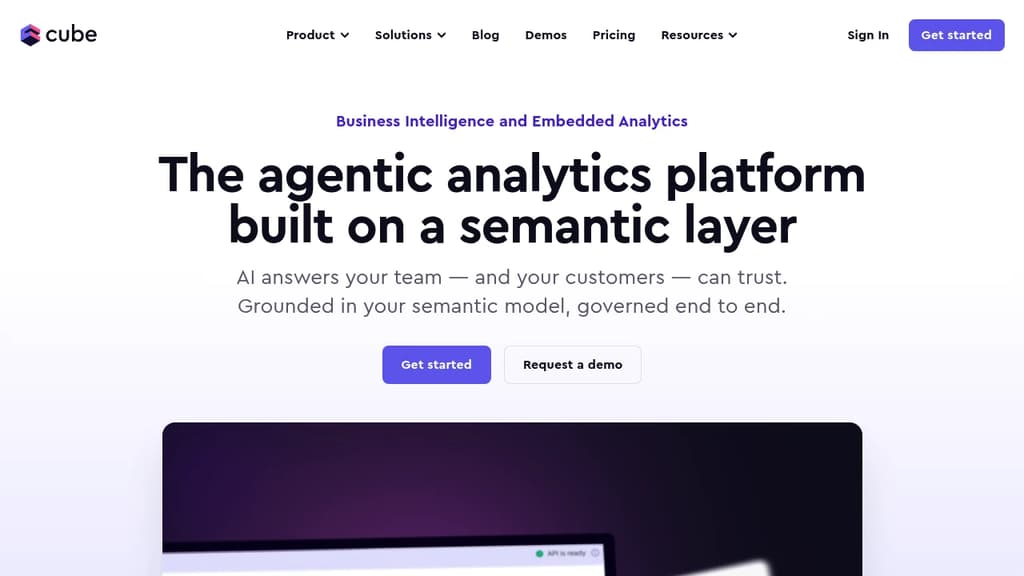
Cube is an open-source universal semantic layer that acts as a bridge between your data sources and analytics tools. It provides a centralized place to define data models, metrics, and access controls that can be used consistently across your entire data stack.
Key benefits of Cube:
- Unified data modeling: Define your metrics, dimensions, and business logic once in Cube and reuse them across all your BI tools, dashboards, and data apps. This ensures consistency and saves time.
- Powerful caching and pre-aggregations: Cube optimizes query performance with intelligent caching and pre-aggregation strategies, delivering fast analytics even on large datasets.
- Flexible API options: Access your data through REST, GraphQL, SQL, or MDX APIs. This allows you to integrate Cube with virtually any front-end tool or custom application.
- Fine-grained access control: Implement row-level and column-level security policies directly in your semantic layer, ensuring data governance across all connected tools.
- Multi-database support: Connect to popular databases and data warehouses like Postgres, MySQL, BigQuery, Snowflake, and more.
- Developer-friendly: Built with a code-first approach, Cube integrates seamlessly into modern data engineering workflows with features like version control and CI/CD support.
By centralizing data definitions and optimizing query performance, Cube helps data teams deliver more consistent, faster, and secure analytics experiences across their organization.

Turso provides a simple developer experience with SQLite compatibility, allowing you to build and scale multi-tenant applications with unlimited databases.
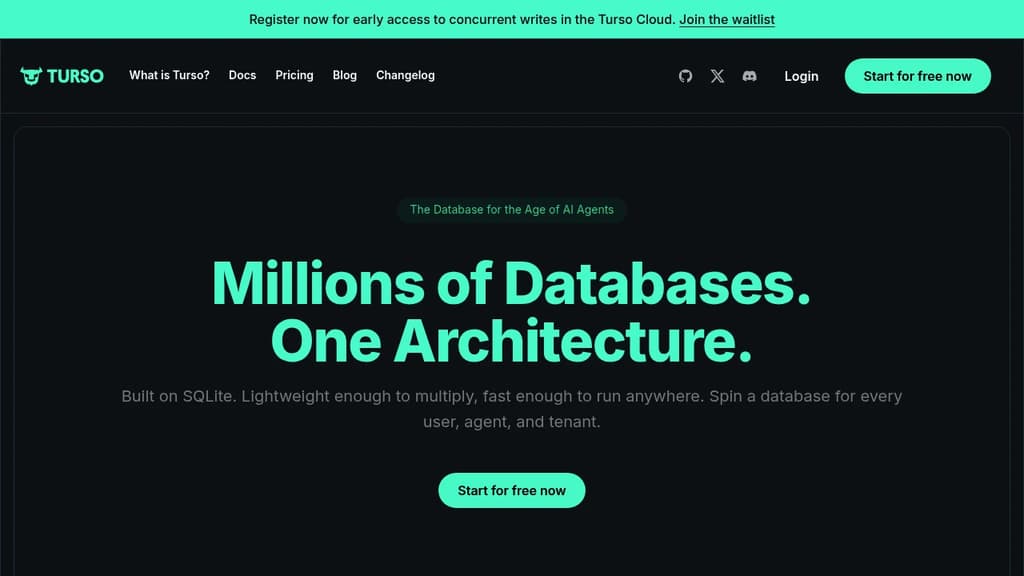
Turso is a powerful database solution designed for developers who want the simplicity of SQLite with the scalability needed for production environments.
Here's why Turso stands out:
-
Multi-tenant AI Applications: Turso enables you to create personalized LLM instances with infinite context windows using unlimited databases. This feature is perfect for building AI-powered applications that require separate data stores for each user or context.
-
On-Device Capabilities: Turso offers SDKs for mobile and on-device AI, allowing you to build powerful offline-capable apps across major platforms. You can optimize LLMs locally using Turso's SQLite-based database within your application, ensuring data privacy and reducing network latency.
-
Vector Search Integration: Seamlessly integrate Vector Embeddings with relational data in single transactions. This feature is crucial for AI and machine learning applications that require efficient similarity searches.
-
Open Source and Secure: Built on libSQL, an open-source SQLite-compatible database engine, Turso ensures your data is always portable. It offers encryption at rest and in transit, with SOC2 and HIPAA compliance available out of the box.
-
Developer-Friendly Experience: Enjoy a simple developer experience that feels like working with SQLite. Turso provides flexible development options, allowing you to work locally or remotely and deploy globally when ready.
-
Scalability and Performance: With features like automatic sync and programmable conflict resolution, Turso keeps your app data fresh and consistent across multiple instances. Its API-first approach and platform API enable efficient, programmatic database management at scale.
Whether you're building a complex AI application, a mobile app with offline capabilities, or a scalable multi-tenant system, Turso provides the tools and flexibility to meet your database needs while maintaining the simplicity developers love about SQLite.

Nitric automates cloud infrastructure provisioning from your application code for AWS, GCP and Azure
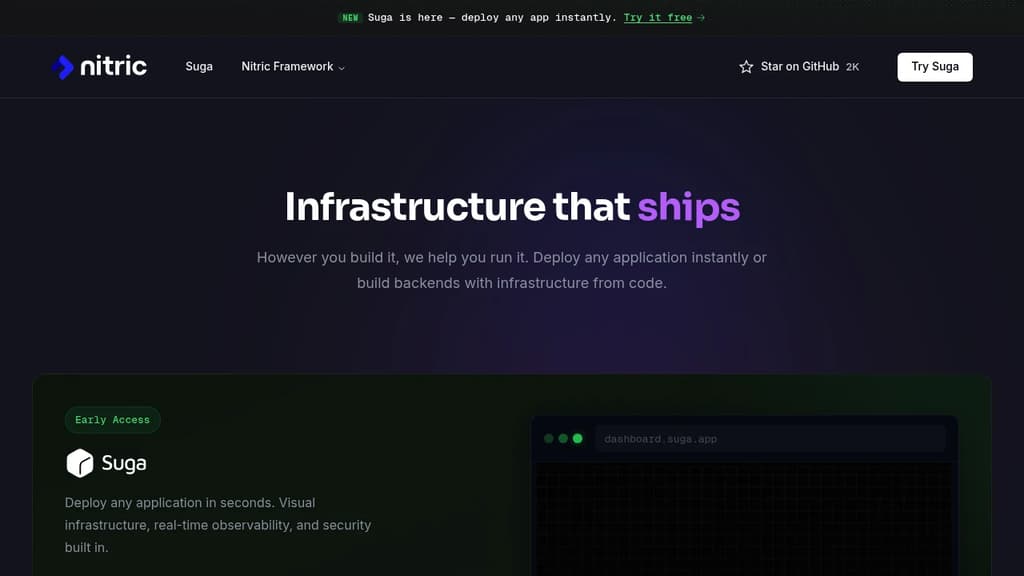
Nitric is an open source universal backend framework that provides infrastructure from code and pluggable deployment automation. It allows developers to declare infrastructure requirements in code for common cloud resources and provides a convenient interface to interact with them.
Key benefits of Nitric include:
-
Effortless infrastructure from code: Use code to declare infrastructure requirements and get deployment automation from customizable plugins. This simplifies provisioning and managing cloud resources.
-
Cloud portability: Nitric makes applications portable across cloud providers, unlocking access to the best cloud features without vendor lock-in. It supports AWS, Google Cloud, and Azure out of the box.
-
Local development: Fine tune your application offline from your first commit. Prototype, develop and test your application without incurring cloud costs.
-
Simplified security: Application security is made simple with declarative resource access that is automatically synced with deployment automation.
-
Intuitive APIs: Common tasks are made intuitive and easy, without limiting fine-grained control when needed.
-
Extensible automation: Use existing Nitric plugins or build custom ones. Nitric enhances automation tools like Terraform, Pulumi and others.
Nitric supports key cloud resources like APIs, storage, databases, messaging, and more. It provides a consistent developer experience for working with these resources across different cloud providers.
The framework aims to streamline backend development by abstracting away infrastructure complexities, while still giving developers full control when needed. This allows teams to focus more on building application logic rather than managing cloud infrastructure.

Swiftly design and ship best-practice GraphQL backends atop existing data sources and APIs.
Tailcall gives you a best-practice GraphQL backend that checks all the boxes:
-
Secure: Validated against a comprehensive database of GraphQL vulnerabilities. Rest easy knowing your GraphQL backends are secure.
-
High-Performance: Tailcall performs ahead-of-time optimizations based on analysis of the schema and data dependencies. Deploy GraphQL without compromises.
-
Statically Verified: Tailcall statically verifies that GraphQL schemas match resolvers and warns about N + 1 issues. Deploy new APIs with confidence.
-
Simple: Tailcall configuration generator can integrate thousands of APIs in a matter of minutes. Configure with ease and deploy with confidence.
-
Customizable: Write custom Javascript to customize any aspect of your GraphQL backend. Leverage this escape hatch to satisfy any requirement.
-
Plug & Play: Engineered to stay out of your way, shipping as a single executable with no dependencies or requirements. Get started quickly and easily.
Tailcall is developed and released under the Apache 2 open source license, the gold standard for OSS. Embrace a vendor-neutral solution.

A powerful backend framework that simplifies API integration, enhances security, and boosts developer productivity for modern web applications.
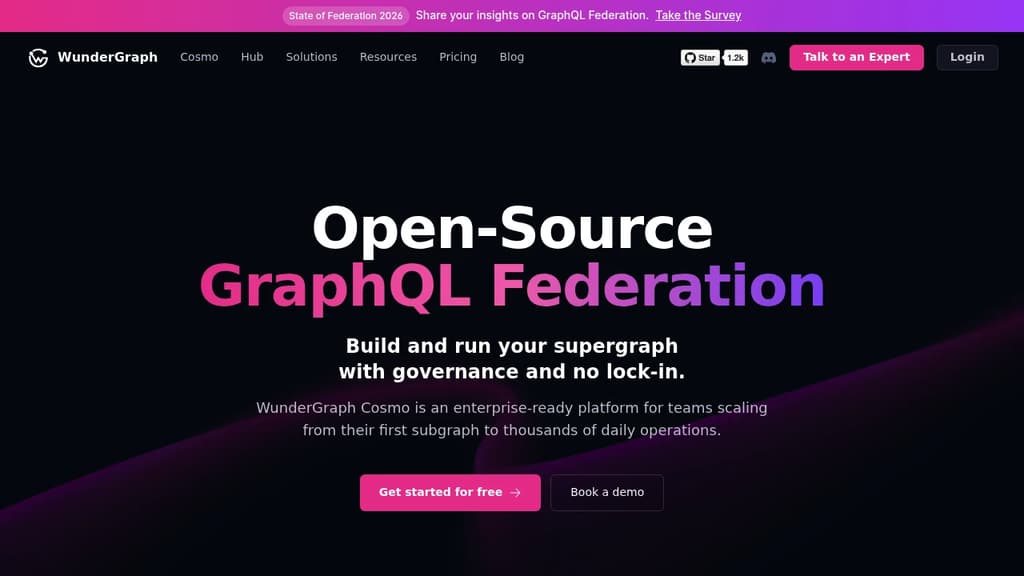
WunderGraph is a revolutionary backend framework designed to simplify the complexities of modern API development and integration. By providing a unified approach to working with various data sources, WunderGraph significantly enhances developer productivity and application performance.
Key benefits of WunderGraph include:
-
Seamless API Integration: Easily connect and unify multiple APIs, databases, and services using a single GraphQL schema, eliminating the need for complex integration code.
-
Enhanced Security: Built-in authentication and authorization features protect your APIs and data, ensuring robust security without additional overhead.
-
Developer-Friendly Workflow: Generate type-safe API clients automatically, enabling faster development and reducing errors in frontend-backend communication.
-
Performance Optimization: Intelligent caching and data fetching strategies improve application speed and reduce server load, resulting in better user experiences.
-
Flexible Deployment: Deploy your applications anywhere with support for serverless, containerized, and traditional hosting environments.
-
Real-Time Capabilities: Effortlessly implement real-time features using subscriptions and live queries, keeping your applications responsive and up-to-date.
By leveraging WunderGraph, development teams can focus on building feature-rich applications rather than wrestling with API complexities, resulting in faster time-to-market and more scalable, maintainable codebases.

A fully open-source schema registry, analytics, and gateway for GraphQL federation and APIs
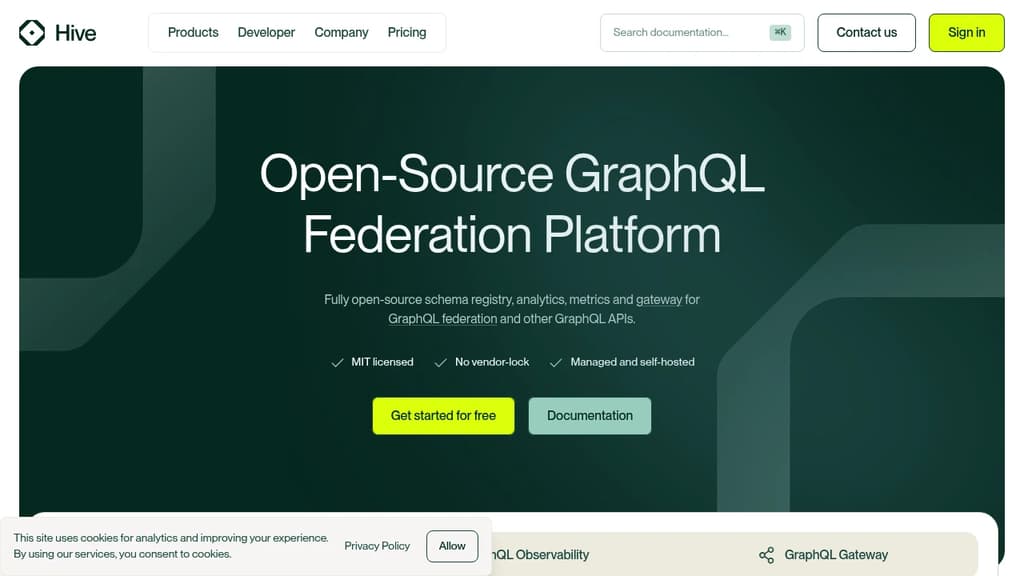
GraphQL Hive is a comprehensive open-source platform for managing GraphQL federation and APIs.
It offers key features like:
-
Schema Registry: Track schema changes across environments and prevent breaking changes before they reach production. The version control system and schema checks help teams evolve their API with confidence.
-
GraphQL Observability: Monitor GraphQL requests to analyze API usage and performance. Track overall API performance, identify slow operations, and gain insights into how clients are utilizing your API.
-
GraphQL Gateway: A high-performance gateway supporting Apollo Federation v1 and v2. It offers real-time features, security capabilities like RBAC and JWT authentication, and integrates with observability tools.
-
Open and Flexible: As a fully open-source solution, GraphQL Hive avoids vendor lock-in. Teams can self-host or use the managed cloud offering. The platform integrates well with existing GraphQL ecosystems and tools.
GraphQL Hive enables teams to build, manage and scale GraphQL APIs more effectively. Its comprehensive feature set covers the entire GraphQL lifecycle from development to production monitoring.

People are looking for alternatives to...
View all alternatives
Spotify

Claude Code

CapCut

Claude

Notion

Lovable
 Bright Data – Web data for AI agents and apps. Built-in unblocking, proxies, and ready-made APIs.
 Sent
Sent