Open Source Context.dev Alternatives
A curated collection of the 3 best open source alternatives to Context.dev.
The best open source alternative to Context.dev is Firecrawl. If that doesn't suit you, we've compiled a ranked list of other open source Context.dev alternatives to help you find a suitable replacement. Other interesting open source alternatives to Context.dev are: Crawl4AI and Maxun.
Context.dev alternatives are mainly Scraping Platforms & SDKs but may also be Web Crawlers. Browse these if you want a narrower list of alternatives or looking for a specific functionality of Context.dev.

Written by Piotr Kulpinski


API for AI agents to search, scrape, crawl, and interact with the live web, returning clean Markdown, structured JSON, or screenshots from any page.
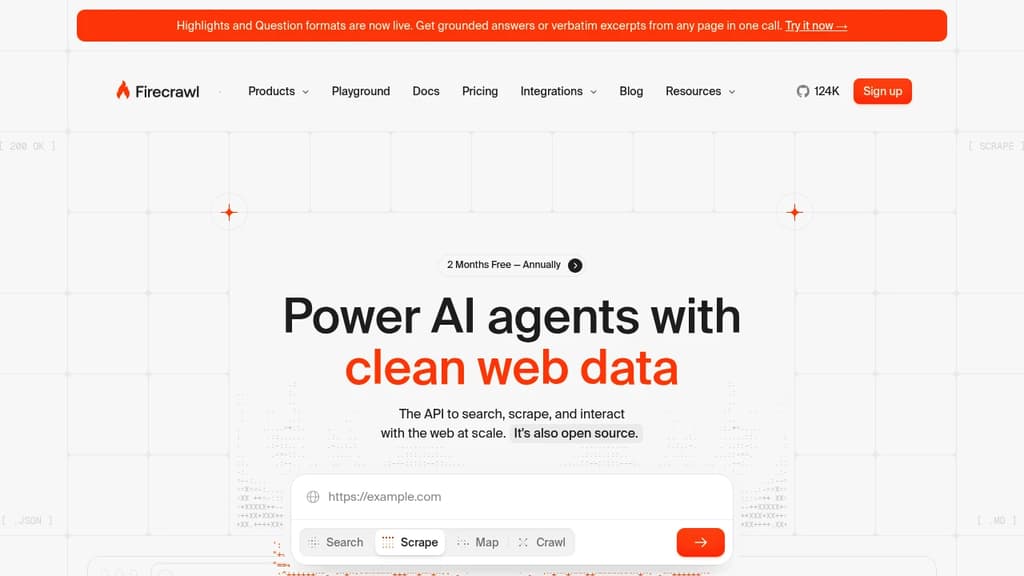
Firecrawl is a web data API built specifically for AI systems. It takes the messy, JavaScript-heavy, human-oriented web and converts it into structured data that agents and LLM pipelines can actually use. Over 80,000 companies rely on it, from indie developers wiring up AI search tools to teams at Apple and Canva running production-scale pipelines.
The three core capabilities work together:
- Search returns full-page Markdown alongside results, so one call goes from a query to usable content without a separate scrape step.
- Scrape handles JavaScript rendering, smart waits, and dynamic content automatically. Pass a URL and get back Markdown, HTML, screenshots, metadata, or structured JSON via a schema you define.
- Interact goes further. It lets agents click, scroll, type, and navigate multi-step flows, reaching data behind logins, pagination, or any sequence of actions a static scrape can't touch.
For browser automation for AI use cases, Firecrawl connects directly to MCP-compatible clients like Cursor, Claude, and Windsurf. There's also a CLI and official SDKs for Python, Node.js, Go, Rust, Java, and Elixir.
Under the hood, it covers 96% of the web with a reported P95 latency of 3.4 seconds across millions of pages. The hosted version adds proprietary infrastructure for proxy management and rendering reliability. The self-hostable version is the largest open source repo in the web crawlers space, with over 100,000 GitHub stars.
Common use cases include deep research agents, RAG pipelines, lead enrichment, competitive intelligence, and price monitoring. The free tier covers 1,000 pages per month, with paid plans scaling to millions of pages for larger workloads.
Unlike scraping tools that stop at raw HTML, Firecrawl parses PDFs and DOCX files, extracts structured data against a JSON schema, and caches results against a growing web index. It's a practical fit for any AI workflow that needs reliable, clean input from the live web.

Open-source web crawler and scraper that produces clean, structured output optimized for LLMs, RAG pipelines, and AI agents. Supports async crawling, CSS/XPath/LLM extraction, and stealth browser control.
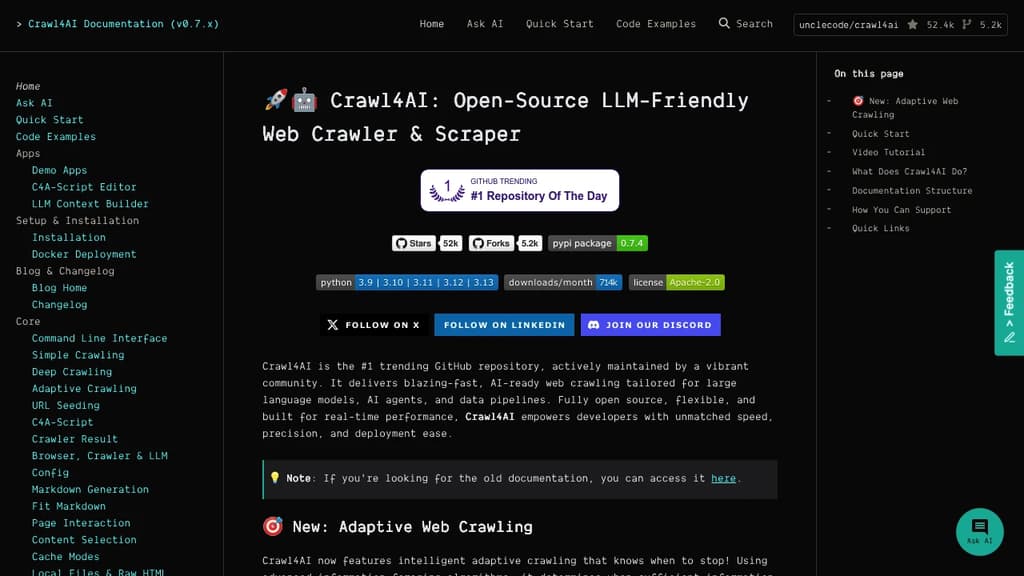
Crawl4AI is a web crawler and scraper built specifically for feeding data into AI pipelines and agents. Where generic scrapers dump raw HTML, Crawl4AI outputs clean Markdown and structured data that LLMs can consume directly, without heavy post-processing.
It's aimed at developers building RAG systems, data pipelines, or AI agents that need reliable, well-formatted web content at scale. The async-first architecture means you can run parallel crawls without blocking, making it practical for real-time use cases.
Key capabilities include:
- Clean Markdown output formatted for direct ingestion into LLMs or AI search tools, with minimal noise
- Structured extraction using CSS selectors, XPath, or LLM-based strategies for pulling repeated patterns from pages
- Adaptive crawling that uses information foraging algorithms to stop once enough data has been gathered to answer a query
- Advanced browser control including hooks, proxies, stealth modes, and session reuse for handling JavaScript-heavy or auth-protected sites
- Chunking and clustering approaches for breaking large pages into digestible pieces before passing to models
- No forced API keys or paywalls – you own the extraction process end to end
Compared to alternatives like Firecrawl or Jina AI, Crawl4AI leans heavily on self-hosting and configurability. You're not routing traffic through a third-party service, and there's no usage metering on the open-source version.
It also ships an AI assistant skill package (compatible with Claude, Cursor, and similar AI coding assistants) that bundles the full SDK reference and ready-to-use extraction scripts, so you can query the docs from inside your editor.
Deployable via pip or Docker, with a Python async API that fits naturally into existing data engineering workflows.
Turn any website into structured data using a visual recorder, natural language prompts, or API. Includes proxy rotation, scheduling, and webhook integrations.
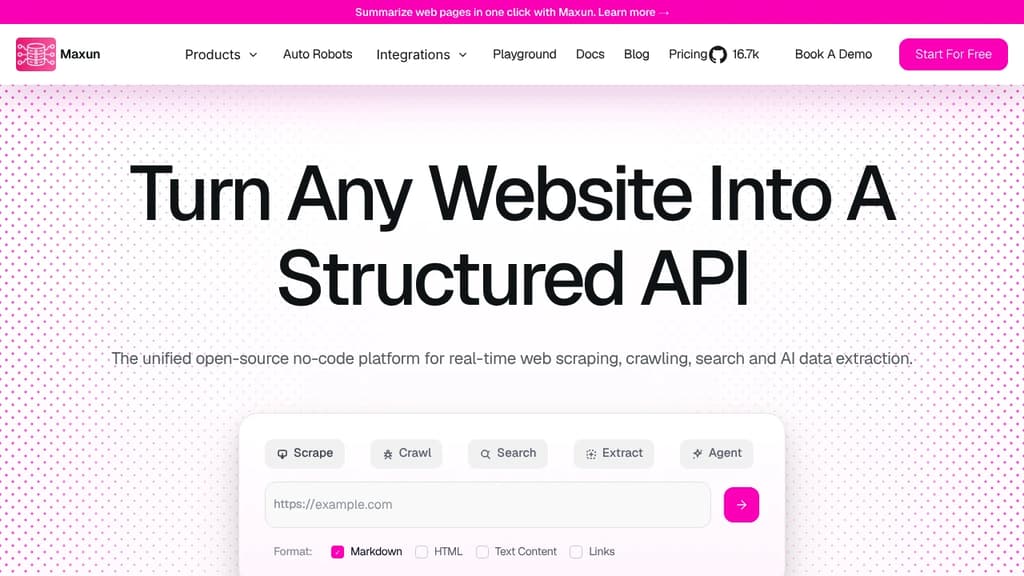
Maxun is a no-code platform for scraping, crawling, and extracting data from websites. It's built for developers and non-technical users alike who need structured data from the web without writing custom scrapers or maintaining brittle pipelines.
The core idea is simple: record your actions in a browser, and Maxun turns that recording into a reusable "robot" that extracts data on demand. No selectors to write, no code to maintain. You can also skip the recorder entirely and describe what you want in plain language. The AI agent navigates the site and pulls the relevant data automatically.
Key capabilities:
- Visual recorder builds production-ready scrapers by watching you browse, capturing clicks and scrolls into a repeatable workflow
- Natural language extraction lets you describe the data you need; the agent figures out how to get it
- Full-site crawling maps and extracts content across entire domains, not just single pages
- Web search finds relevant pages matching a query before extraction
- Scheduled monitoring runs scrapers hourly or daily to track price changes, job listings, or any content that updates
- Stealth mode handles proxy rotation and browser fingerprinting so scrapers don't get blocked
- Multiple output formats including Markdown, HTML, raw text, and links, ready for LLM pipelines or downstream apps
For developers who want more control, Maxun exposes a REST API, Python and JavaScript SDKs, a CLI, and native MCP support for agent orchestration. It fits naturally into workflows where an AI agent needs to call a web scraping tool as a skill. There are also pre-built robots for common targets like GitHub trending repos, IMDb, YouTube, and Airbnb listings.
Compared to tools like Firecrawl or Crawl4AI, Maxun leans harder into the no-code recorder experience and autonomous agents, making it accessible to people who don't want to touch an API at all. It's a self-hostable alternative to proprietary platforms like Apify or Octoparse, with the full codebase available on GitHub.
Over 100 million rows have been extracted through the platform, and it carries more than 14,000 GitHub stars.

People are looking for alternatives to...
View all alternatives
Spotify

Claude Code

CapCut

Claude
Notion

Lovable
 Docmost – Open-source wiki software with real-time collaboration, diagrams, AI, SSO, RBAC permissions and more.
 Stellar Hosted