Open Source Apache Cloudberry Alternatives
A curated collection of the 4 best open source alternatives to Apache Cloudberry.
The best open source alternative to Apache Cloudberry is ClickHouse. If that doesn't suit you, we've compiled a ranked list of other open source Apache Cloudberry alternatives to help you find a suitable replacement. Other interesting open source alternatives to Apache Cloudberry are: TimescaleDb, Databend, and CrateDB.
Apache Cloudberry alternatives are mainly Relational Databases (SQL) but may also be Cloud Data Warehouses or Time Series Databases. Browse these if you want a narrower list of alternatives or looking for a specific functionality of Apache Cloudberry.

Written by Piotr Kulpinski


High-performance columnar OLAP database system for real-time analytics on big data, with SQL support and linear scalability.
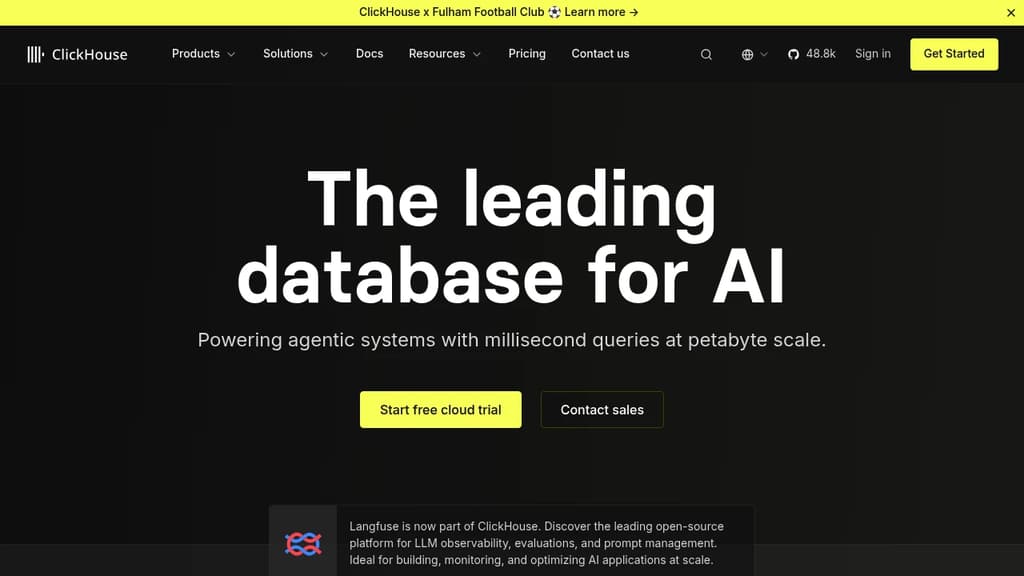
ClickHouse is a powerful open-source columnar database management system designed for online analytical processing (OLAP) of big data. It offers unparalleled performance and efficiency, making it an ideal choice for businesses dealing with massive datasets and complex analytical queries.
Key benefits of ClickHouse include:
- Exceptional Speed: Process billions of rows and terabytes of data in seconds, thanks to its columnar storage format and advanced query optimization techniques.
- Linear Scalability: Easily scale horizontally across commodity hardware to handle growing data volumes without compromising performance.
- SQL Support: Familiar SQL syntax with extensions for analytical queries, making it accessible to data analysts and engineers.
- Real-time Data Ingestion: Insert and query data simultaneously, enabling real-time analytics on fresh data.
- Compression: Highly efficient data compression reduces storage costs and improves query performance.
- Fault Tolerance: Built-in replication and sharding capabilities ensure high availability and data reliability.
- Versatility: Support for a wide range of data types, including arrays and nested structures, accommodating diverse analytical needs.
- Integration: Seamless integration with popular data processing tools and ecosystems, enhancing its utility in modern data stacks.
ClickHouse empowers organizations to unlock insights from their data at unprecedented speeds, enabling data-driven decision-making and innovative analytical applications across industries.

PostgreSQL extension for time-series data with automatic partitioning, up to 95% columnar compression, continuous aggregates, and ~200 native SQL functions.
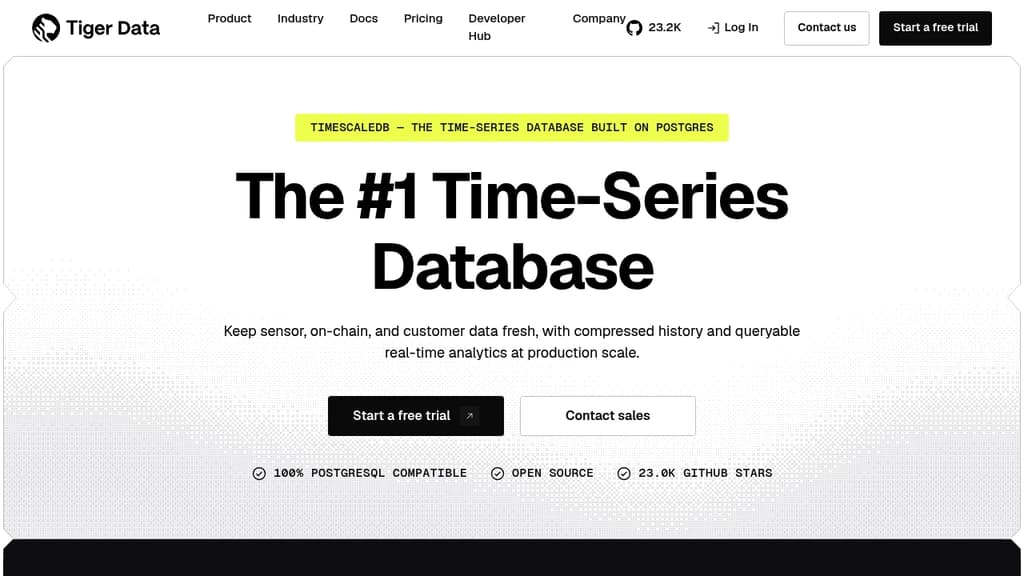
TimescaleDB is a PostgreSQL extension that turns Postgres into a purpose-built time-series database. It's designed for teams that want specialized time-series performance without abandoning the SQL ecosystem they already know. Sensor data, on-chain events, application metrics, customer behavior – if it's timestamped and high-volume, this is what it's built for.
The core abstraction is the hypertable: a regular Postgres table that's automatically partitioned by time (or ID) under the hood. Partition skipping at query planning means the database eliminates irrelevant chunks before scanning begins, so queries stay fast even as data grows into billions of rows.
Key capabilities:
- Hybrid row/columnar storage – recent data stays in the rowstore for fast ingest and point lookups; older data auto-converts to columnar format for analytical scans, with SIMD-accelerated vectorized execution
- Compression up to 95% – delta, dictionary, and RLE encodings compress historical data aggressively, and queries can filter directly on compressed data without decompressing first
- Continuous aggregates – incrementally refreshed materialized views that update in parallel batches; real-time mode includes the latest uncommitted data so dashboards never go stale
- ~200 time-series SQL functions – hyperfunctions cover time-weighted averages, interpolation, gap-filling, and partial aggregations that avoid reprocessing historical data
- Automated data management – built-in job scheduler handles retention policies, columnstore conversion, and aggregate refresh with configurable retries and full auditability
Because it's 100% PostgreSQL-compatible, existing Postgres tooling, drivers, ORMs, and extensions all work without modification. That's a meaningful difference from purpose-built alternatives like InfluxDB, QuestDB, or TDengine, which require learning new query languages or migration overhead.
Cloudflare uses it to balance analytical performance with operational simplicity, keeping analytical and configuration data under one roof. The project has 22,000+ GitHub stars and an active Slack community of 12,000+ members.

Databend is an open-source, elastic cloud data warehouse built for high-performance analytics and seamless integration with popular data tools.
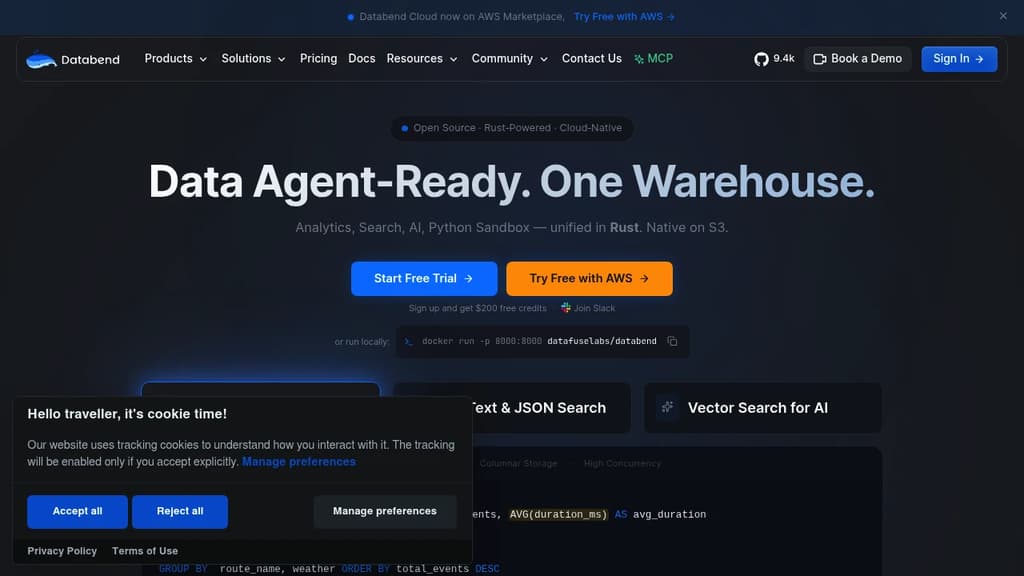
Databend is an open-source cloud data warehouse designed for high-performance analytics at scale. Some key features and benefits include:
- Cloud-native architecture optimized for object storage platforms
- SQL:2011 compliant with support for complex queries and time travel
- Seamless integration with popular BI, ETL, and data science tools
- Native AI capabilities to enhance analytics workflows
- Robust security with role-based and data-based access controls
- Sub-second analytics for real-time insights
- Efficient compression and storage for logs and event data
- Data archiving capabilities for long-term retention
- Massively parallel processing for large-scale offline computing
Databend offers fully-managed cloud, self-hosted enterprise, and free community editions to suit different needs. The cloud version provides a pay-as-you-go model with multi-region availability on AWS.
Benchmarks show Databend Cloud outperforming Snowflake by 10-36% on TPC-H queries while costing significantly less. The platform integrates easily with popular data systems and tools to enable end-to-end analytics workflows.
With its combination of performance, flexibility and cost-efficiency, Databend aims to be an economical alternative to established cloud data warehouses for organizations looking to unlock insights from their data at scale.

Distributed SQL database designed for high-speed ingestion and complex queries on massive datasets, ideal for IoT and time-series data.
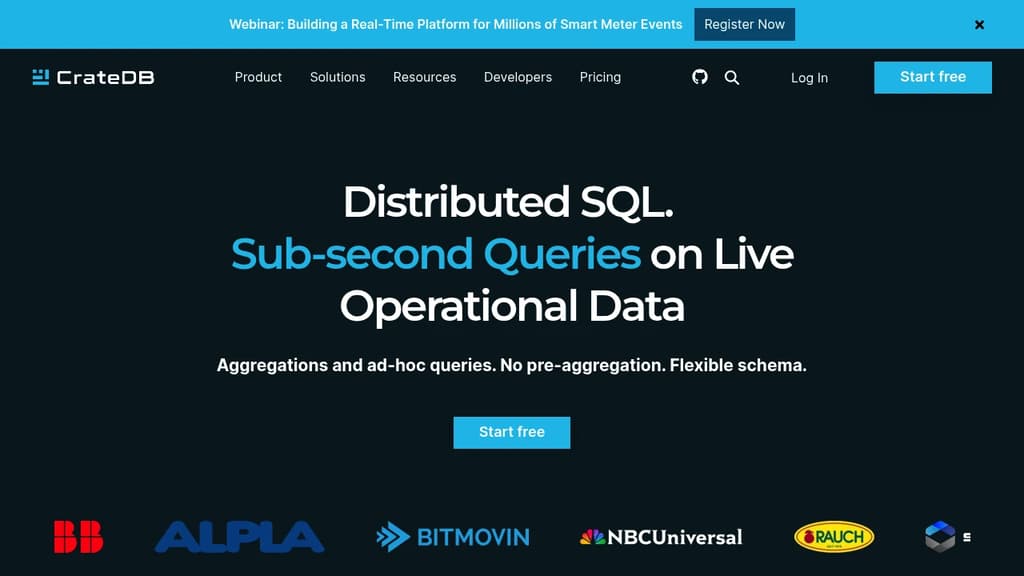
CrateDB is a powerful, distributed SQL database that excels in handling massive amounts of machine data in real-time. Built for the modern data landscape, it offers:
- Scalability: Easily scale horizontally across clusters to handle growing data volumes and user loads.
- Real-time analytics: Perform complex queries on large datasets with sub-second response times.
- Time-series optimization: Specifically designed to efficiently store and query time-series and IoT data.
- SQL + NoSQL: Combine the familiarity of SQL with the flexibility of schemaless data.
- Full-text search: Built-in Lucene-based full-text search capabilities for comprehensive data exploration.
- Multi-model: Support for structured, semi-structured, and geospatial data in a single database.
- Cloud-native: Containerized architecture for easy deployment in cloud environments.
- Low operational overhead: Self-healing clusters and automated sharding reduce management complexity.
CrateDB empowers organizations to derive actionable insights from their machine data, supporting use cases from IoT analytics and monitoring to log analysis and real-time dashboards. With its unique architecture, CrateDB bridges the gap between traditional relational databases and modern NoSQL systems, offering the best of both worlds for data-intensive applications.

People are looking for alternatives to...
View all alternatives
Spotify

Claude Code

CapCut

Claude
Notion

Lovable
 Sent – Messaging Infrastructure for Developers. One API for SMS, WhatsApp, and RCS across 190+ countries.
 Sent
Sent