Open Source Clay Alternatives
A curated collection of the 5 best open source alternatives to Clay.
The best open source alternative to Clay is Twenty. If that doesn't suit you, we've compiled a ranked list of other open source Clay alternatives to help you find a suitable replacement. Other interesting open source alternatives to Clay are: Frappe CRM, EspoCRM, Relaticle, and Warpdrive.
Clay alternatives are mainly CRM Systems. Browse these if you want a narrower list of alternatives or looking for a specific functionality of Clay.

Written by Piotr Kulpinski


Self-hostable CRM built for technical teams who need a fully customizable, extensible platform without vendor lock-in or proprietary tooling.
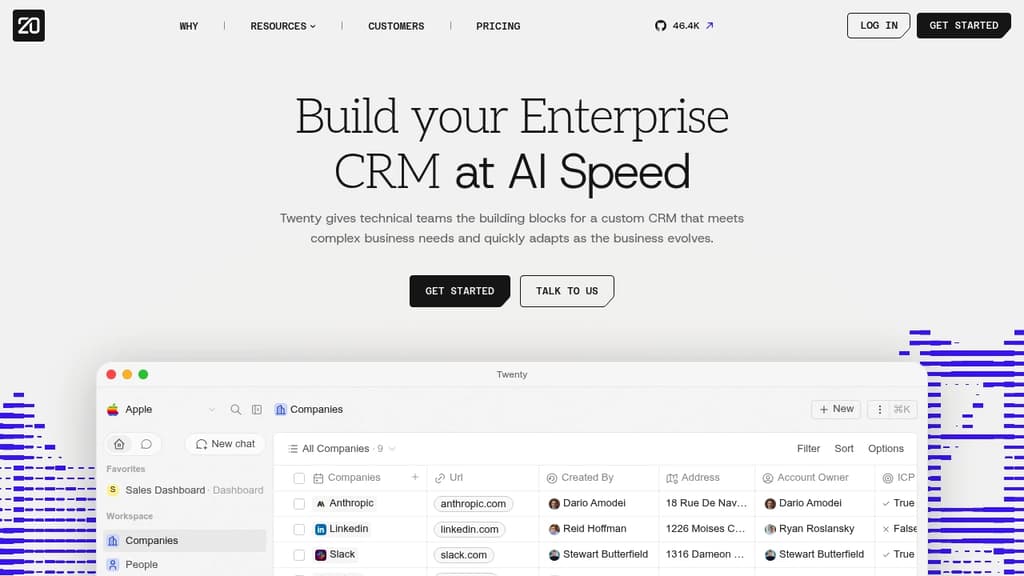
Twenty is a CRM built for teams that have outgrown generic tools but don't want to spend months building something from scratch. It gives developers a production-grade foundation covering data modeling, permissions, authentication, and workflow automation, while letting non-technical users customize objects, fields, views, and workflows directly from Settings without writing a line of code.
The core idea is composability. Instead of bending your business to fit a fixed data model, you define the objects and relationships that match how your team actually works. A company running carbon credits, agricultural products, and industrial systems can run all three from a single modular setup. A team migrating from Salesforce or HubSpot can import data via CSV or API and have a working CRM in days.
For developers, Twenty ships an Apps framework that lets you scaffold extensions in TypeScript and deploy custom objects, server-side logic functions, React components that render inside Twenty's UI, AI agents and skills, custom views, and navigation items. Every Cloud workspace includes a native MCP server, so AI assistants like Claude or Cursor can read and write CRM data in natural language.
Key capabilities include:
- Custom data model: Define any object, field type, or relation without touching a schema file manually
- No-code workflows: Build automations from Settings, no developer required
- AI coding support: Works with Cursor, Claude, and ChatGPT for rapid iteration on custom extensions
- Real-time updates: Live data across all views with an AI chat assistant built in
- Self-hosted or managed cloud: Full infrastructure ownership or a zero-ops cloud option at $9/user/month
- API-first: REST and GraphQL APIs, plus MCP for AI tool integration
- Role-based permissions: Row-level access control available on the Organization plan
The UI is clean and Notion-like, with keyboard shortcuts, smart command menus, and kanban or table views for opportunities. Teams that have moved from proprietary CRMs report cost reductions of over 90% after switching to a self-hosted instance. Unlike other open source CRM options, Twenty is designed to scale from a startup's first pipeline to an enterprise-grade operational backbone.

A flexible and customizable CRM platform for managing contacts, deals, and customer relationships without the complexity or user-based pricing of traditional solutions.
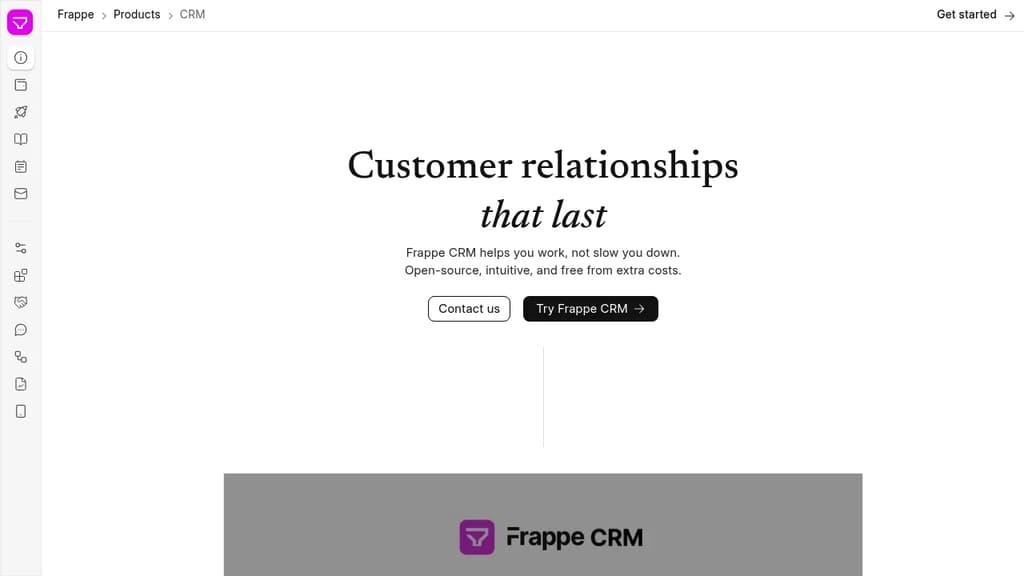
Frappe CRM delivers a refreshingly simple approach to customer relationship management. Built as an open-source solution, it provides all essential features without overwhelming complexity:
- Unified Contact Management - Track leads, deals, and organizations in one centralized view
- Seamless Communication - Integrate email, calls, and team discussions for complete conversation history
- Flexible Customization - Adapt fields, workflows and permissions to match your exact needs
- Smart Automation - Streamline lead assignments and follow-ups to boost team efficiency
- Powerful Reporting - Gain insights through customizable views and saved reports
- Key Integrations - Connect with ERPNext, WhatsApp, email and other business tools
As an open-source platform with no per-user fees, Frappe CRM enables businesses to scale their sales operations without rising software costs or vendor lock-in.

Open-source CRM software for managing customers, companies, projects and opportunities. Intuitive interface with cloud and self-hosted options available.
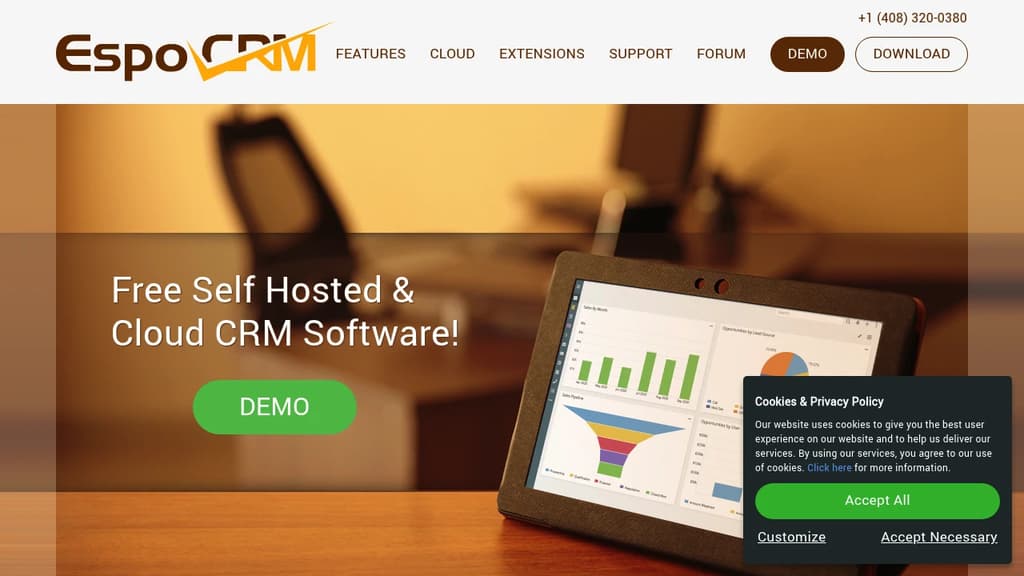
Complete customer relationship management in one intuitive platform. Track and manage all your business relationships - from individual contacts and companies to projects and sales opportunities - through a clean, user-friendly interface.
Key features include:
- Contact & company management - Centralize all customer information
- Sales pipeline tracking - Monitor opportunities from lead to close
- Project management - Organize and track project progress
- Flexible deployment - Choose between cloud-hosted or self-hosted solutions
- Customizable workflows - Adapt the system to your business processes
Trusted by 50,000+ companies across 163 countries, this mature platform has been refined over 11 years of development. Whether you're a small business or enterprise, the software scales to meet your needs while maintaining simplicity.
Available as both cloud and on-premise solutions, giving you complete control over your data and deployment preferences. The open-source nature ensures transparency, security, and the ability to customize according to your specific requirements.

Open-source CRM with a built-in AI assistant, 37 MCP tools for external agents, custom fields, role-based permissions, and a REST API. No per-seat pricing.
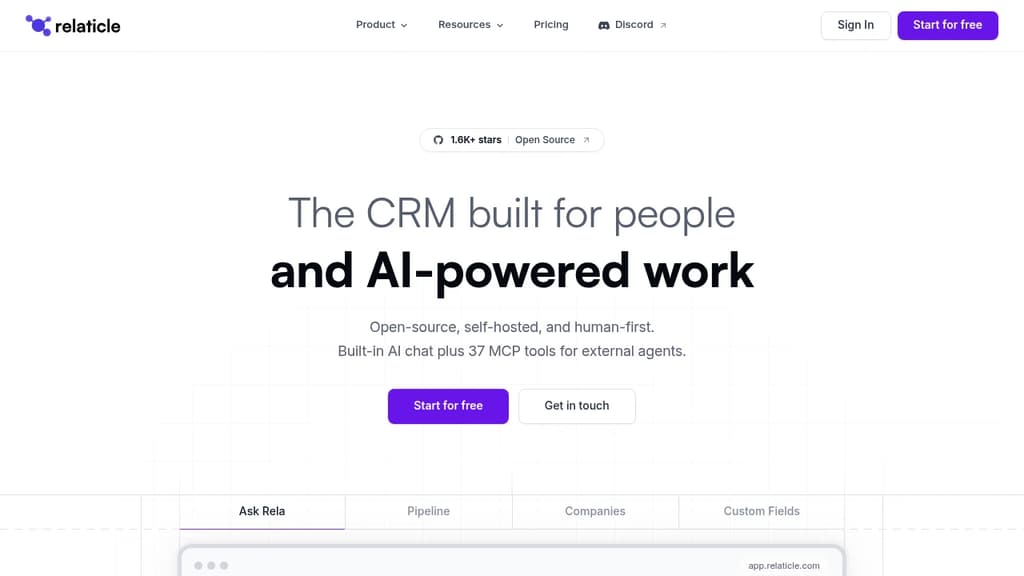
Relaticle is a self-hosted, open-source CRM built for teams who want to manage contacts, companies, deals, and tasks without giving up control of their data or paying per seat. It runs on your own infrastructure under AGPL-3.0, and it's free forever.
What sets it apart from tools like Pipedrive or HubSpot is that AI isn't bolted on as an add-on. It's woven into three distinct ways to work: a traditional UI, a built-in chat interface, and an MCP server for external agents.
Built-in AI chat lets you ask natural-language questions about your CRM data, @-mention specific records to scope a query, create or update records by typing, and get pipeline summaries or task rollups on demand. Voice input works too. Destructive actions (updates, deletes) always show an approval card before anything changes, and approved actions can be undone within five seconds.
MCP server with 37 tools connects any agent that speaks the Model Context Protocol. Claude, ChatGPT, Gemini, or your own custom agent can read, create, update, delete, and analyze CRM data through the same permission layer and schema that the UI uses. No separate sync, no shadow database.
Key capabilities at a glance:
- Custom data model: 22 field types including entity relationships, conditional visibility, and per-field encryption, no migrations needed
- Pipeline management: custom stages, lifecycle tracking, win/loss analysis
- Task management: assign tasks to contacts, companies, or deals; ask the chat to draft follow-ups or reschedule
- Team permissions: multi-workspace support with 5-layer authorization
- Import/export: CSV migration with column mapping, validation, and error handling
- REST API: full CRUD plus activity history and pipeline analysis for custom integrations
- Notes and activity log: capture by hand, voice, or chat; searchable across all records
Self-hosted teams supply their own AI provider keys (Anthropic, Google, or any OpenAI-compatible endpoint), so conversation history stays in your own database. Relaticle never trains on your data. A managed hosted option is also available if you'd rather skip the infrastructure work.
With 2,000+ automated tests, PHPStan static analysis, and 56+ MCP-specific tests, it's built for production use, not just experimentation.

Pipeline management, deal workspace, contacts, and two-way Gmail for BD teams. Runs on your own infrastructure, MIT licensed, no per-seat fees.
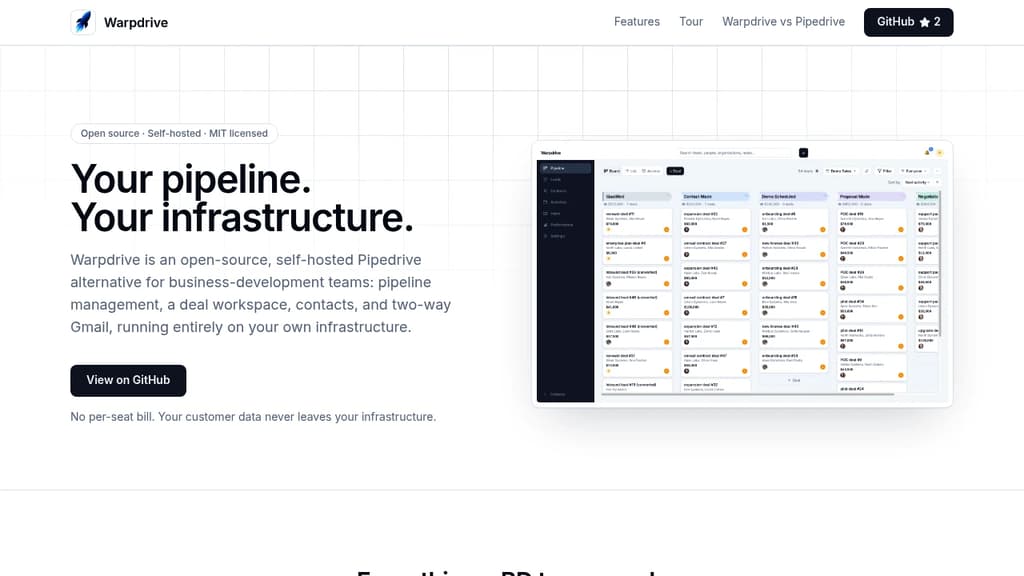
Warpdrive is a self-hosted Pipedrive alternative built for business-development teams who want full control over their customer data. No SaaS subscription, no per-seat billing, no vendor servers touching your pipeline. Your data stays on your infrastructure.
The feature set covers the core BD workflow without scope creep:
- Pipeline board with drag-and-drop stages, per-stage weighted totals, rotting-deal indicators, and saved filters
- Deal workspace that puts activities, notes, files, email threads, and the full change history on a single timeline
- Contacts and organizations with custom fields, firmographics, a leads inbox, and CSV import with an undo step
- Two-way Gmail with thread linking to deals and people, open and click tracking, templates, and scheduled send
- Realtime by default via a self-hosted WebSocket server, so board moves, mentions, and notifications are live without a paid pub-sub service
- Permissions and stats covering role-based visibility, teams, and funnel and activity performance reporting
Things deliberately left out: invoicing, workflow automation, web forms, a marketplace, and native mobile apps. That's a deliberate trade-off, not an oversight.
The whole stack ships as a single Docker Compose file. App, WebSocket server, background worker, Postgres, and MinIO all run together, with Caddy handling HTTPS automatically. Google Workspace SSO and Gmail OAuth use your own accounts and consent screen, so nothing routes through a third party. Built on Next.js, TypeScript, Postgres, and tRPC.
If you're running a small BD team and the Pipedrive bill is hard to justify, or if keeping customer data off vendor servers is a hard requirement, Warpdrive covers the essentials without compromise.

People are looking for alternatives to...
View all alternatives
Claude Code

Spotify

CapCut

Claude
Notion

Lovable
 Capture – Capture screenshots, generate PDFs, scrape content, extract metadata, and automate browsers with one API.
 c15t
c15t