Open Source WunderGraph Alternatives
A curated collection of the 3 best open source alternatives to WunderGraph.
The best open source alternative to WunderGraph is Tailcall. If that doesn't suit you, we've compiled a ranked list of other open source WunderGraph alternatives to help you find a suitable replacement. Other interesting open source alternatives to WunderGraph are: Hive and Orbital.
WunderGraph alternatives are mainly API Infrastructure Tools but may also be ETL & Data Integration Tools or API Integration Tools. Browse these if you want a narrower list of alternatives or looking for a specific functionality of WunderGraph.

Written by Piotr Kulpinski


Swiftly design and ship best-practice GraphQL backends atop existing data sources and APIs.
Tailcall gives you a best-practice GraphQL backend that checks all the boxes:
-
Secure: Validated against a comprehensive database of GraphQL vulnerabilities. Rest easy knowing your GraphQL backends are secure.
-
High-Performance: Tailcall performs ahead-of-time optimizations based on analysis of the schema and data dependencies. Deploy GraphQL without compromises.
-
Statically Verified: Tailcall statically verifies that GraphQL schemas match resolvers and warns about N + 1 issues. Deploy new APIs with confidence.
-
Simple: Tailcall configuration generator can integrate thousands of APIs in a matter of minutes. Configure with ease and deploy with confidence.
-
Customizable: Write custom Javascript to customize any aspect of your GraphQL backend. Leverage this escape hatch to satisfy any requirement.
-
Plug & Play: Engineered to stay out of your way, shipping as a single executable with no dependencies or requirements. Get started quickly and easily.
Tailcall is developed and released under the Apache 2 open source license, the gold standard for OSS. Embrace a vendor-neutral solution.

A fully open-source schema registry, analytics, and gateway for GraphQL federation and APIs
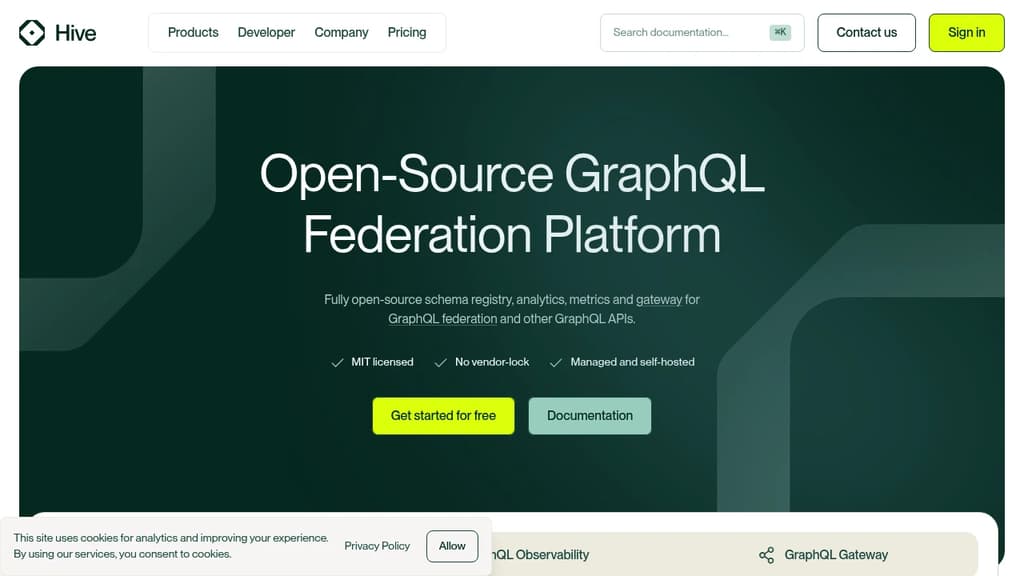
GraphQL Hive is a comprehensive open-source platform for managing GraphQL federation and APIs.
It offers key features like:
-
Schema Registry: Track schema changes across environments and prevent breaking changes before they reach production. The version control system and schema checks help teams evolve their API with confidence.
-
GraphQL Observability: Monitor GraphQL requests to analyze API usage and performance. Track overall API performance, identify slow operations, and gain insights into how clients are utilizing your API.
-
GraphQL Gateway: A high-performance gateway supporting Apollo Federation v1 and v2. It offers real-time features, security capabilities like RBAC and JWT authentication, and integrates with observability tools.
-
Open and Flexible: As a fully open-source solution, GraphQL Hive avoids vendor lock-in. Teams can self-host or use the managed cloud offering. The platform integrates well with existing GraphQL ecosystems and tools.
GraphQL Hive enables teams to build, manage and scale GraphQL APIs more effectively. Its comprehensive feature set covers the entire GraphQL lifecycle from development to production monitoring.

Automated data integration platform that connects APIs, databases, and event streams using semantic schemas. Deploy secure integrations in minutes with Git-based workflows.
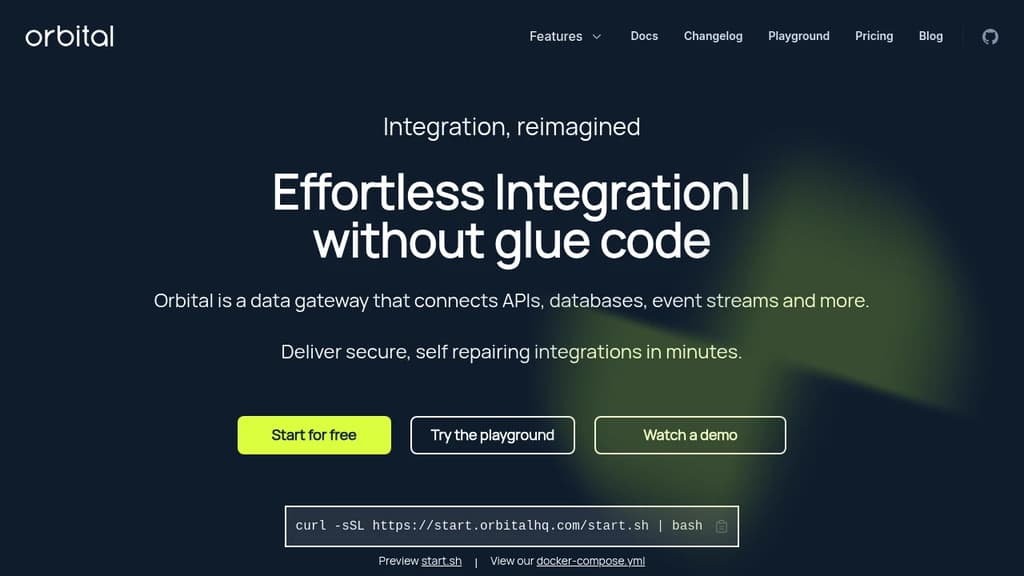
Orbital transforms how development teams handle data integration by eliminating the need for traditional glue code and complex mapping files. This automated integration platform connects APIs, databases, and event streams using semantic type metadata embedded directly in your existing schemas.
Key capabilities include:
- Zero glue code architecture - No resolvers, API clients to generate, or YAML mapping files to maintain
- Semantic schema integration - Embed tags in OpenAPI, Protobuf, and database schemas to define data relationships
- Query-driven orchestration - Use declarative queries to fetch data from multiple sources automatically
- Git-based deployment - Push to deploy endpoints instantly with automatic migration support
- Multi-format publishing - Deploy as REST APIs, event streams, WebSocket connections, or queue integrations
- Built-in caching - Instant performance optimization with intelligent caching layers
The platform excels in microservices orchestration, allowing teams to query for needed data while Orbital handles service coordination behind the scenes. For event-based architectures, it decouples producers and consumers by providing custom events tailored to each consumer's exact requirements.
Orbital's declarative approach to data pipeline management enables rapid onboarding of external data feeds without building complex ETL processes. The system automatically adapts as APIs evolve, ensuring integrations remain functional through schema changes.

People are looking for alternatives to...
View all alternatives
Spotify

Claude Code

CapCut

Claude

Notion

Lovable
 Sent – Messaging Infrastructure for Developers. One API for SMS, WhatsApp, and RCS across 190+ countries.
 Stellar Hosted