Ad
 
Learn more

Open Source Weaviate Alternatives

A curated collection of the 10 best open source alternatives to Weaviate.

The best open source alternative to Weaviate is Mem0. If that doesn't suit you, we've compiled a ranked list of other open source Weaviate alternatives to help you find a suitable replacement. Other interesting open source alternatives to Weaviate are: Milvus, Qdrant, Chroma, and Letta.

Weaviate alternatives are mainly Data Platforms for AI but may also be Vector Databases or LLM Application Frameworks. Browse these if you want a narrower list of alternatives or looking for a specific functionality of Weaviate.

Piotr Kulpinski's profile

Written by Piotr Kulpinski

Universal memory layer for LLM applications that learns from user interactions, reduces token costs by 80%, and delivers personalized AI experiences.

Screenshot of Mem0 website

Transform your AI applications with persistent memory that learns and adapts. Mem0 is a self-improving memory layer that enables LLM applications to remember user preferences, context, and interactions across sessions, creating truly personalized AI experiences.

Key benefits include:

  • Massive cost savings - Cuts prompt tokens by up to 80% through intelligent memory compression
  • One-line integration - Start in seconds with zero configuration or boilerplate code
  • Framework flexibility - Works seamlessly with OpenAI, LangGraph, CrewAI, and more in Python or JavaScript
  • Enterprise-ready security - SOC 2 & HIPAA compliant with BYOK encryption and audit trails
  • Flexible deployment - Run on-premises, private cloud, or Kubernetes with the same API

Perfect for diverse use cases: Healthcare assistants that remember patient history, adaptive learning tutors that track student progress, sales tools that maintain context across long cycles, and customer support that builds on previous interactions.

Proven performance: Benchmarked 26% higher response quality compared to OpenAI memory while using 90% fewer tokens. Trusted by 50,000+ developers and backed by Y Combinator, with customers like Sunflower Sober scaling to 80,000+ users and OpenNote reducing costs by 40%.

Looking for open source alternatives to other popular services? Check out other posts in the alternatives series and openalternative.co, a directory of open source software with filters for tags and alternatives for easy browsing and discovery.

Open-source vector database optimized for similarity search, scaling to billions of vectors with minimal performance loss
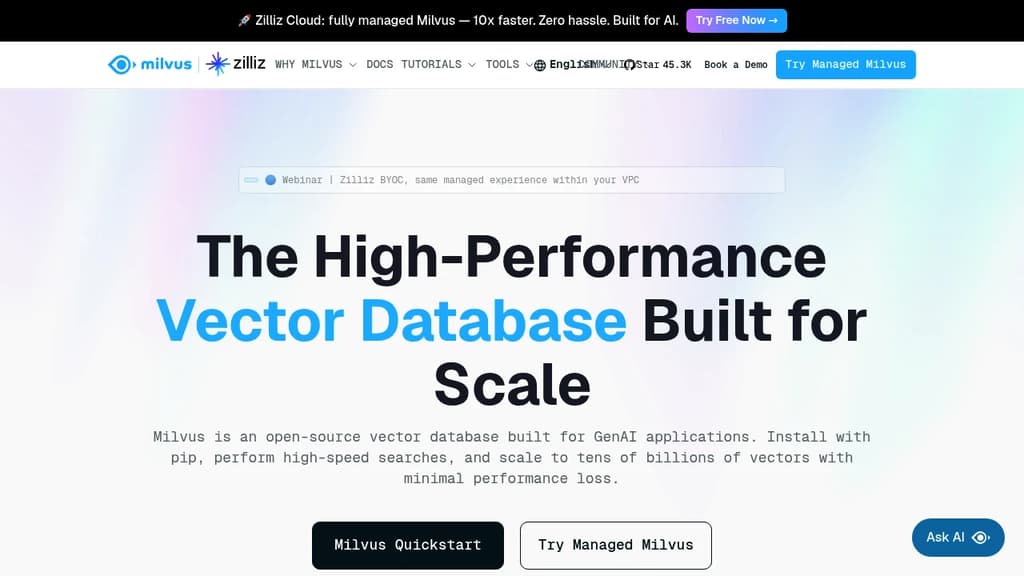
Screenshot of Milvus website

Milvus is an open-source vector database built specifically for GenAI applications. It offers high-performance similarity search capabilities and seamless scalability to handle billions of vectors.

Key features:

  • Easy installation: Get started quickly with a simple pip install
  • Blazing-fast searches: Perform high-speed similarity searches on massive vector datasets
  • Elastic scalability: Scale effortlessly to tens of billions of vectors with minimal performance impact
  • Flexible deployment: Choose from lightweight Milvus Lite for prototyping, robust Standalone for production, or fully distributed deployment for enterprise-scale workloads
  • Rich ecosystem: Integrates smoothly with popular AI tools like LangChain, LlamaIndex, OpenAI, and more
  • Advanced capabilities: Supports metadata filtering, hybrid search, multi-vector queries and other powerful features

Milvus empowers developers to build robust and scalable GenAI applications across various domains including image retrieval, recommendation systems, and semantic search. Its focus on performance, scalability and ease-of-use makes it a top choice for vector similarity search at any scale.

Qdrant is an open-source vector database that provides high-performance similarity search for AI and machine learning applications.
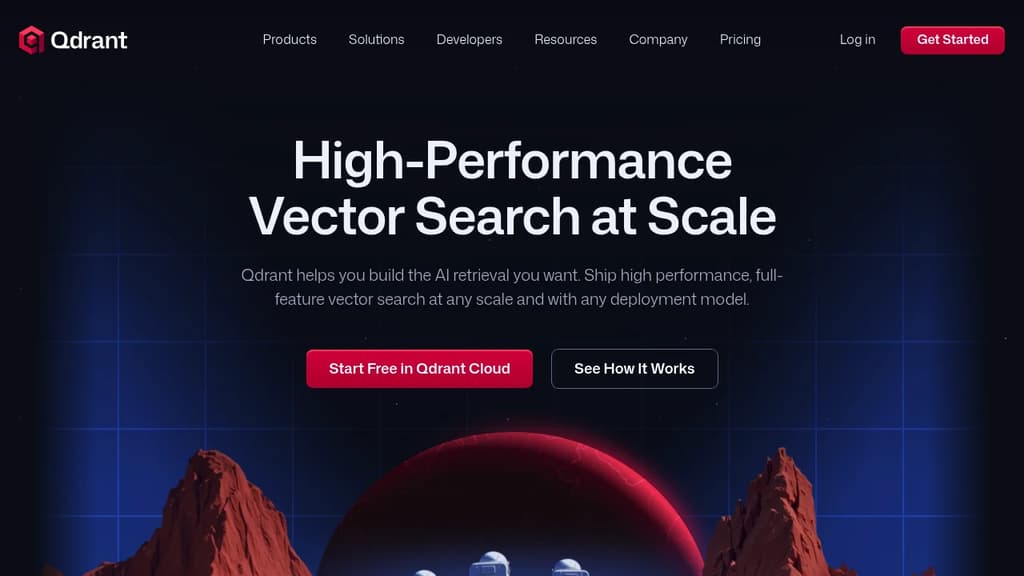
Screenshot of Qdrant website

Qdrant is a powerful open-source vector database designed for high-performance similarity search in AI and machine learning applications. Built with Rust for unmatched speed and reliability, Qdrant excels at handling billions of high-dimensional vectors.

Key features:

  • Cloud-native scalability: Easily scale vertically and horizontally with zero-downtime upgrades
  • Flexible deployment: Quick setup with Docker for local testing or cloud deployment
  • Cost-efficient storage: Built-in compression options to dramatically reduce memory usage
  • Advanced search capabilities: Supports semantic search and handles multimodal data efficiently
  • Easy integration: Lean API for seamless integration with existing systems

Qdrant is ideal for powering recommendation systems, advanced search applications, and retrieval augmented generation (RAG) workflows. Its ability to quickly process complex queries on large datasets makes it suitable for a wide range of AI-driven use cases.

Real-world impact: Trusted by leading companies like Bosch, Cognizant, and Bayer for enterprise-scale AI applications. Qdrant consistently outperforms alternatives in ease of use, performance, and value.

Whether you're building a cutting-edge AI product or enhancing existing applications with vector search capabilities, Qdrant provides the speed, scalability, and flexibility needed to bring your ideas to life.

Open-source vector database designed for AI applications. Store, search, and retrieve embeddings with semantic similarity matching and metadata filtering.
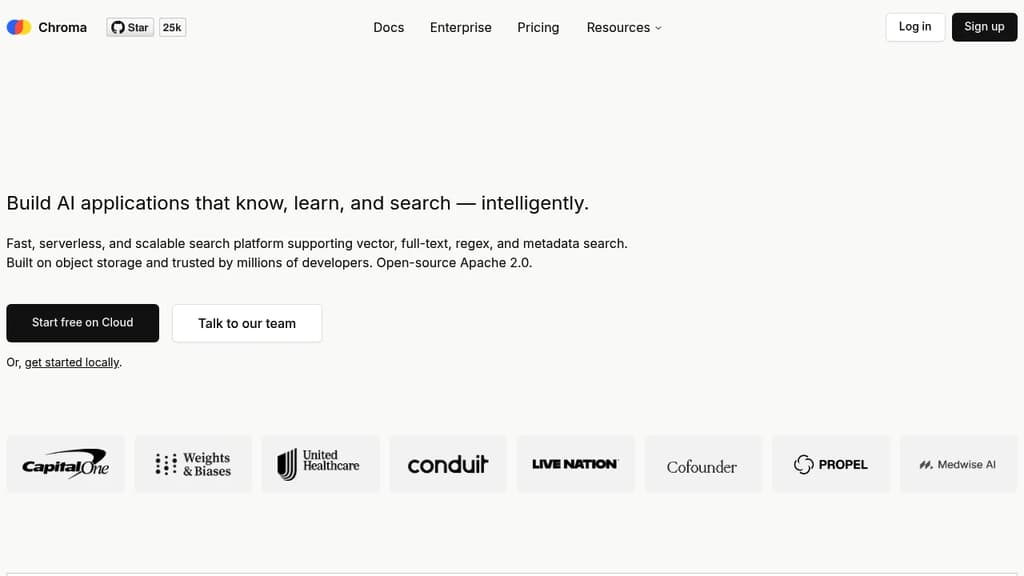
Screenshot of Chroma website

Chroma is a powerful open-source vector database specifically built for AI applications that need efficient storage and retrieval of embeddings. Perfect for developers building RAG (Retrieval-Augmented Generation) systems, semantic search engines, and AI-powered applications.

Key features include:

  • Vector storage and similarity search - Store high-dimensional embeddings and perform fast semantic similarity queries
  • Metadata filtering - Combine vector search with traditional filtering for precise results
  • Multiple embedding models - Support for OpenAI, Sentence Transformers, and custom embedding functions
  • Flexible deployment - Run locally, in-memory, or deploy to production with persistent storage
  • Simple Python API - Get started quickly with intuitive methods for adding, querying, and managing collections
  • Language integrations - Native support for Python and JavaScript with additional language bindings

Whether you're building a chatbot that needs to search through documents, creating a recommendation system, or developing any AI application requiring semantic search capabilities, Chroma provides the foundation you need with minimal setup and maximum flexibility.

Letta is an open-source platform for creating AI agents with built-in memory, reasoning, and support for thousands of tools.

Screenshot of Letta website

Letta is an open-source platform that enables developers to build and deploy advanced AI agents.

Some key features include:

  • Built-in memory management: Powered by the research behind MemGPT, Letta agents have self-managed memory capabilities, allowing them to maintain context over extended conversations and tasks.
  • Reasoning capabilities: Agents can perform complex reasoning and decision-making based on their knowledge and context.
  • Extensive tool support: Letta supports integration with over 7,000 tools, allowing agents to interact with a wide range of external systems and APIs.
  • Visual development environment: The Agent Development Environment (ADE) provides an intuitive interface for iterating on agent prompts, tools, and model configurations.
  • Production-ready infrastructure: Letta's cloud offering is designed for scalability, allowing agents to grow in utility over time.
  • Model-agnostic approach: Developers can use their preferred language models and easily swap between different providers.
  • Open-source core: The core Letta platform is open-source, promoting transparency and customization.

With its focus on memory management, extensive capabilities, and developer-friendly features, Letta aims to push the boundaries of what's possible with AI agents. Whether you're building prototypes or production-ready systems, Letta provides the tools and infrastructure to create more capable and context-aware AI assistants.

Add persistent memory to LLM apps with millisecond recall times. Store, retrieve, and personalize user data across sessions with enterprise-grade security.

Screenshot of Supermemory website

Transform your AI applications with blazing-fast long-term memory that delivers sub-300ms recall times. Supermemory provides a universal memory API that works seamlessly across all LLM models and modalities.

Key benefits include:

  • 10x faster recall than competitors like Zep, with 25x speed improvement over Mem0
  • 70% cost reduction compared to traditional memory infrastructure
  • Human-like memory evolution with automatic updates, forgetfulness, and contextual understanding
  • Enterprise-ready security with SOC 2 compliance and flexible deployment options

The platform handles multimodal data ingestion from files, documents, chats, emails, and app streams with automatic cleaning and chunking. Advanced embeddings and graph-based enrichment create smart, interconnected memories that scale effortlessly.

Integration is simple - drop Supermemory into your existing stack with SDKs for OpenAI, Anthropic, AI SDK, and Cloudflare. Connect to popular platforms like Google Drive, Notion, and OneDrive to sync user context automatically.

Perfect for developers building personalized AI experiences, search engines, content libraries, and knowledge management systems. Start free with 1M tokens processed and 10K search queries, then scale as your memory becomes your competitive advantage.

Looking for open source alternatives to other popular services? Check out other posts in the alternatives series and openalternative.co, a directory of open source software with filters for tags and alternatives for easy browsing and discovery.

Deep Lake is an open-source database for storing, querying and managing complex AI data like images, audio, and embeddings.
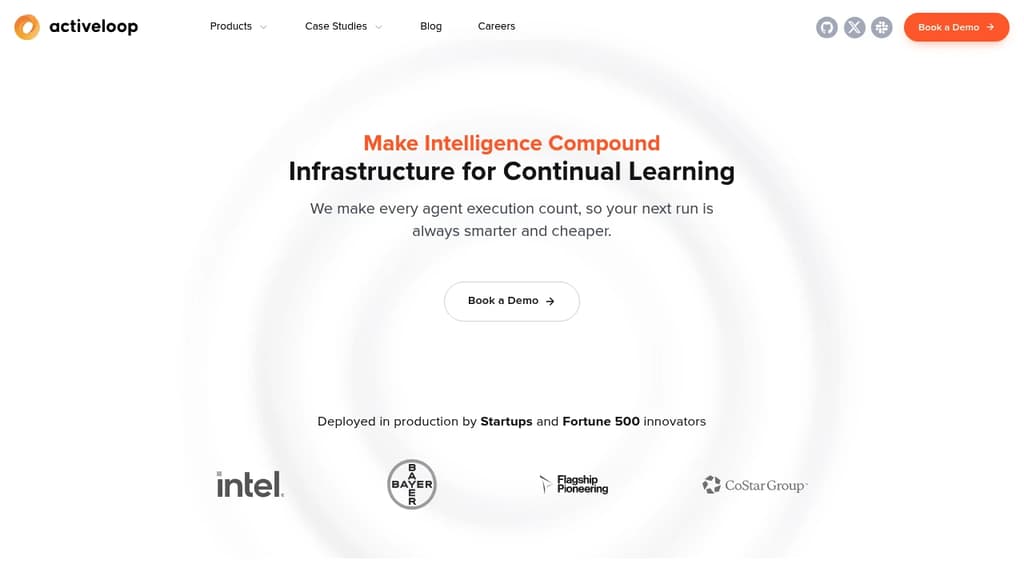
Screenshot of Activeloop website

Deep Lake is an open-source tensor database designed specifically for AI and machine learning workflows. It allows you to efficiently store, query, and manage complex unstructured data like images, audio, video, and embeddings.

Some key features of Deep Lake:

  • Tensor storage: Store data as tensors for fast streaming to ML models
  • Vector search: Built-in vector similarity search for embeddings and other high-dimensional data
  • Querying: SQL-like querying capabilities for complex data filtering
  • Versioning: Git-like versioning to track changes to datasets over time
  • Visualization: Visualize datasets and embeddings directly in notebooks or browser
  • Streaming: Stream data directly to ML frameworks like PyTorch and TensorFlow
  • Cloud integration: Seamlessly work with data stored in cloud object stores

Deep Lake aims to simplify ML data management and accelerate the development of AI applications. It provides a standardized way to work with unstructured data across the ML lifecycle - from data preparation to model training to deployment.

The open-source nature allows for customization and integration into existing ML workflows. Deep Lake can significantly reduce data preparation time and enable faster experimentation and iteration on ML models.

Rust-built native graph-vector database combining vector similarity search and graph traversals. 10x faster development with unified architecture, sub-1ms queries.
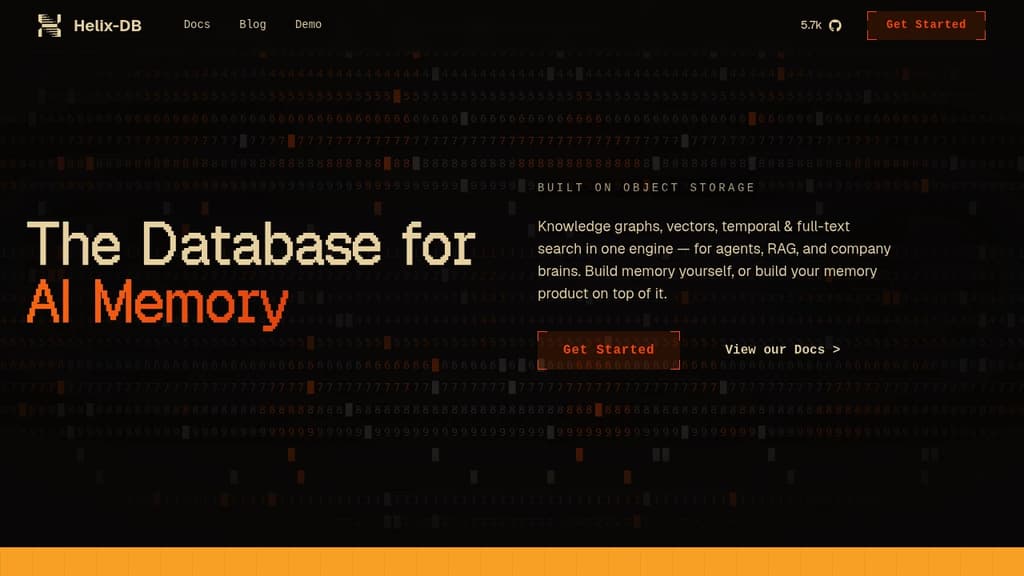
Screenshot of HelixDB website

HelixDB is a groundbreaking native graph-vector database that eliminates the need for multiple databases by unifying vector similarity search and graph traversal operations in a single, high-performance engine. Built in Rust and backed by Y Combinator and NVIDIA, it's specifically designed for AI agents, RAG systems, and applications requiring advanced contextual retrieval.

Key performance advantages:

  • Vector similarity search: ~2ms average response time
  • Graph traversals: Sub-1ms execution speed
  • Cost reduction: Up to 50% lower operational costs by eliminating architectural complexity
  • Type-safe queries: Advanced static analysis with real-time feedback and autocomplete

Developer-friendly features:

  • Simple CLI installation with curl -sSL "https://install.helix-db.com" | bash
  • Hybrid query traversals combining vector and graph operations seamlessly
  • Comprehensive SDKs and extensive documentation
  • Local deployment or managed cloud service options

Enterprise support includes:

  • 24/7 expert monitoring and support
  • Enterprise-grade security and compliance
  • Automatic scaling for traffic spikes
  • 99.99% uptime guarantee

Perfect for teams building next-generation AI applications who want to reduce database complexity while achieving industry-leading performance. The growing developer community and active support channels make it easy to get started and scale efficiently.

Laminar is an open-source platform that helps collect, understand, and utilize data for building high-quality LLM applications.

Screenshot of Laminar website

Laminar is an innovative, open-source platform designed to revolutionize the development of Large Language Model (LLM) products. It offers a comprehensive suite of tools for engineering best-in-class AI applications from first principles.

Key features and benefits:

  1. Traces: Laminar provides powerful tracing capabilities, allowing developers to gain a clear picture of every step in their LLM application's execution. This feature simultaneously collects invaluable data that can be used for:

    • Setting up better evaluations
    • Creating dynamic few-shot examples
    • Fine-tuning models
  2. Zero-overhead observability: All traces are sent in the background via gRPC, ensuring minimal impact on performance. The platform supports tracing for both text and image models, with audio model support coming soon.

  3. Online evaluations: Laminar enables the setup of LLM-as-a-judge or Python script evaluators to run on each received span. This approach to evaluation is more scalable than human labeling and particularly beneficial for smaller teams.

  4. Dataset creation: Users can build datasets from their traces, which can be utilized in evaluations, fine-tuning, and prompt engineering.

  5. Prompt chain management: Laminar goes beyond single prompts, allowing users to build and host complex chains, including mixtures of agents or self-reflecting LLM pipelines.

  6. Open-source and self-hostable: The platform is fully open-source and easy to self-host, giving users complete control over their data and infrastructure.

Laminar empowers developers to create more robust, efficient, and effective LLM applications by providing a data-centric approach to AI engineering. Whether you're working on improving model performance, optimizing prompts, or scaling your AI solutions, Laminar offers the tools and insights needed to excel in the rapidly evolving field of AI engineering.

Integrate graph AI into your products to extract valuable insights and reduce costs from your data.

Screenshot of Pixlie website

Pixlie AI is an open-source knowledge graph engine that empowers you to unlock actionable insights from your data. By leveraging fast and cost-effective graph-based AI, you can connect your private data with public information to gain a deeper understanding of your business landscape.

Key features:

  • Self-hosted and private: Run Pixlie AI on your own infrastructure for complete data control
  • Multiple data formats: Ingest data from CSV, JSON, Markdown, and more
  • Integrated web crawler: Enhance your data with public knowledge automatically
  • Team collaboration: Share results securely with your team, on-premises or in the cloud
  • Semantics management: Use the built-in admin UI to manage real-world semantics extracted from your data
  • AI model integration: Leverage Anthropic's Claude API or local AI models for advanced analysis
  • Entity and relationship extraction: Classify text and extract entities cost-effectively
  • Knowledge graph enrichment: Continuously improve your data connections
  • No-code graph queries: Explore your entire knowledge graph through an intuitive interface
  • API access: Integrate Pixlie AI into your applications for seamless data querying

Experience the power of graph-based AI and transform your data into valuable insights with Pixlie AI. Get started today and unlock the full potential of your information ecosystem.

Share:

Favicon of OpenAlternative AdsOpenAlternative Ads
Weekly advertisement packages now available. Connect with an audience of professional tech enthusiasts.
Book in under 5 mins
Favicon of OpenAlternative Ads

People are looking for alternatives to...

Favicon


Favicon


Favicon


Favicon


Favicon


Favicon