Open Source Spike API Alternatives
A curated collection of the 2 best open source alternatives to Spike API.
The best open source alternative to Spike API is Gatus. If that doesn't suit you, we've compiled a ranked list of other open source Spike API alternatives to help you find a suitable replacement. Other interesting open source alternative to Spike API is Open Wearables.
Spike API alternatives are mainly Infrastructure Monitoring Tools but may also be Uptime Monitoring Tools or Status Pages. Browse these if you want a narrower list of alternatives or looking for a specific functionality of Spike API.

Written by Piotr Kulpinski


A highly customizable monitoring solution that provides automated status pages, extensive alerting options, and detailed testing capabilities for your services and infrastructure
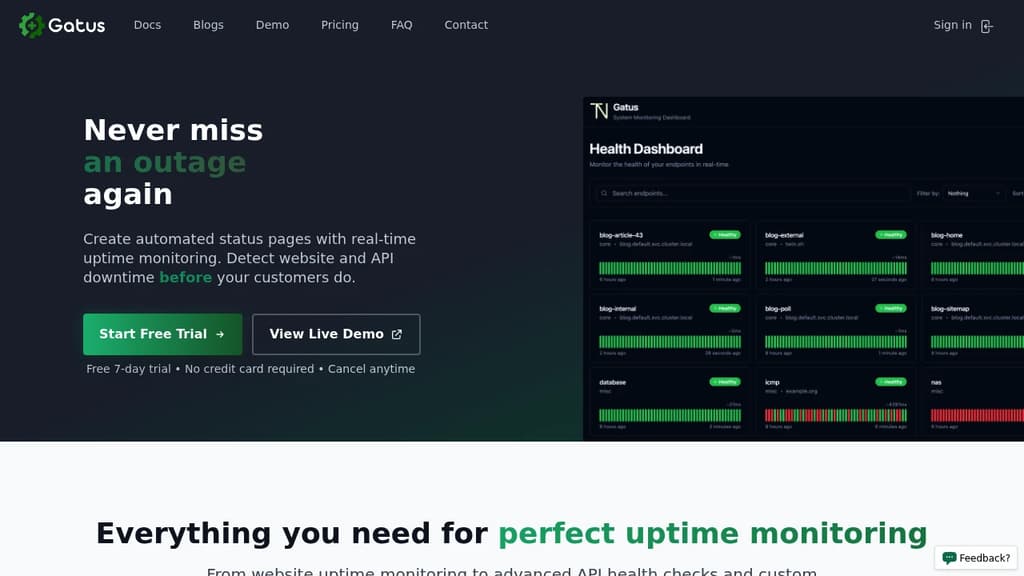
Gatus is a powerful monitoring solution that helps you keep track of your infrastructure's health in real-time. The platform offers comprehensive monitoring capabilities for HTTP, GraphQL, DNS, ICMP/PING, TCP, and certificate expiration checks.
Key features include:
- Highly customizable monitoring with conditions for response time, body content, and IP addresses
- Extensive alerting system supporting Email, Slack, PagerDuty, Teams, Twilio, Discord, and more
- Developer-focused approach with detailed insights and automated user acceptance testing
- Real-time status updates that automatically reflect your services' current state
- Customer-centric design providing clear, accurate information about ongoing issues
The platform stands out by being completely open source, allowing for community contributions and custom feature development. Unlike traditional status pages that only show historical uptime, Gatus focuses on providing immediate, actionable information about current service status.

Self-hosted health intelligence platform with open algorithms, AI reasoning engine, and zero per-user fees. Connect Apple Health, Whoop, Garmin, Oura, and more.

Open Wearables transforms raw wearable data into intelligent health recommendations through transparent, auditable algorithms. Unlike proprietary SaaS platforms that hide scoring logic behind black boxes, this MIT-licensed, self-hosted platform gives you complete control over health scoring and AI reasoning.
Key capabilities include:
- Unified wearable integration across Apple Health, Whoop, Oura, Garmin, Samsung Health, and more with normalized, deduplicated data
- Open health algorithms for sleep, recovery, strain, stress, HRV, VO2 max, and additional metrics you can audit and customize
- Health AI reasoning engine that detects trends, flags anomalies, and connects patterns across scores—not just a wrapper around raw LLMs
- Domain-specific coaching profiles for wellness, performance, clinical monitoring, or custom use cases using the same underlying data
- Zero per-user fees regardless of scale, eliminating the $0.50-2/month costs of competing SaaS APIs
- HIPAA-ready architecture with self-hosted deployment on your infrastructure for full compliance control
The platform bridges the gap between data collection and actionable intelligence. Instead of presenting raw metrics, it delivers context-aware recommendations—detecting when strain exceeds capacity, recovery trends downward, or sleep consistency drops, then suggesting concrete actions like intensity reduction or recovery prioritization.
Developers can deploy their first API call in 5 minutes and ship production-ready health features in days. The MCP server integration works with any LLM, while open source code enables debugging, customization, and long-term independence from vendor lock-in.

People are looking for alternatives to...
View all alternatives
Spotify

Claude Code

CapCut

Claude

Notion

Lovable
 Sent – Messaging Infrastructure for Developers. One API for SMS, WhatsApp, and RCS across 190+ countries.
 Sent
Sent