Open Source Same Alternatives
A curated collection of the 3 best open source alternatives to Same.
The best open source alternative to Same is Reflex. If that doesn't suit you, we've compiled a ranked list of other open source Same alternatives to help you find a suitable replacement. Other interesting open source alternatives to Same are: Dyad and Morphic.
Same alternatives are mainly Low-Code/No-Code Platforms but may also be Development Environments or AI App & Website Builders. Browse these if you want a narrower list of alternatives or looking for a specific functionality of Same.

Written by Piotr Kulpinski


Build, iterate, and deploy full-stack web apps entirely in Python. Reflex combines an AI app builder, a full-stack framework, and one-click deployment in one platform.
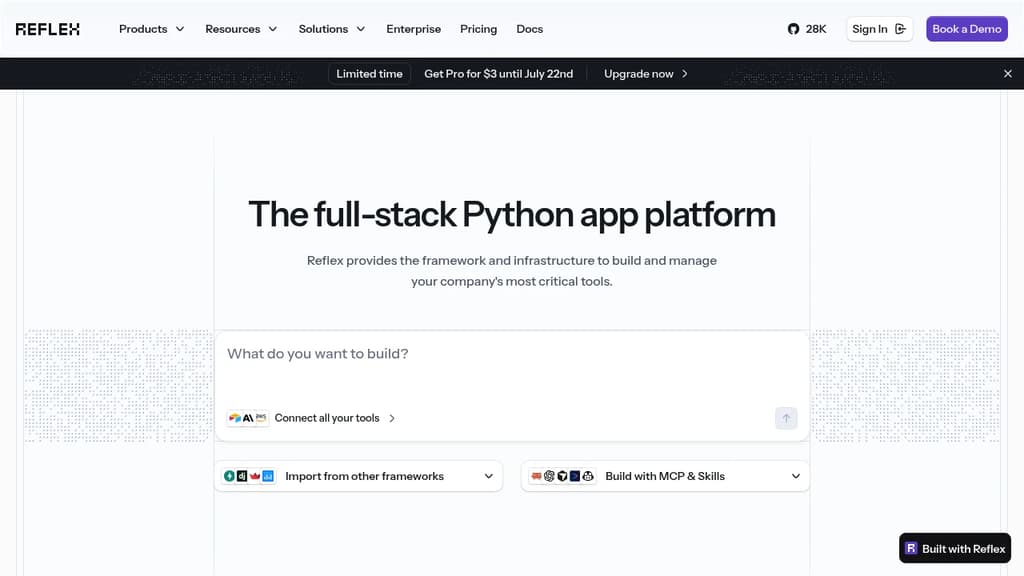
Reflex is a full-stack Python platform for teams building internal tools and customer-facing web apps. The pitch is simple: write everything in Python, skip the JavaScript ecosystem entirely, and deploy to any cloud without stitching together separate tools for frontend, backend, and infrastructure.
It's aimed at backend engineers, data scientists, and ML teams who have strong Python skills but don't want to context-switch into React or manage a separate frontend codebase. Several Fortune 500 companies use it in production, and the open-source community has built a large number of apps on it.
Key capabilities:
- AI app builder – Describe what you want and Reflex generates a tested, production-ready Python app. The output is real code you can edit, not a black box.
- Full-stack framework – One language covers UI components, state management, and backend logic. No separate frontend/backend split.
- Deploy anywhere – Ship to AWS, GCP, Azure, or bare metal with a single command. Supports on-prem, VPC, and fully air-gapped deployments.
- Enterprise integrations – Works with private PyPI registries, Postgres, Databricks, and internal Python packages your team already uses.
- Security – SOC 2 certified, supports HIPAA-compliant deployments, Apache 2.0 licensed. You own everything you build.
- MCP + Skills agent toolkit – Apps are built to work with both human users and AI agents.
For teams coming from Streamlit or similar tools, Reflex handles the cases where lightweight frameworks break down: large-scale data (users report ingesting 100GB+ daily), complex UI requirements, and multi-team production deployments. It's also a credible alternative to internal tool builders that lock you into proprietary abstractions.
If you've evaluated AI-assisted builders like Bolt.new but need something that stays in Python and integrates with your existing data infrastructure, Reflex sits in a different category. The framework is open source; the managed platform adds deployment, monitoring, and team management on top.

Create full-stack AI applications using any model or tool. Run entirely on your machine with complete privacy, flexibility, and control over your code.
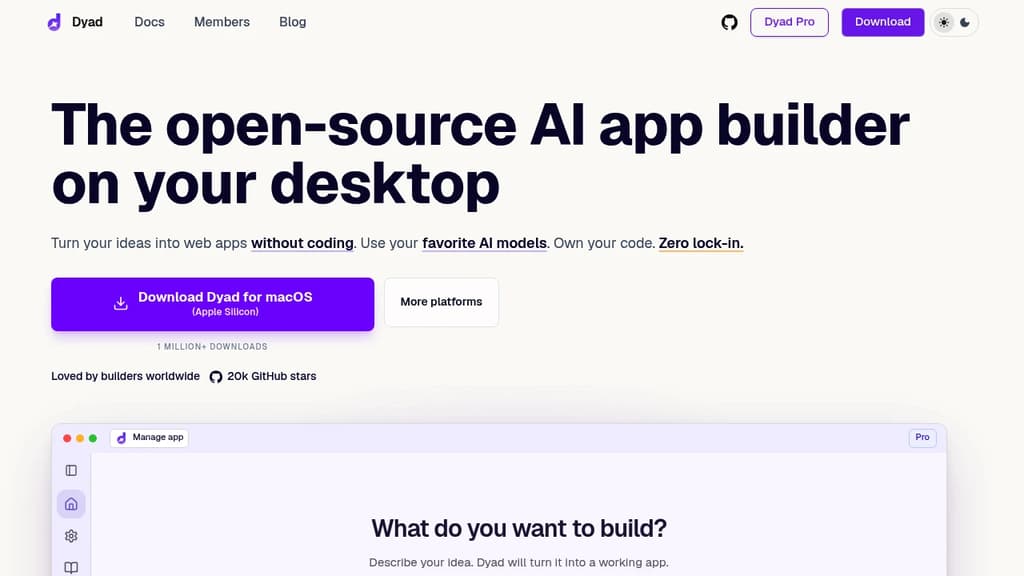
Build unlimited AI apps without vendor restrictions using this powerful local development platform. Downloaded over 1 million times, Dyad offers complete freedom to use any AI model including GPT-5, Claude Sonnet 4.5, and Gemini 3 with your own API keys.
Complete local control means your source code never leaves your machine. Work with your preferred IDE like VS Code or Cursor while enjoying instant, responsive interactions and real-time preview capabilities. No more frustrating differences between cloud builders and local development environments.
Full-stack capabilities let you build more than just UI components. Create complete applications with built-in Auth, Database, and Server Functions - all within Dyad's integrated environment.
Key benefits include:
- Zero lock-in policy - switch models and tools freely
- Privacy-first approach - everything runs locally on your machine
- Seamless workflow integration - works with existing development tools
- Free tier available - no sign-up required to get started
- Open-source foundation - community-driven development and improvements
Whether you're a seasoned developer or AI enthusiast, Dyad provides the flexibility to build sophisticated applications while maintaining complete ownership of your code and data. The platform supports both free local models for maximum privacy and cloud-based models for enhanced capabilities.

Open-source answer engine that dynamically generates UI components while providing AI-powered responses, combining conversational AI with interactive interfaces.
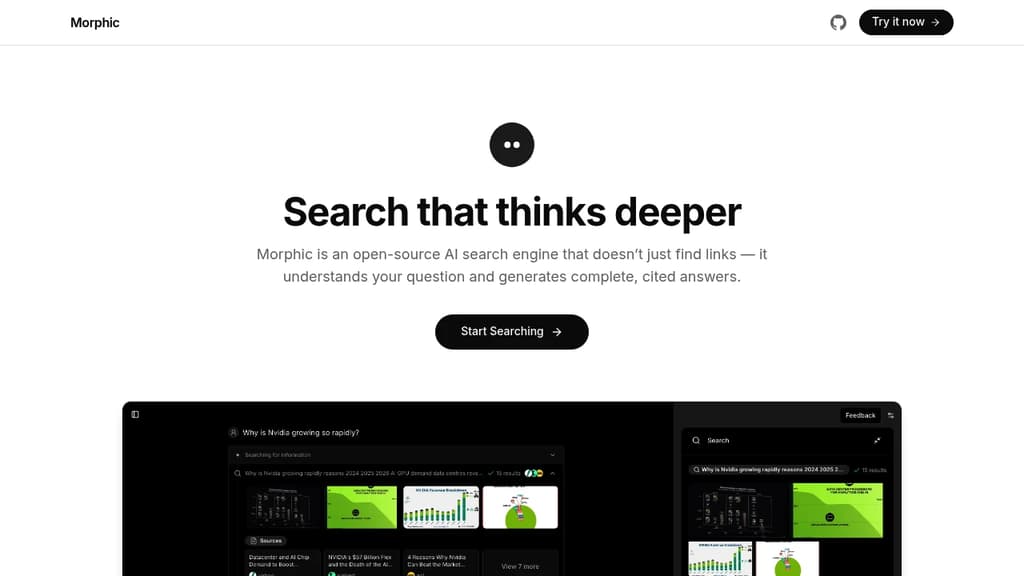
Morphic revolutionizes the way users interact with AI systems by dynamically generating user interfaces as part of its response mechanism. This open-source answer engine goes beyond traditional chatbot interactions by creating contextual UI elements that enhance the user experience.
Key capabilities:
- Generates custom UI components on-the-fly based on user queries
- Provides AI-powered responses with interactive elements
- Handles diverse query types from quick searches to complex analysis
- Creates visual summaries and interactive displays
- Supports both conversational and structured data interactions
The system excels at adapting its interface to match user needs, whether it's displaying comparative analyses, generating charts, or presenting document summaries. Its open-source nature allows for community contributions and customizations, making it a versatile tool for developers and end-users alike.

People are looking for alternatives to...
View all alternatives
Spotify

Claude Code

Claude

CapCut

Notion

Lovable
 InfluxDB – The purpose-built time series platform for high-velocity ingestion and real-time queries at scale.
 Sent
Sent