The best open source alternative to Reflex is Pythagora. If that doesn't suit you, we've compiled a ranked list of other open source Reflex alternatives to help you find a suitable replacement. Other interesting open source alternatives to Reflex are: Dyad and CodinIT.dev.
Reflex alternatives are mainly AI App & Website Builders but may also be AI Coding Assistants or Development Environments. Browse these if you want a narrower list of alternatives or looking for a specific functionality of Reflex.
AI development platform that builds React and Node.js apps inside VS Code, with 14 specialized agents handling planning, coding, debugging, and one-click deployment.

Pythagora is an AI development platform that runs as a plugin inside VS Code or Cursor. Give it a plain-language description of what you want to build, and 14 specialized agents handle the rest: planning the architecture, writing React front-end code, building a Node.js backend, connecting databases (MongoDB, PostgreSQL, MySQL), and deploying the finished app. It's designed to go further than tools that hand you a rough prototype and leave the hard parts to you.
The back-end debugging layer is one of the more concrete differentiators. When something breaks, Pythagora tracks task flows, inspects dependencies, suggests fixes, and re-runs failed jobs automatically. You get error logs and step-through debugging, not a blank error message and a forced rebuild from scratch.
The platform targets small teams, startups, and businesses that want custom internal tools or production apps without building everything by hand. A free tier is available. Pro and Premium plans start at $49/month, with custom Enterprise options for larger organizations.
A few things worth knowing about scope and ownership:
The template library shows what it handles in practice: CRM pipelines, OKR trackers, employee onboarding flows, GitHub analytics dashboards, documentation sites with AI chat, and prompt management tools. These are real internal tools with auth, permissions, email notifications, and external API integrations, not toy demos.
If you're comparing options, Replit takes a browser-based approach rather than living inside your editor, while tools like Plandex or Dyad focus on different parts of the AI coding workflow. Pythagora's angle is the full pipeline from description to deployed app, inside the editor you're already using. Backed by Y Combinator and reported to have over 80,000 users.
Looking for open source alternatives to other popular services? Check out other posts in the alternatives series and openalternative.co, a directory of open source software with filters for tags and alternatives for easy browsing and discovery.
Create full-stack AI applications using any model or tool. Run entirely on your machine with complete privacy, flexibility, and control over your code.
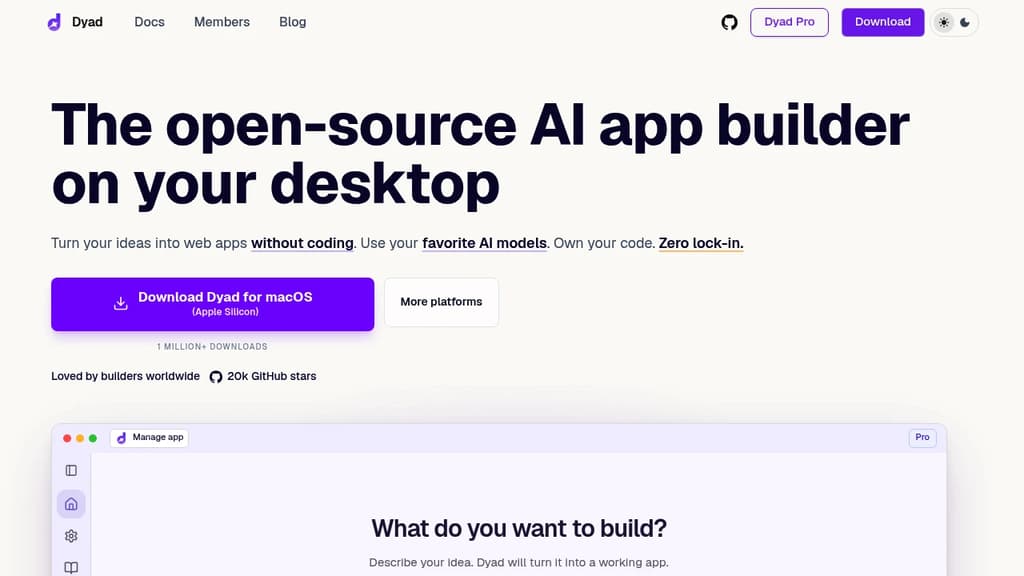
Build unlimited AI apps without vendor restrictions using this powerful local development platform. Downloaded over 1 million times, Dyad offers complete freedom to use any AI model including GPT-5, Claude Sonnet 4.5, and Gemini 3 with your own API keys.
Complete local control means your source code never leaves your machine. Work with your preferred IDE like VS Code or Cursor while enjoying instant, responsive interactions and real-time preview capabilities. No more frustrating differences between cloud builders and local development environments.
Full-stack capabilities let you build more than just UI components. Create complete applications with built-in Auth, Database, and Server Functions - all within Dyad's integrated environment.
Key benefits include:
Whether you're a seasoned developer or AI enthusiast, Dyad provides the flexibility to build sophisticated applications while maintaining complete ownership of your code and data. The platform supports both free local models for maximum privacy and cloud-based models for enhanced capabilities.

Build, deploy, and own full-stack web apps using AI prompts. Supports 19+ AI providers, Postgres, auth, storage, and serverless functions out of the box.

CodinIT.dev is an AI app builder aimed at indie hackers and solo developers who want to go from a single prompt to a production-ready web app without getting trapped in a proprietary ecosystem. You own the generated code, deploy wherever you want, and aren't tied to one AI provider.
The platform bundles everything a full-stack app typically needs:
One notable angle: you can build entirely in Python without touching JavaScript or frontend frameworks. That's a meaningful difference from tools like Bolt.new or Reflex, which either assume frontend knowledge or require a specific stack. CodinIT supports up to 10 frameworks and over 500 AI models across 19+ providers.
The build experience accepts screenshots, video, and Figma designs as input alongside text prompts, so you can describe what you want visually. It also includes a testing mode that simulates real user interactions to catch bugs before you ship.
Deployment is one click, and because the code is yours, you can take it elsewhere at any time. No credit card is required to start, and the platform is fully open source. For developers who've felt burned by the lock-in of hosted Replit-style tools, that combination of full ownership and broad AI provider support is the main draw.