Open Source Redis Alternatives
A curated collection of the 2 best open source alternatives to Redis.
The best open source alternative to Redis is Dragonfly. If that doesn't suit you, we've compiled a ranked list of other open source Redis alternatives to help you find a suitable replacement. Other interesting open source alternative to Redis is SlateDB.
Redis alternatives are mainly In-Memory Databases but may also be NoSQL & Document Databases. Browse these if you want a narrower list of alternatives or looking for a specific functionality of Redis.

Written by Piotr Kulpinski


Dragonfly is a high-performance, Redis-compatible in-memory data store that delivers up to 25x more throughput and 80% lower costs than legacy solutions.
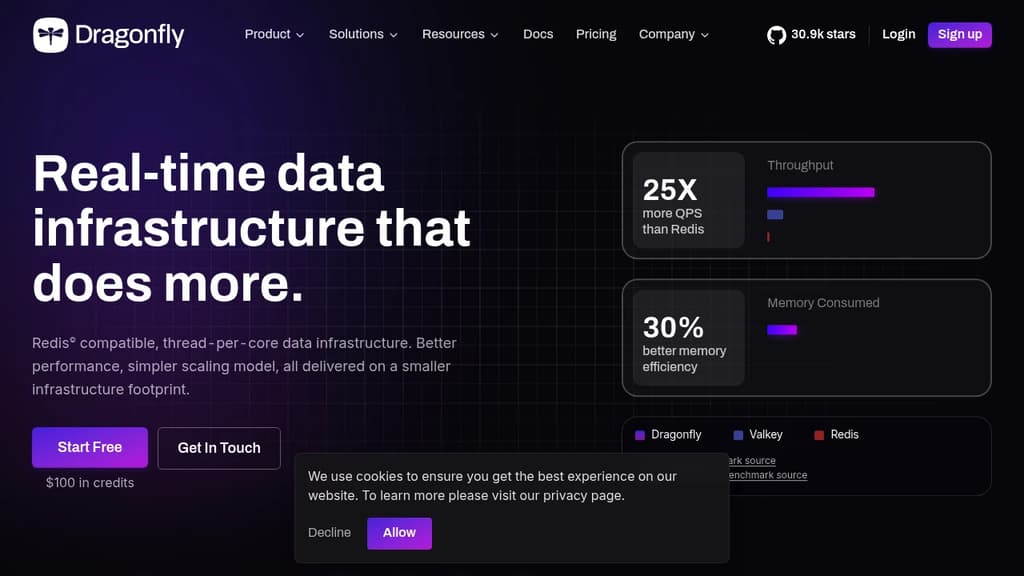
Dragonfly is a cutting-edge in-memory data store designed to meet the demanding performance and efficiency requirements of modern cloud-based applications. As a drop-in replacement for Redis, Dragonfly offers seamless integration while providing significant advantages:
- Unparalleled Performance: Achieve up to 25x more throughput compared to legacy in-memory data stores, with 3.9 million QPS per instance.
- Cost Efficiency: Reduce infrastructure costs by up to 80% through superior compute and memory efficiency.
- Simplified Operations: Scale vertically first, minimizing operational complexity and improving system reliability.
- Full Redis Compatibility: Utilize existing Redis APIs, SDKs, and tooling without code changes.
- Modern Architecture: Optimized for cloud computing with an async core and support for all CPU cores.
- Advanced Features: Benefit from LRFU eviction, Lua 5.4.4 support, and native Open Telemetry integration.
Key benefits of switching to Dragonfly:
- Dramatic Performance Boost: Experience sub-millisecond reads and fully leverage multi-core environments.
- Significant Cost Savings: Require less hardware while achieving improved data performance.
- Operational Simplicity: Enjoy easier scaling and management compared to traditional Redis clusters.
- Improved Reliability: Benefit from a more stable system with smoother failover capabilities.
- Future-Proof Technology: Leverage a database designed for modern cloud infrastructure and workloads.
Dragonfly is trusted by developers from leading companies like Buzzfeed, Ubisoft, Epic Games, and Wayfair. Whether you're looking to enhance performance, reduce costs, or simplify your data infrastructure, Dragonfly offers a powerful solution for high-performance, scalable applications.

SlateDB is an embedded storage engine that leverages object storage for durability, scalability, and simplified replication without the need for disk management.
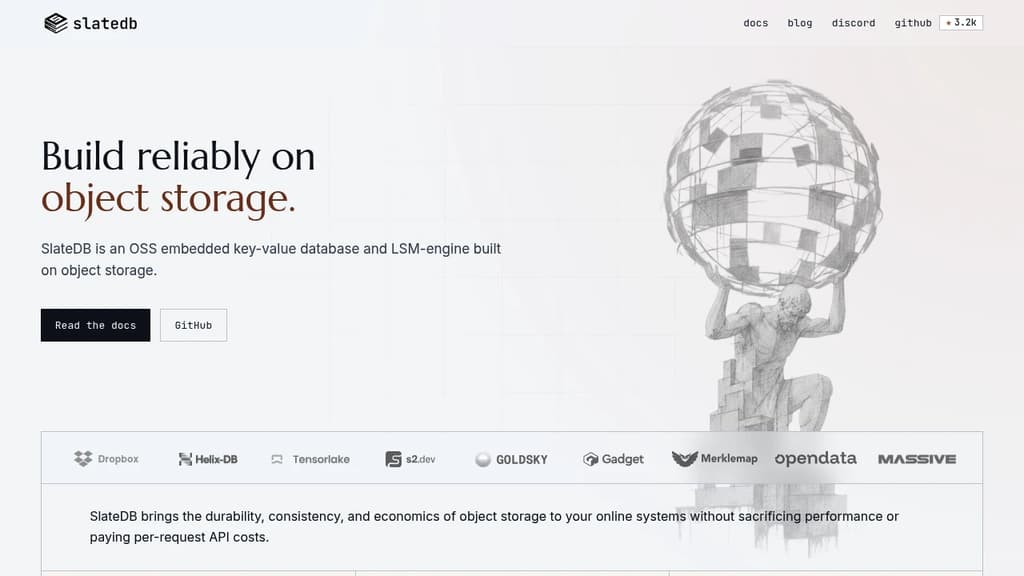
SlateDB is an innovative embedded storage engine that revolutionizes data management by building on top of object storage.
Here are its key features and benefits:
- Object Store Durability: SlateDB inherits the exceptional durability of your chosen object store, offering up to 99.999999999% durability. This ensures your data remains safe and accessible.
- Zero-Disk Architecture: By running without disks, SlateDB eliminates common issues like disk failures and corruption. This design simplifies infrastructure management and reduces hardware-related concerns.
- Simple Replication: SlateDB leverages the underlying object store's replication capabilities, removing the need for complex custom replication protocols. This approach streamlines data distribution and backup.
- Tunable Performance: Configure SlateDB to optimize for your specific needs, whether it's low latency, cost-efficiency, or high durability. This flexibility allows you to balance performance and resources effectively.
- Scalable Readers: Supporting a single writer and multiple readers, SlateDB is designed for concurrent access. It also includes built-in detection and fencing of zombie writers, ensuring data consistency.
- Built in Rust: As an embeddable library written in Rust, SlateDB offers performance, safety, and cross-language compatibility. Use it with your preferred programming language for seamless integration.
SlateDB simplifies database management by abstracting away many low-level concerns, allowing developers to focus on building their applications rather than managing infrastructure. Its design makes it particularly suitable for cloud-native applications, distributed systems, and scenarios where durability and scalability are crucial.

People are looking for alternatives to...
View all alternatives
Spotify

Claude Code

Claude

CapCut
Notion

Lovable
 CodeRabbit – The leading AI Code Review platform. Ship better quality code in 50% less time, with 90% fewer bugs.
 Stellar Hosted