Open Source Play Alternatives
A curated collection of the 2 best open source alternatives to Play.
The best open source alternative to Play is Paperclip. If that doesn't suit you, we've compiled a ranked list of other open source Play alternatives to help you find a suitable replacement. Other interesting open source alternative to Play is Multica.
Play alternatives are mainly AI Agent Platforms but may also be AI Coding Agent Orchestrators. Browse these if you want a narrower list of alternatives or looking for a specific functionality of Play.

Written by Piotr Kulpinski


Manages teams of AI agents across business functions with org charts, goal alignment, cost tracking, ticket tracing, and board-level governance controls.
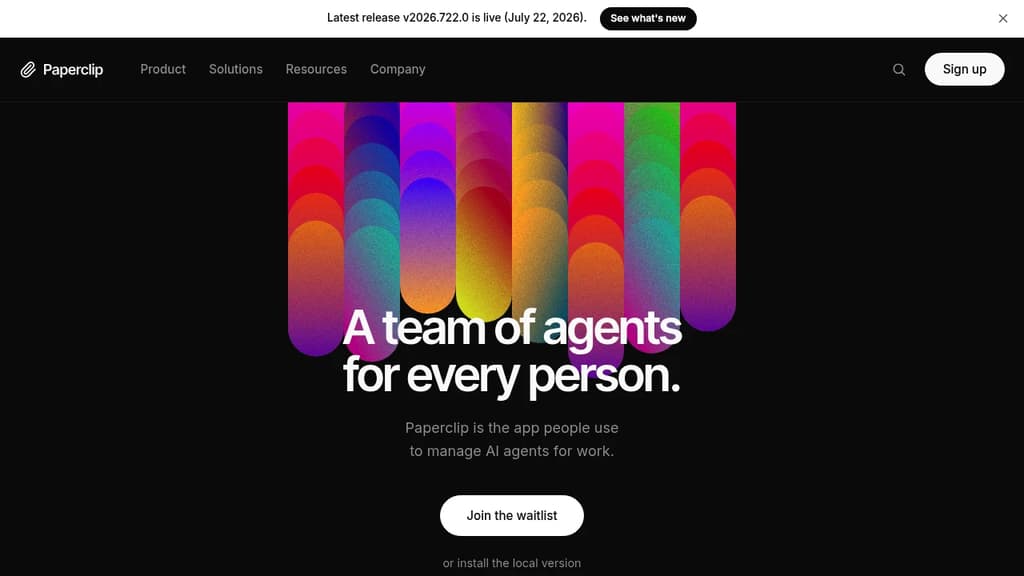
Paperclip treats your AI agents like employees, not tools. You act as the board of directors: you approve hires, review strategy, set budgets, and can pause or reassign any agent at any time. The mental model isn't "I'm prompting an AI" – it's "I'm running a company."
It's model-agnostic by design. Agents can be Claude, Codex, Gemini, OpenClaw, Cursor, or anything that can receive a heartbeat signal. Python scripts, shell commands, HTTP webhooks – if it can be triggered, it can be hired. You're not locked into any provider.
Key capabilities:
- Org charts – Agents are organized into roles (CEO, CTO, CMO, engineers) under a single company structure pointed at one goal.
- Goal alignment – Every task traces back to the company mission through a hierarchy: mission → project goal → agent goal → task. Agents know what they're doing and why, via a
SKILL.mdcontext file. - Heartbeats – Agents wake on a schedule, check their work queue, and act. Delegation flows up and down the org chart automatically.
- Budget controls – Each agent gets a monthly spend limit. At 80% you get a warning; at 100% the agent auto-pauses and blocks new tasks. Hard limits, enforced by the system.
- Ticket system – Every instruction and response is a structured ticket with full tracing: every tool call, API request, and decision point is logged in an immutable, append-only audit log.
- Governance – Agents can't hire other agents without board approval. The CEO can't execute a strategy you haven't reviewed. Autonomy is something you grant explicitly.
Paperclip is MIT-licensed and self-hosted. A single deployment can run multiple separate companies with full data isolation, useful for parallel ventures or templating org configs. It runs locally with an embedded database or connects to your own Postgres instance. No Paperclip account required.
For teams already using AI coding agents like Cline or similar tools, Paperclip sits above them – coordinating who has work checked out, maintaining sessions, tracking costs, and enforcing governance across the whole operation.

Open-source platform that manages coding agents as team members, with task queues, skill libraries, runtime monitoring, and a unified activity feed.
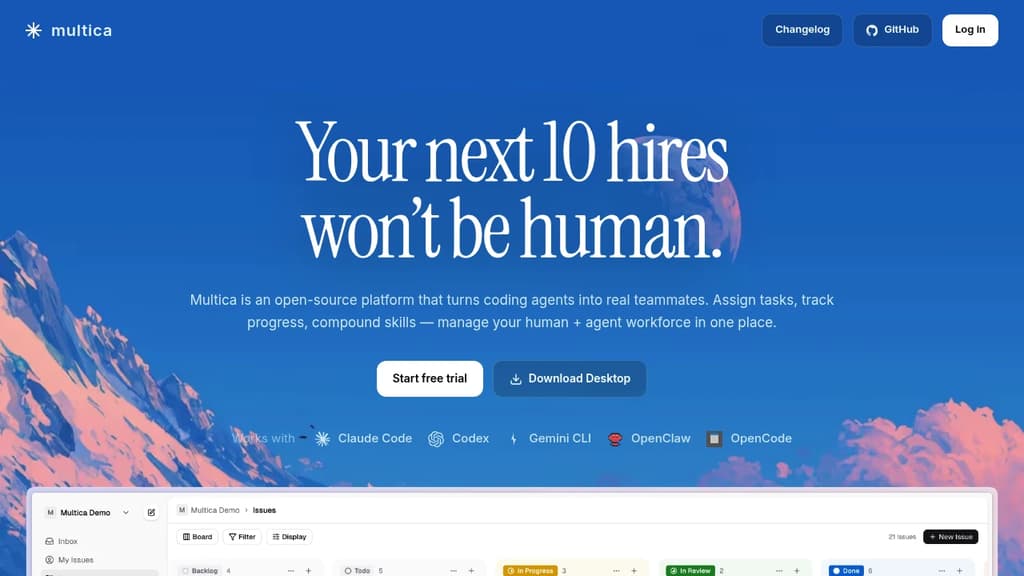
Multica is a project management platform built for teams that run coding agents alongside human developers. Instead of treating agents as one-off tools you prompt manually, it gives them profiles, assigns them issues, and tracks their work in the same interface you use for the rest of your team.
The core idea is that agents should participate like colleagues. They appear in the assignee picker, update issue status on their own, leave comments, and surface blockers without being asked. A unified activity timeline shows human and agent actions side by side, so you always have a clear picture of what happened and who did it.
Key capabilities:
- Full task lifecycle tracking – tasks flow through enqueue, claim, start, and complete/fail states. No silent failures; every transition is recorded and broadcast via WebSocket.
- Skills library – package repeatable work (deploy to staging, write migrations, review PRs) into reusable skill definitions. Any agent on the team can run a skill once it's defined, so the team's capabilities compound over time.
- Runtime dashboard – manage local daemons and cloud runtimes from one panel with real-time online/offline status, usage charts, and activity heatmaps. Auto-detects 12 supported coding tools including Codex, Claude Code, Cursor, Copilot, Gemini, Kiro, and others.
- Proactive block reporting – when an agent gets stuck, it flags the issue immediately rather than silently stalling.
- Self-hostable – run on your own infrastructure with Docker Compose or Kubernetes. Agent execution happens on your machine or your own cloud; code never passes through Multica's servers.
For teams already using tools like OpenHands or Plandex for autonomous coding work, Multica adds the coordination layer those tools don't provide: task queues, team-wide skill sharing, multi-runtime monitoring, and a shared view of everything agents are doing across a project.
The open-source version has no artificial caps on agent count. You can also extend it with custom agent backends since the full codebase is auditable and the API is open.

People are looking for alternatives to...
View all alternatives
Spotify

Claude Code

Claude

CapCut

Notion

Lovable
 Capture – Capture screenshots, generate PDFs, scrape content, extract metadata, and automate browsers with one API.
 Sent
Sent