Open Source Plandex Alternatives
A curated collection of the 2 best open source alternatives to Plandex.
The best open source alternative to Plandex is OpenHands. If that doesn't suit you, we've compiled a ranked list of other open source Plandex alternatives to help you find a suitable replacement. Other interesting open source alternative to Plandex is Cline.
Plandex alternatives are mainly AI Coding Agents but may also be AI Assisted Coding Tools. Browse these if you want a narrower list of alternatives or looking for a specific functionality of Plandex.

Written by Piotr Kulpinski


AI agent platform that runs autonomous coding agents to plan, write, and ship changes across codebases end-to-end, with support for any model and self-hosted deployment.
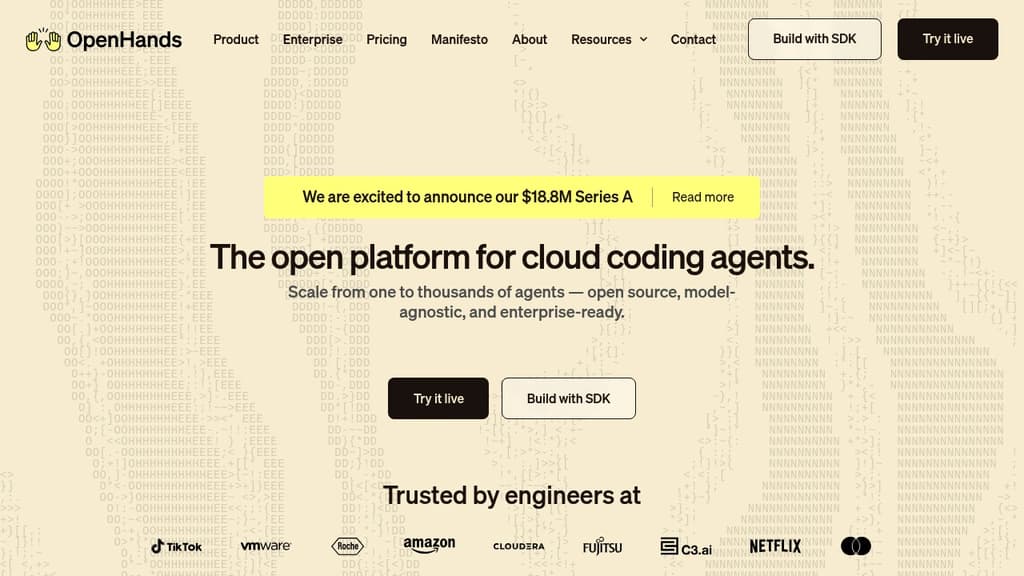
OpenHands is an AI agent platform built for software teams that need more than code suggestions. Instead of autocompleting lines in an editor, it runs autonomous agents that plan, execute, and ship changes across entire codebases. Think: open a GitHub issue, an agent investigates, writes the fix, runs tests, and opens a pull request for review.
It's model-agnostic by design. You can point it at any LLM, swap models as needs change, and integrate it into existing CI/CD pipelines without rearchitecting your workflow. For teams already using self-hosted developer infrastructure, it fits naturally into that setup.
Key capabilities include:
- Vulnerability remediation: Scans repositories, patches security issues, and opens reviewable PRs automatically
- PR review automation: Reviews pull requests for quality, security, and best practices
- Legacy migration: Migrates COBOL systems to Java with testing and validation built in
- Incident triage: Investigates production errors, traces root causes, and posts actionable debugging summaries
- Test coverage expansion: Generates and maintains tests for new features to catch regressions before they ship
- Parallel execution: Runs thousands of agent tasks simultaneously, not just one at a time
The platform runs inside isolated Docker or Kubernetes environments. Your code stays in your environment, on-prem or private cloud, with full auditability over every agent action and artifact. That matters for teams with strict compliance requirements.
A Large Codebase SDK handles dependency mapping across complex systems, letting multiple agents work in parallel without creating conflicts. This makes it practical for large legacy codebases that most AI tools struggle with.
Teams can interact with OpenHands through a web UI, CLI, or SDK. It integrates directly with GitHub, GitLab, Slack, and standard ticketing tools, so agents can be triggered from wherever work already happens. Developers building their own AI-powered tooling can embed the SDK into custom workflows.
OpenHands has accumulated over 75,000 GitHub stars and an active contributor community. The open-source foundation means full visibility into how agents behave, which is a meaningful difference from closed-source alternatives.
Looking for open source alternatives to other popular services? Check out other posts in the alternatives series and openalternative.co, a directory of open source software with filters for tags and alternatives for easy browsing and discovery.

AI coding agent that runs inside VS Code and the terminal, supporting multi-file edits, bash execution, and any LLM provider via bring-your-own-key.

Cline is an open-source AI coding agent that works inside VS Code and the command line. It reads and edits files across a project, runs terminal commands, reacts to their output in real time, and handles long-running processes like dev servers or test suites.
The Plan/Act mode split lets you discuss a strategy with the agent before it touches any code, then switch to Act mode when you're ready to execute. Every step is approvable, or you can enable auto-approve for unattended runs.
Model choice is unrestricted. Claude, GPT, Gemini, local Ollama or LM Studio instances, and any OpenAI-compatible endpoint all work. You bring your own key or your own weights.
For teams, Cline supports multi-agent setups where a coordinator delegates to specialist agents with their own tools and context windows. It also connects to Slack, Discord, Telegram, and Linear, and runs headlessly inside GitHub Actions or GitLab pipelines. Tools like Roo Code and OpenHands take a similar multi-agent approach if you want to compare.
.clinerules files let you ship coding standards, architecture guidelines, and deployment conventions alongside your repo so the agent follows project-specific rules consistently.
Extensibility comes through the SDK and MCP server support, which lets you register custom tools and connect to databases, APIs, or infrastructure. The project is Apache 2.0 licensed with 250+ contributors.
 Stellar Hosted
People are looking for alternatives to...

 Stellar Hosted – Managed Open Source software hosting in the EU: secure, compliant, fast.