Open Source MuleSoft Alternatives
A curated collection of the 2 best open source alternatives to MuleSoft.
The best open source alternative to MuleSoft is Apache APISIX. If that doesn't suit you, we've compiled a ranked list of other open source MuleSoft alternatives to help you find a suitable replacement. Other interesting open source alternative to MuleSoft is Fusio.
MuleSoft alternatives are mainly API Infrastructure Tools. Browse these if you want a narrower list of alternatives or looking for a specific functionality of MuleSoft.

Written by Piotr Kulpinski


Apache APISIX is an open-source API gateway built on NGINX and etcd, offering dynamic routing, 100+ plugins, load balancing, authentication, and traffic management for APIs and LLM workloads.
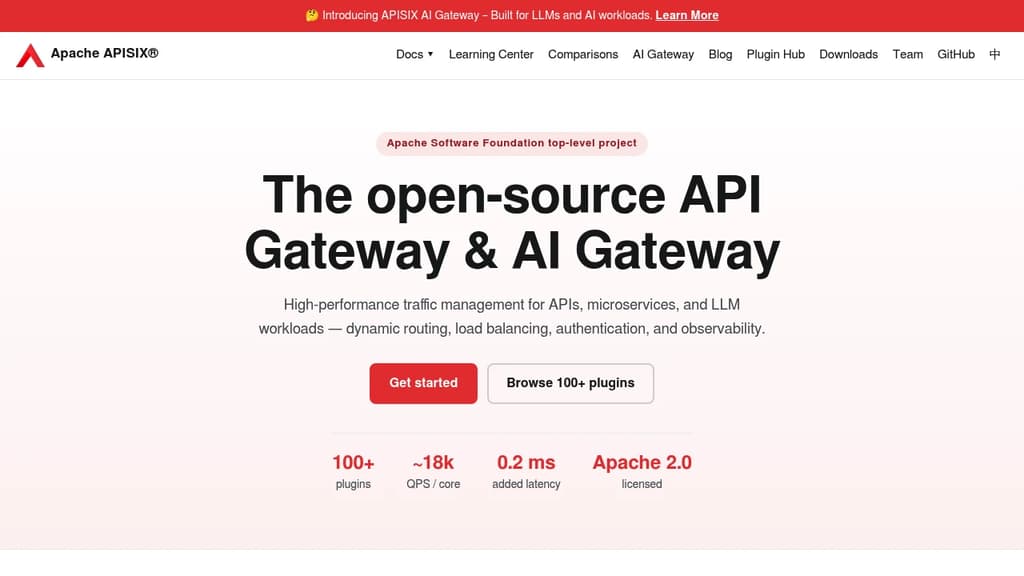
Apache APISIX is a high-performance, open-source API gateway designed for teams running microservices, APIs, and increasingly, AI workloads. Built on NGINX and etcd, it handles roughly 18,000 requests per second per core with around 0.2ms added latency. That's not a marketing claim – it's a product of its radixtree route matching and plugin architecture.
The gateway is fully dynamic. Configuration changes propagate across the cluster via etcd in real time, with no restarts required. Plugins hot-reload, routes update live, and health checks run continuously. For teams that need to iterate quickly without downtime, this matters.
Key capabilities include:
- 100+ plugins covering authentication (JWT, Key Auth, OIDC, Keycloak), rate limiting, CORS, circuit breaking, and observability integrations
- LLM traffic management – proxy and govern requests to 20+ providers including OpenAI, Anthropic, AWS Bedrock, DeepSeek, and Ollama, making it a capable AI gateway alongside tools like LiteLLM or Portkey
- Protocol flexibility – HTTP, gRPC, WebSockets, Dubbo, MQTT, and HTTP-to-gRPC transcoding
- Platform agnostic – runs on bare metal, VMs, Kubernetes, and ARM64 hardware
- Custom extensibility – write your own plugins, load balancing algorithms, and routing logic
Compared to alternatives like Tyk or KrakenD, APISIX leans heavily on its plugin ecosystem and the Apache Software Foundation's governance model. It's a top-level ASF project, Apache 2.0 licensed, with a broad community behind it.
The AI gateway layer isn't a separate product. It's the same routing and plugin infrastructure applied to LLM traffic, which means you get the same observability, security controls, and load balancing for your AI apps that you already run for your REST APIs.

Open source API management platform that exposes databases as REST, routes microservice traffic, handles billing, and generates SDKs across multiple languages.
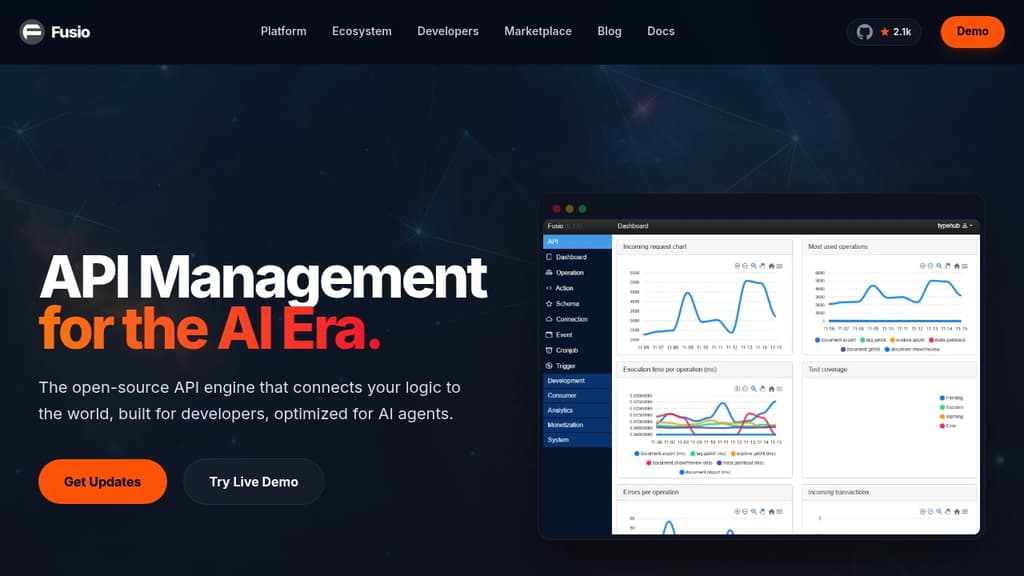
Fusio is a self-hostable API management platform aimed at developers who need to take backend logic and expose it as production-ready APIs. It covers the full lifecycle: from creating and securing endpoints to monetizing them and generating client SDKs automatically.
The platform sits between your data and the outside world. You can point it at an existing SQL or NoSQL database and instantly expose it as a REST API, without writing boilerplate. It also acts as a microservice gateway, handling routing, authentication, and traffic orchestration across services.
Key capabilities include:
- Database API Gateway: expose legacy databases as REST endpoints with minimal setup
- Microservice Gateway: secure and route traffic between internal services
- Analytics & Monitoring: track usage, performance, and errors in real time
- Developer Portal: self-service documentation, API key management, and testing tools for consumers
- API Monetization: manage subscription plans, quotas, and billing directly within the platform
- SDK Generation: automatically produce client libraries in multiple languages
- AI and MCP Integration: connect APIs to AI agents and model context protocol workflows
The AI integration angle sets Fusio apart from tools like Gravitee or Nango. Where those focus on gateway routing or integration syncing, Fusio explicitly targets AI agent consumption, making it practical for teams building on top of LLM frameworks like Langflow or Dify that need structured API access.
Licensed under Apache 2.0, it's built for teams that want full control over their API infrastructure without depending on a managed cloud vendor.

People are looking for alternatives to...
View all alternatives
Spotify

Claude Code

Claude

CapCut

Notion

Lovable
 Sent – Messaging Infrastructure for Developers. One API for SMS, WhatsApp, and RCS across 190+ countries.
 Openlane