Open Source LocalStack Alternatives
A curated collection of the 3 best open source alternatives to LocalStack.
The best open source alternative to LocalStack is Spinifex. If that doesn't suit you, we've compiled a ranked list of other open source LocalStack alternatives to help you find a suitable replacement. Other interesting open source alternatives to LocalStack are: Floci and MiniStack.
LocalStack alternatives are mainly Cloud Emulator Tools but may also be Cloud Computing Services. Browse these if you want a narrower list of alternatives or looking for a specific functionality of LocalStack.

Written by Piotr Kulpinski


Spinifex recreates EC2, S3, EBS, VPC, IAM, and more on your own hardware, so AWS-built software runs unchanged without touching a hyperscaler.
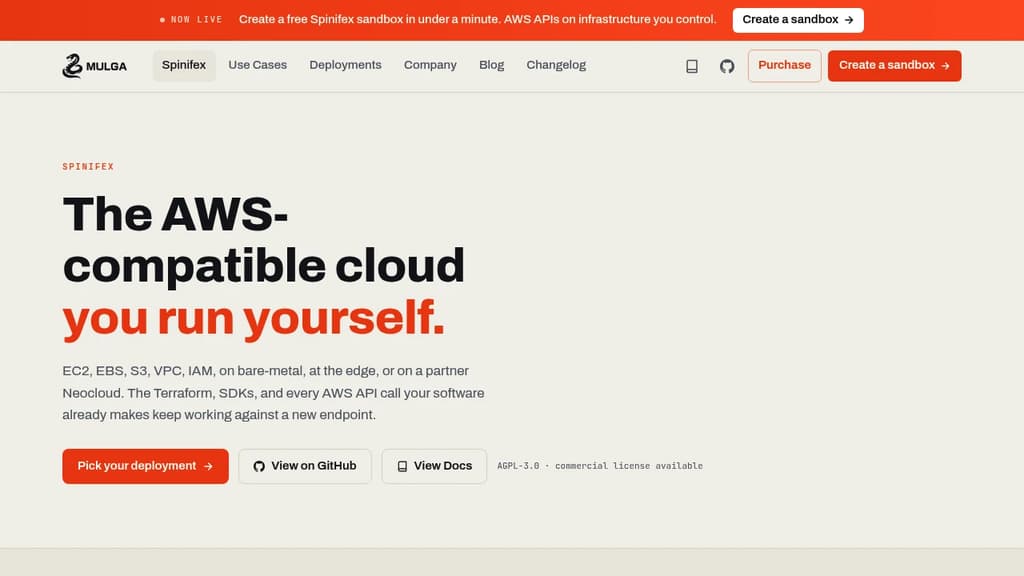
Spinifex is an open-source platform that runs AWS-compatible APIs on infrastructure you own. If your software already talks to EC2, S3, EBS, VPC, or IAM, it keeps working on Spinifex without any code changes. Same AWS SDKs, same Terraform configs, same CLI. You change where the workload runs, not what it is.
The core use case is straightforward: move workloads off hyperscalers, run them on your own racks, at the edge, or on a Neocloud partner, without re-platforming. It's particularly relevant for sectors where data sovereignty, air-gapped deployments, or cost control matter most: defence, healthcare, financial services, energy, and AI/ML teams paying GPU rates to a hyperscaler.
Spinifex didn't just wrap an existing API layer. The engineering underneath was rebuilt from scratch:
- Object storage (S3-compatible): Reed-Solomon erasure coding across nodes for durability without triple-replication costs.
- Block storage (EBS-compatible): Volumes that keep serving when a node drops. Snapshots, attach/detach, and growable volumes included.
- Compute (EC2-compatible): QEMU/KVM on bare metal you own. No hypervisor tax eating into performance.
- Networking (VPC): Built on OVN/OVS.
- Identity (IAM): SigV4 authentication and policy enforcement.
- Kubernetes (EKS): Conformant K8s included in the same stack.
- Container registry and service (ECR/ECS): Available alongside load balancing (ALB/NLB) and managed databases (RDS).
Deployment shapes are flexible. Spinifex runs on a single node, a cluster, an edge box, or an air-gapped rack. The API surface stays the same across all three.
Licensed under AGPL-3.0, the core is auditable and self-hostable. You're not dependent on a vendor's continued goodwill to keep running your own infrastructure.

Run AWS services locally in development and CI without an account, quotas, or feature restrictions. MIT licensed, no telemetry.
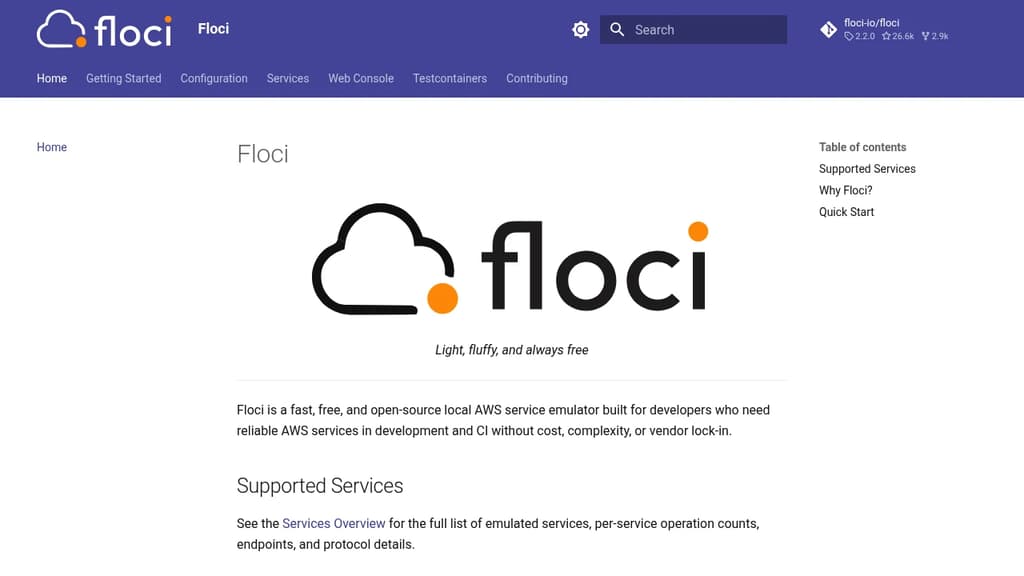
Floci is a local AWS emulator for development, testing and CI. It runs AWS-compatible services on your machine without an AWS account, an auth token or paid feature gates. Point your SDK, the AWS CLI, Terraform, CDK, OpenTofu or your test suite at http://localhost:4566 and keep working as usual.
It's a drop-in replacement for LocalStack: swap the Docker image and your existing setup keeps running. Every service is available to everyone, and there's no paid tier behind the free one.
What it covers:
- Real Docker where fidelity matters. Lambda, RDS, ElastiCache, ECS, EC2, EKS, OpenSearch, MSK and CodeBuild run on real Docker containers, not shallow mocks.
- Standard AWS tooling. Regions, SDKs, CLI commands and infrastructure-as-code workflows work without changes. Terraform provisions resources locally with the standard HashiCorp AWS provider.
- Fast enough for CI. The native image starts in milliseconds and keeps idle memory low.
- Configurable persistence. Pick in-memory, persistent, hybrid or write-ahead log storage.
- Web console. A browser UI at
/_floci/uilets you inspect the resources in your local emulator.
Start it with the Floci CLI (floci start) or a one-service Docker Compose file. Floci is MIT licensed, and the same team builds sibling emulators for Azure, Google Cloud and Oracle Cloud.

MIT-licensed AWS emulator running 60+ services in a single Docker container. Drop-in replacement for LocalStack with real Postgres, Redis, and Docker containers.
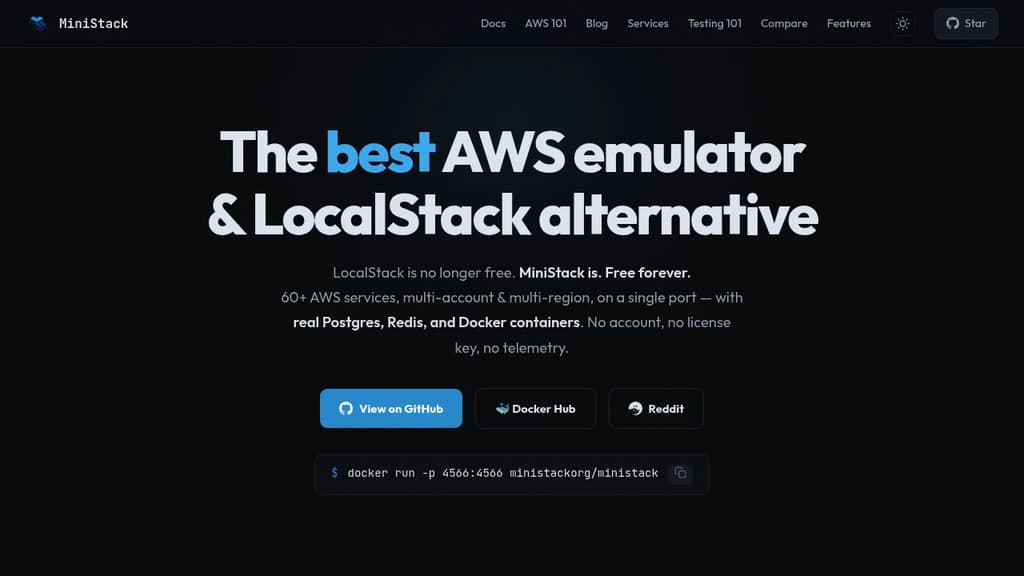
MiniStack is a local AWS emulator that runs 60+ services in a single container on port 4566. It's built as a free, permanent alternative to LocalStack, which moved most of its core services behind a paid plan. No account, no API key, no telemetry. MIT-licensed with no feature gates.
It starts in under 2 seconds, idles at roughly 30MB of RAM, and ships a Docker image around 270MB. Compare that to LocalStack's ~500MB idle footprint and ~1GB image.
What sets it apart is real infrastructure where it counts:
- RDS spins up actual Postgres or MySQL Docker containers you can connect to with any database client
- ElastiCache starts a real Redis or Memcached container, usable as a session store or pub/sub broker
- ECS RunTask pulls and runs real Docker containers via the Docker socket
- Athena executes genuine SQL through DuckDB when installed, returning real result sets from S3 data
- Lambda runs actual Python with warm workers, SQS event source mapping, and Layers support
Services that were Pro-only on LocalStack, including EMR, EBS, EFS, ALB/ELBv2, EC2, Cognito, CloudFormation, and WAF v2, are all free here.
The full list covers S3, SQS, SNS, DynamoDB, IAM, STS, Secrets Manager, CloudWatch Logs and Metrics, SSM, EventBridge, Kinesis, Step Functions, API Gateway v1 and v2, Glue, Firehose, Route53, Cognito, EC2 with full VPC support, ECR, AppSync, CloudFront, Bedrock (with proxy to Ollama or llama.cpp), IoT Core with MQTT over WebSocket, MWAA with real Airflow containers, and more.
SDK and tooling compatibility is broad:
- Works with boto3, AWS CLI, Terraform, CDK, Pulumi, Java SDK v2, and Go SDK v2
- Terraform users point the
awsprovider's endpoints athttp://localhost:4566with no other changes - An official Testcontainers Java module is available on Maven Central for JUnit 5 and Spring Boot setups
- 5,700+ tests pass across Python and Java
Multi-account and multi-region support is included. CloudFormation supports change sets, rollback, and cross-stack export support. Step Functions runs a full ASL engine with sync execution and all state types.
The license is MIT, not BSL. Every service listed is free to use, fork, or embed with no restrictions.

People are looking for alternatives to...
View all alternatives
Spotify

Claude

Claude Code

CapCut

Notion

Lovable
 Stellar Hosted – Managed Open Source software hosting in the EU: secure, compliant, fast.

 Highseat