Open Source Lightpanda Alternatives
A curated collection of the 7 best open source alternatives to Lightpanda.
The best open source alternative to Lightpanda is Firecrawl. If that doesn't suit you, we've compiled a ranked list of other open source Lightpanda alternatives to help you find a suitable replacement. Other interesting open source alternatives to Lightpanda are: Browser Use, Crawl4AI, Skyvern, and ego lite.
Lightpanda alternatives are mainly Browser Automation for AI Tools but may also be Scraping Platforms & SDKs or Web Crawlers. Browse these if you want a narrower list of alternatives or looking for a specific functionality of Lightpanda.

Written by Piotr Kulpinski


API for AI agents to search, scrape, crawl, and interact with the live web, returning clean Markdown, structured JSON, or screenshots from any page.
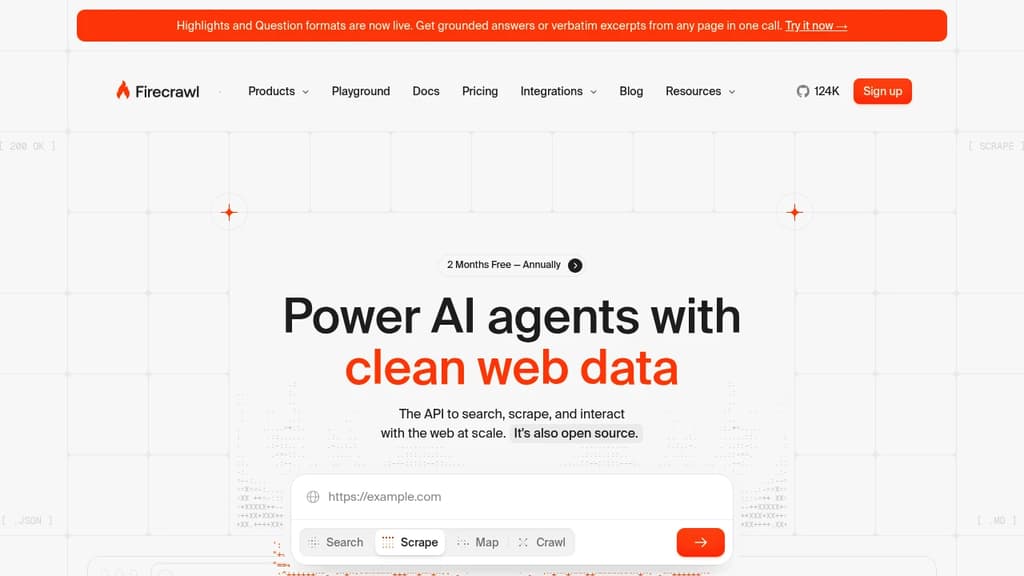
Firecrawl is a web data API built specifically for AI systems. It takes the messy, JavaScript-heavy, human-oriented web and converts it into structured data that agents and LLM pipelines can actually use. Over 80,000 companies rely on it, from indie developers wiring up AI search tools to teams at Apple and Canva running production-scale pipelines.
The three core capabilities work together:
- Search returns full-page Markdown alongside results, so one call goes from a query to usable content without a separate scrape step.
- Scrape handles JavaScript rendering, smart waits, and dynamic content automatically. Pass a URL and get back Markdown, HTML, screenshots, metadata, or structured JSON via a schema you define.
- Interact goes further. It lets agents click, scroll, type, and navigate multi-step flows, reaching data behind logins, pagination, or any sequence of actions a static scrape can't touch.
For browser automation for AI use cases, Firecrawl connects directly to MCP-compatible clients like Cursor, Claude, and Windsurf. There's also a CLI and official SDKs for Python, Node.js, Go, Rust, Java, and Elixir.
Under the hood, it covers 96% of the web with a reported P95 latency of 3.4 seconds across millions of pages. The hosted version adds proprietary infrastructure for proxy management and rendering reliability. The self-hostable version is the largest open source repo in the web crawlers space, with over 100,000 GitHub stars.
Common use cases include deep research agents, RAG pipelines, lead enrichment, competitive intelligence, and price monitoring. The free tier covers 1,000 pages per month, with paid plans scaling to millions of pages for larger workloads.
Unlike scraping tools that stop at raw HTML, Firecrawl parses PDFs and DOCX files, extracts structured data against a JSON schema, and caches results against a growing web index. It's a practical fit for any AI workflow that needs reliable, clean input from the live web.

Python library that lets AI agents browse the web by giving them real browser control, DOM access, and the ability to interact with any website.
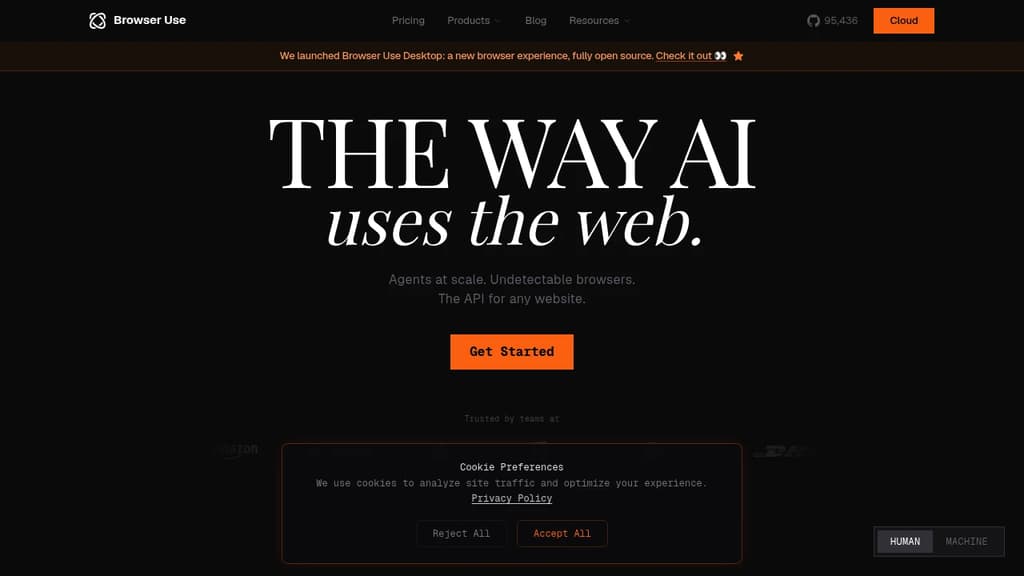
Browser Use is a Python library that connects AI agents to real browsers. Instead of scraping static HTML or working through fragile selectors, agents get full control of a live browser session: they can click, type, scroll, fill forms, handle logins, and extract data from any site, including ones that require JavaScript to render.
It's built for developers building AI-powered automation workflows where the target website doesn't offer an API. Think automating research tasks, filling out multi-step web forms, pulling data from behind authentication walls, or running agents that need to navigate real-world web interfaces.
Key capabilities include:
- Multi-tab support so agents can work across several pages in a single session
- DOM extraction that gives the agent a structured view of what's on the page, not just a screenshot
- Vision support for pages where visual context matters
- Parallel agent execution for running tasks at scale across many browser instances
- Session persistence so agents can maintain state across steps, including cookies and login sessions
- LLM-agnostic design meaning you can wire it to OpenAI, Anthropic, or any other model you're using
Compared to tools like Skyvern or Crawl4AI, Browser Use sits closer to the developer-facing, programmable end of the spectrum. You define the agent's goal in natural language, and the library handles translating that into browser actions. There's no low-code UI; it's code-first and designed to be embedded in larger agent pipelines.
The project has broad adoption, with usage reported across Fortune 500 teams and a large open source community. It pairs well with agent frameworks and can be combined with Firecrawl when you need both structured crawling and interactive browsing in the same workflow.

Open-source web crawler and scraper that produces clean, structured output optimized for LLMs, RAG pipelines, and AI agents. Supports async crawling, CSS/XPath/LLM extraction, and stealth browser control.
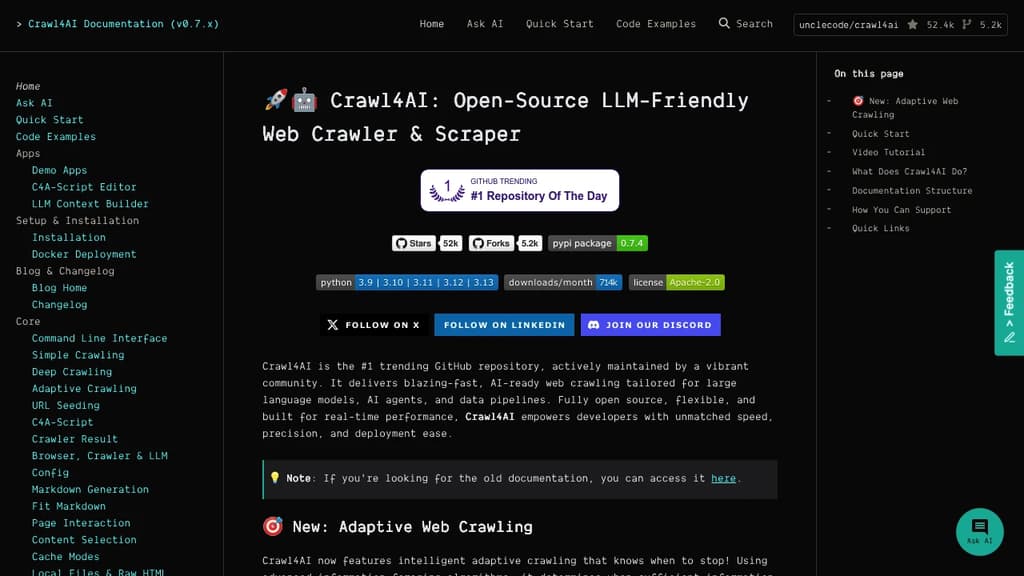
Crawl4AI is a web crawler and scraper built specifically for feeding data into AI pipelines and agents. Where generic scrapers dump raw HTML, Crawl4AI outputs clean Markdown and structured data that LLMs can consume directly, without heavy post-processing.
It's aimed at developers building RAG systems, data pipelines, or AI agents that need reliable, well-formatted web content at scale. The async-first architecture means you can run parallel crawls without blocking, making it practical for real-time use cases.
Key capabilities include:
- Clean Markdown output formatted for direct ingestion into LLMs or AI search tools, with minimal noise
- Structured extraction using CSS selectors, XPath, or LLM-based strategies for pulling repeated patterns from pages
- Adaptive crawling that uses information foraging algorithms to stop once enough data has been gathered to answer a query
- Advanced browser control including hooks, proxies, stealth modes, and session reuse for handling JavaScript-heavy or auth-protected sites
- Chunking and clustering approaches for breaking large pages into digestible pieces before passing to models
- No forced API keys or paywalls – you own the extraction process end to end
Compared to alternatives like Firecrawl or Jina AI, Crawl4AI leans heavily on self-hosting and configurability. You're not routing traffic through a third-party service, and there's no usage metering on the open-source version.
It also ships an AI assistant skill package (compatible with Claude, Cursor, and similar AI coding assistants) that bundles the full SDK reference and ready-to-use extraction scripts, so you can query the docs from inside your editor.
Deployable via pip or Docker, with a Python async API that fits naturally into existing data engineering workflows.

Transform manual browser tasks into automated workflows using AI. Handle complex forms, CAPTCHAs, 2FA, and data extraction across any website at scale.
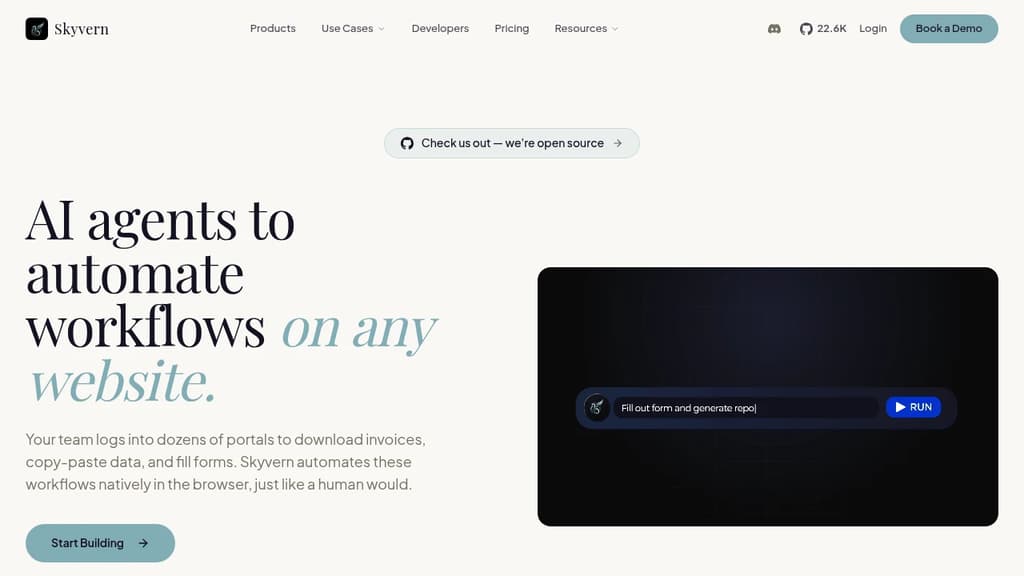
Transform tedious browser-based tasks into intelligent automated workflows that adapt to any website. No more brittle scripts or manual repetition - just describe what you need done in plain English and watch AI handle the complexity.
Key capabilities that set it apart:
- Universal website compatibility - Works on any webpage without custom coding
- Advanced authentication handling - Manages 2FA, CAPTCHA solving, and secure logins
- Intelligent form processing - Fills complex multi-step forms dynamically
- Scalable execution - Run thousands of tasks simultaneously via API
- Data extraction flexibility - Export results in CSV, JSON, or custom schemas
- Explainable AI actions - Full transparency into every automated step taken
Popular use cases include:
- Automated invoice retrieval from vendor portals
- Bulk job applications with personalized submissions
- Contact form filling for outbound campaigns
- Government form completion and submission
- Procurement pipeline automation
- Multi-vendor data collection and comparison
The platform combines computer vision with large language models to understand webpage layouts and execute complex workflows reliably. Proxy network support enables geo-targeted automation, while built-in error handling ensures consistent results across different website structures and updates.

A Chromium-based browser that lets AI agents like Claude Code and Codex run web automation using your real logged-in sessions, without interrupting your browsing.
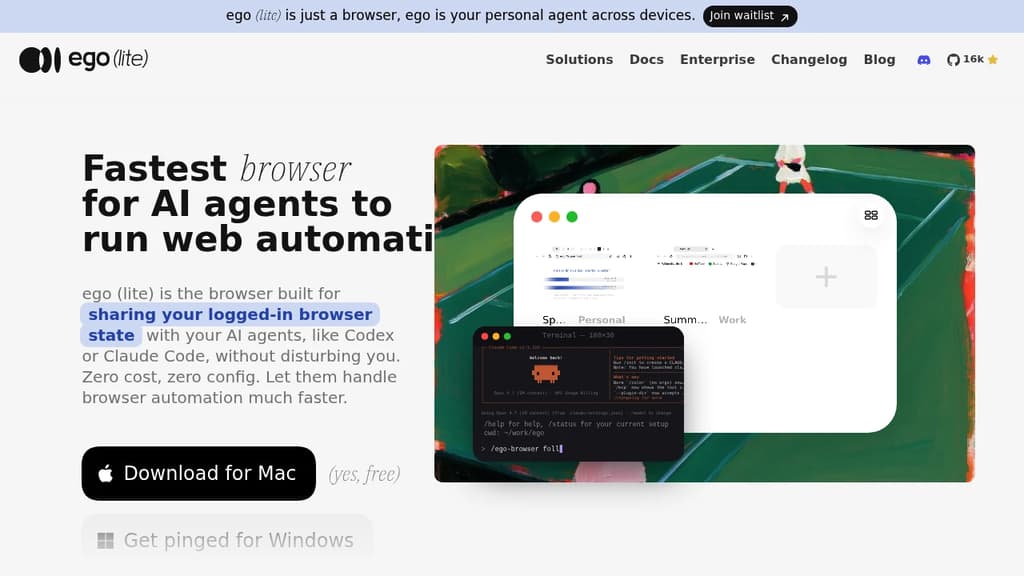
ego (lite) is a Chromium browser designed to be used by both you and your AI agents at the same time. Instead of spinning up a separate headless browser that has no access to your logins, agents like Claude Code, Codex, or Cursor drive ego (lite) directly through a connection layer called ego-browser. They get your real cookies, sessions, and logged-in state from day one.
The core problem it solves: most browser automation for AI tools require a blank browser instance that has to re-authenticate to every service before doing anything useful. ego (lite) skips that entirely by sharing the same Chromium profile you already use daily.
Key capabilities:
- Spaces keep the agent's work isolated from yours. It runs tasks in its own workspace; your tabs stay untouched unless you hand one over.
- Parallel task execution lets multiple agents run separate automation jobs simultaneously, each in its own Space, without colliding.
- Batch JavaScript actions let an agent run several in-page steps in one pass rather than one tool call at a time, cutting token usage and finishing complex tasks up to 3.45x faster than comparable tools.
- Semantic snapshots are generated inside a custom Chromium engine, not a JavaScript shim. They reach into cross-origin iframes, shadow DOM, and third-party widgets like Stripe, Salesforce, and React portals that standard tools miss.
- Chrome migration imports your bookmarks, passwords, extensions, cookies, and tab groups in one click during onboarding.
- No login friction means agents never hit captchas, 2FA prompts, or SSO redirects, because they're already authenticated through your session.
Unlike Browserbase or Anchor Browser, ego (lite) is also your daily browser. You don't run it alongside Chrome; it replaces Chrome. Any agent that can invoke a shell command can drive it through ego-browser, with no SDK to integrate and no model lock-in. All browsing data stays local on your machine.

Open-source browser infrastructure that lets AI agents and automation scripts control cloud browser fleets via a simple API, with built-in CAPTCHA solving and proxy management.
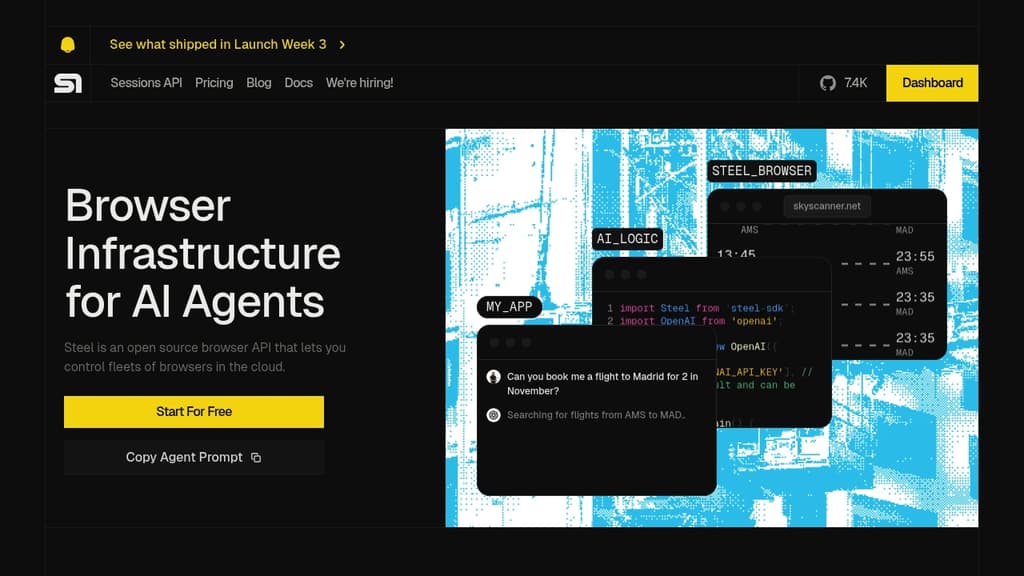
Steel gives AI agents and automation developers a way to run browsers in the cloud without managing infrastructure. It exposes a Sessions API that spins up on-demand browser instances, handles the messy parts of web automation (bot detection, CAPTCHAs, session state), and integrates with tools you're probably already using.
It's built for teams working on browser automation for AI: agents that book flights, scrape data at scale, fill forms, or interact with auth-walled sites. It also fits RPA pipelines, sales automation, QA testing, and foundational model training that requires real web data.
Key capabilities:
- Sessions API spins up browser sessions on demand, with average start times under one second
- Built-in CAPTCHA solving keeps automations running without manual intervention
- Proxy and fingerprint controls reduce the chance of being flagged as a bot
- Context management lets you save and reuse cookies and local storage across sessions, so agents can pick up mid-flow
- Long sessions run up to 24 hours per session
- Session Viewer lets you watch or replay live and recorded sessions for debugging
- Auto sign-in gives agents secure access to sites behind authentication
- One-line migration from local Puppeteer, Playwright, or Selenium to cloud sessions
Steel works with Python, Node.js, Puppeteer, Playwright, and Selenium. It has cookbook examples for pairing with Browser Use, OpenAI's Computer Use, and Claude's Computer Use, making it a practical backend for agent frameworks that need real browser access.
The project is open source. You can self-host it with Docker for local development or run it fully on your own infrastructure. The hosted cloud option is available for teams that don't want to manage the stack themselves, with a free tier included.

Privacy-focused AI browser with intelligent agents for research, analysis, and workflow automation. Features unified memory, compliance guardrails, and seamless integrations.
Browser Operator is an open-source, privacy-friendly AI browser that revolutionizes how professionals work on the web. Unlike traditional browsers, it integrates intelligent AI agents directly into your browsing experience, creating a powerful command center for research, analysis, and automation.
The platform features three core AI agents: Search Agent for finding citable sources across the web, Deep Wide Research for synthesizing content and providing insights, and Workflow Agent for automating repetitive tasks. These agents work seamlessly with your existing tools through MCP integrations, connecting Jira, Confluence, GitHub, Slack, G-Suite, and more.
Key capabilities include:
- Unified Memory System with context graphs that remember what matters across all enterprise tools
- Compliance Guardrails Engine with policy DSL, explain-before-act UX, and line-level audit logs
- Trusted Agent Runtime featuring deterministic scheduling, resource quotas, and multi-agent workflows
- Universal LLM Support for both local and cloud-based models
- Browser-native Integration where AI agents see and interact with your actual workspace
The platform addresses real professional needs: recruiters can source specialized talent across multiple platforms, VC analysts can build targeted startup lists, compliance officers can track regulatory changes, and operations managers can automate inventory notifications. With transparent guardrails and complete audit trails, Browser Operator turns regulatory compliance into a competitive advantage while maintaining the highest privacy standards.

People are looking for alternatives to...
View all alternatives
Spotify

Claude Code

CapCut

Claude

Notion

Lovable
 Sent – Messaging Infrastructure for Developers. One API for SMS, WhatsApp, and RCS across 190+ countries.

 Stellar Hosted