Open Source Letta Alternatives
A curated collection of the 1 best open source alternatives to Letta.
The best open source alternative to Letta is Mem0. If that doesn't suit you, we've compiled a ranked list of other open source Letta alternatives to help you find a suitable replacement.
Letta alternatives are mainly AI Memory & Context. Browse these if you want a narrower list of alternatives or looking for a specific functionality of Letta.

Written by Piotr Kulpinski


Adds persistent, searchable memory to AI agents and apps, so they remember user preferences and past interactions across sessions without pipeline changes.
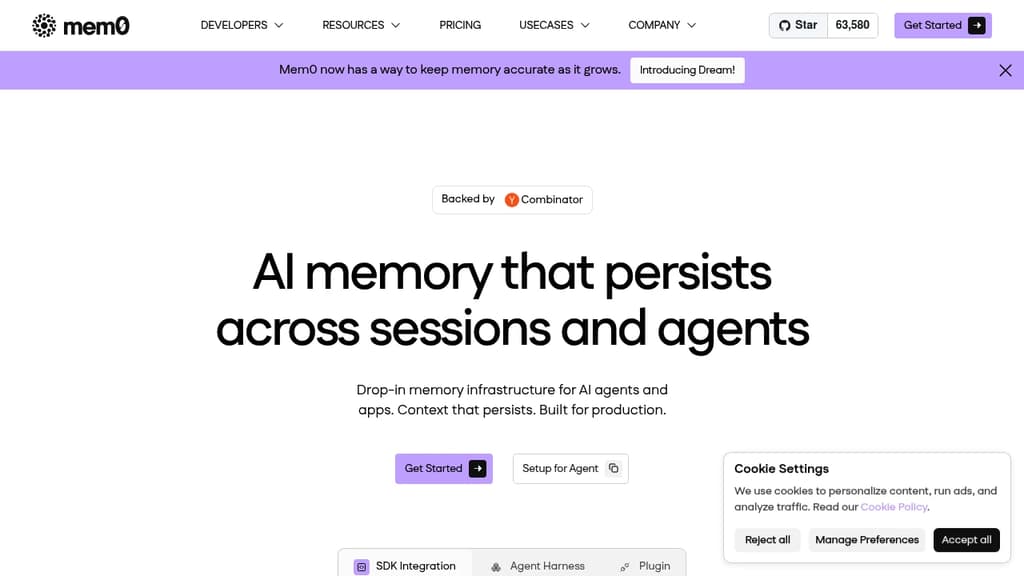
Mem0 is a memory infrastructure layer built for AI agents and applications that need to retain context across sessions. Without something like this, every conversation starts from scratch, forcing developers to stuff redundant history into prompts or lose personalization entirely. Mem0 solves that by extracting, storing, and retrieving memories automatically as users interact.
The core idea is simple: you send messages to Mem0, it learns from them, and later retrieves the relevant context when needed. No boilerplate configuration required. It fits into existing agent architectures without restructuring your pipeline.
Key capabilities include:
- Memory Compression Engine that condenses chat history into compact, token-efficient memories, cutting latency and API costs
- Multi-signal retrieval that surfaces the right memories at the right time, benchmarked on LoCoMo, LongMemEval, and BEAM datasets
- User-scoped memory so each user's preferences, history, and context stay separate and addressable by ID
- Full audit logging with visibility into every read and write, including who accessed what and when
- Flexible deployment across Kubernetes, private cloud, or air-gapped environments with a consistent API
- Compliance at the enterprise level: SOC 2 (Type 1), HIPAA, BYOK, and zero-trust architecture
Mem0 is particularly well-suited for products where personalization compounds over time: healthcare assistants that track patient history, customer support bots that remember past issues, or AI chat interfaces that need to feel consistent across sessions. It also works well as the memory backend for more complex agent frameworks that handle multi-step reasoning but lack native persistence.
Over 90,000 developers use it in production. The SDK supports Python and Node.js, and the managed API makes it easy to get started without self-hosting. For teams that need full control, self-hosted deployment is available with the same API surface.

People are looking for alternatives to...
View all alternatives
Spotify

Claude Code

CapCut

Claude

Notion

Lovable
 Stellar Hosted – Managed Open Source software hosting in the EU: secure, compliant, fast.
 Openlane