Open Source Inngest Alternatives
A curated collection of the 3 best open source alternatives to Inngest.
The best open source alternative to Inngest is Temporal. If that doesn't suit you, we've compiled a ranked list of other open source Inngest alternatives to help you find a suitable replacement. Other interesting open source alternatives to Inngest are: Trigger and Hatchet.
Inngest alternatives are mainly Durable Execution Tools. Browse these if you want a narrower list of alternatives or looking for a specific functionality of Inngest.

Written by Piotr Kulpinski


Open source platform that eliminates infrastructure complexity by handling failures, network issues, and long-running processes to ensure reliable workflow execution
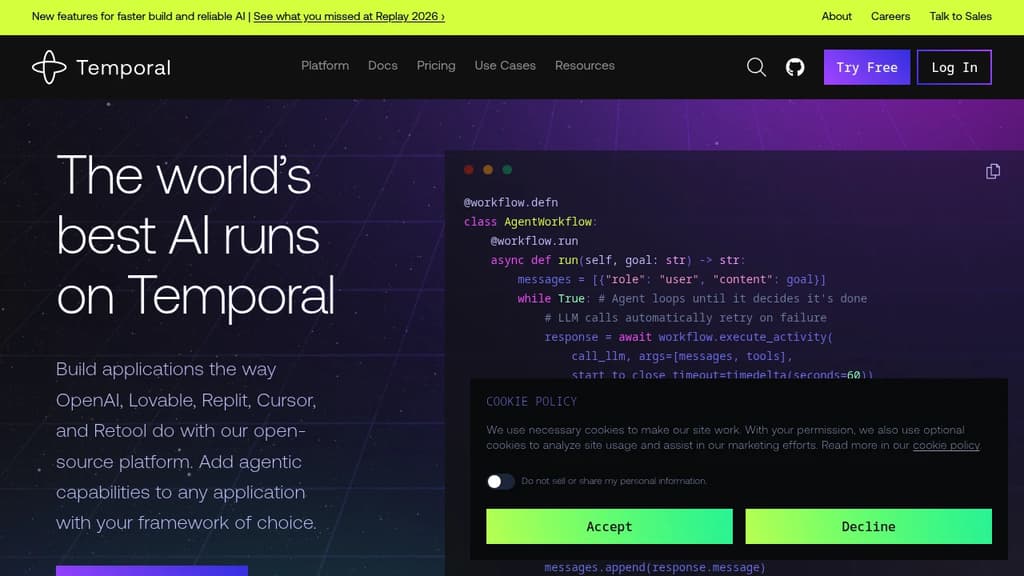
Temporal is a powerful open source platform that transforms how developers build distributed applications. It provides a durable execution system that handles complex infrastructure challenges automatically, allowing developers to focus purely on business logic.
Key benefits include:
- Simplified Development: Write workflow code as if writing a simple program, without worrying about infrastructure failures
- Built-in Reliability: Automatically handles network issues, service outages, and long-running processes
- Complete Visibility: Track execution progress and state of every workflow in real-time
- Language Flexibility: Supports multiple programming languages including Go, Java, PHP, and TypeScript
The platform is trusted by major companies like Snap, Datadog, and Coinbase for critical business processes like payment processing, order management, and infrastructure automation.

Open source TypeScript platform for building and deploying AI agents and background workflows with retries, queues, observability, and elastic scaling.
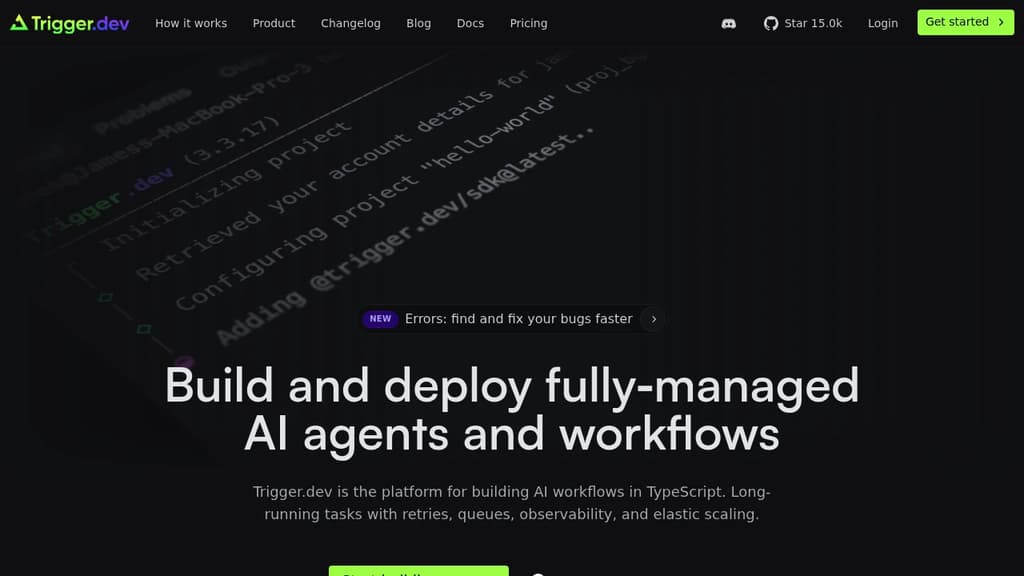
Trigger.dev is a managed platform for running long-running TypeScript tasks in production. It handles the infrastructure so you can write straightforward async code without worrying about timeouts, server provisioning, or queue management.
The core use case is AI workflows and agents. You define tasks that can call LLMs, use tools, process files, or chain multiple steps together. Tasks run with automatic retries, configurable backoff, and full execution logs. If something fails, you can replay individual runs from the dashboard.
Beyond AI, it covers scheduled jobs, media processing, browser automation, email sequences, and ETL pipelines. You can run Python scripts alongside your TypeScript code, add system packages, use FFmpeg for video tasks, or automate browsers with Puppeteer.
Realtime lets you stream task status and LLM responses directly to your frontend as tasks progress, without polling. If you want tracing and observability across LLM calls specifically, tools like OpenLIT or OpenLLMetry cover that layer.
Every run is logged with its inputs, outputs, attempt history, and timing. You can filter runs, apply bulk actions, and set up alerts via email, Slack, or webhooks when tasks fail. Each deploy is versioned atomically, so in-flight tasks aren't disrupted by new code.
Pricing is usage-based. You only pay for actual execution time. It's also Apache 2.0 licensed and self-hostable if you prefer to run it on your own infrastructure. For teams comparing workflow orchestration options, Temporal is a common alternative with a different approach to durability and state.

Durable orchestration platform for managing AI agents, scheduling background tasks, and running mission-critical workflows.
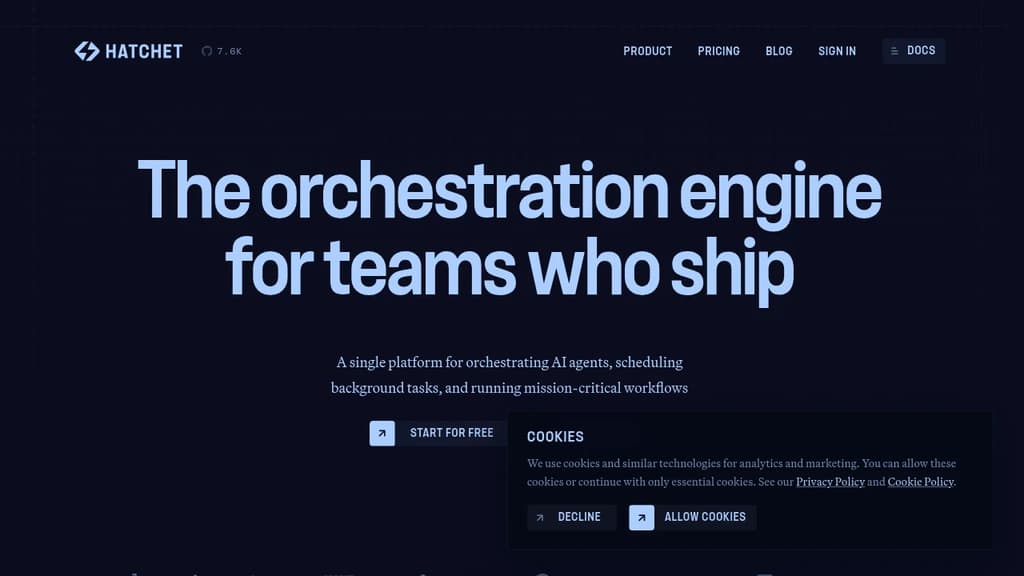
Hatchet is a durable orchestration platform that helps engineering teams build and deploy mission-critical AI agents, durable workflows, and background tasks. It supports applications written in Python, Typescript, Go and Ruby, and can be used as a service through Hatchet Cloud or self-hosting (it's open-source and 100% MIT-licensed). Hatchet provides a full platform for queuing, automatic retries, real-time monitoring, alerting, and logging.
While Hatchet is particularly well-suited for:
- AI agents - Hatchet’s durability features allow agents to automatically checkpoint their current state and pick up where they left off when faced with unexpected errors. Hatchet’s observability features and distributed-first approach are built for debugging long-running agents at scale.
- Massive parallelization - Hatchet is built to handle millions of parallel task executions without overloading your workers. Worker-level slot control allows your workers to only accept the amount of work they can handle, while features like fairness and priorities are built to help scale massively parallel ingestion.
- Mission-critical workloads - everything in Hatchet is durable by default. This means that every task, DAG, event or agent invocation is stored in a durable event log and ready to be replayed at some point in the future.
Whether you're a small startup or a large enterprise, Hatchet provides the tools and flexibility needed to accelerate your development cycles, improve code quality, and maintain robust, scalable cloud infrastructure.

People are looking for alternatives to...
View all alternatives
Claude Code

Spotify

CapCut

Claude

Notion

Lovable
 Sent – Messaging Infrastructure for Developers. One API for SMS, WhatsApp, and RCS across 190+ countries.
 Capture