Open Source HUMAN Security Alternatives
A curated collection of the 1 best open source alternatives to HUMAN Security.
The best open source alternative to HUMAN Security is OneHuman. If that doesn't suit you, we've compiled a ranked list of other open source HUMAN Security alternatives to help you find a suitable replacement.
HUMAN Security alternatives are mainly CAPTCHA & Bot Protection Tools. Browse these if you want a narrower list of alternatives or looking for a specific functionality of HUMAN Security.

Written by Piotr Kulpinski


Detects AI agents using customer credentials, masks private fields, holds risky actions for passkey approval, and signs every decision on your own server.
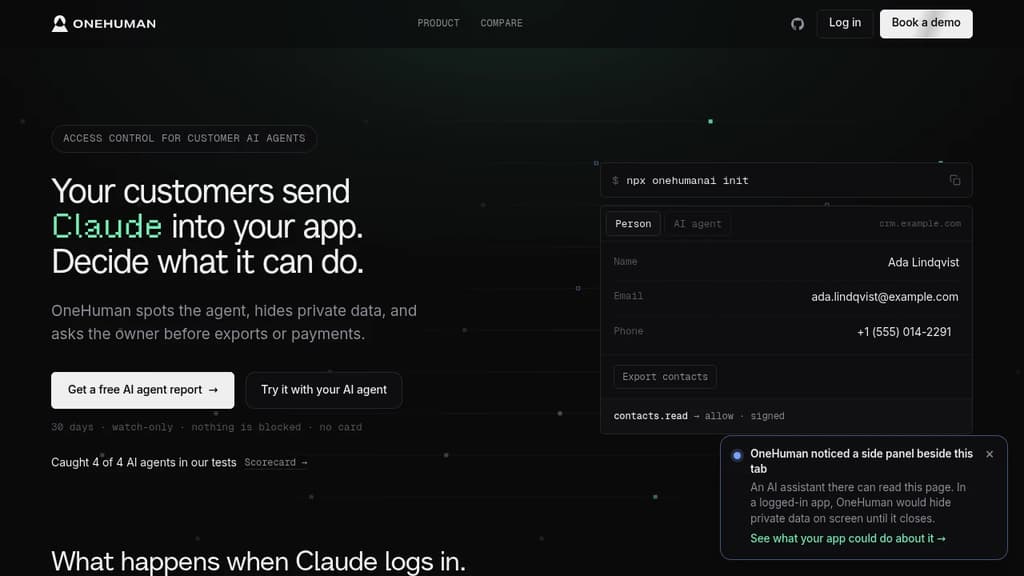
When a customer lets Claude or ChatGPT log into your app using their own credentials, your app can't tell the difference between them and a real user. That agent can read every email address and phone number on screen, export all contacts in one click, and trigger payments without anyone approving it. OneHuman sits inside your app, after login, and decides what those agents can see and do.
It works in three steps before the agent's first click: it spots the agent the moment it attaches to the session, masks private fields like emails, phone numbers and balances into dots, and holds risky actions like exports or payments until the account owner confirms with a passkey. Every decision is signed on your server, giving you a verifiable audit trail.
Who it's for
- B2B SaaS, fintech and banks whose customers already let agents like Claude or Codex act on their behalf inside your product.
- Product, security and fraud teams who need per-action control over what those agents can read or trigger.
- Compliance and audit teams that need a signed record of which actions a real person approved.
- Teams that want self-hosted control: the SDK is Apache-2.0, runs fully on-premises, and no data leaves your network.
It is not a tool for monitoring your own employees' AI use. It controls the agents your customers bring into your product.
This is a different problem from bot protection or HUMAN Security-style traffic filtering. Bot protection works at the door, before login. An agent working with a customer's credentials is already inside. OneHuman works at each action, not at the perimeter.
Key capabilities:
- Agent detection catches agents before their first interaction, without blocking legitimate users.
- Field masking hides private data from agents while keeping the rest of the app functional.
- Passkey gating holds exports and payments until the real account owner approves.
- Signed audit log records every allow, mask or hold decision on your own server.
- Watch-only mode lets you run a 30-day report to see which agents are already in your app before enforcing anything.
Policies are defined per route in a JSON file, so teams can set different rules for reading contacts versus exporting them or updating deals. In internal tests it correctly identified 4 of 4 AI agents, and flagged only 2 of 397 human clicks as uncertain, defaulting to "unknown" rather than blocking.

People are looking for alternatives to...
View all alternatives
Spotify

Claude Code

Claude

CapCut

Notion

Lovable
 Postiz – The All-in-One agentic social media scheduling tool
 Capture