Open Source Guru Alternatives
A curated collection of the 5 best open source alternatives to Guru.
The best open source alternative to Guru is Onyx. If that doesn't suit you, we've compiled a ranked list of other open source Guru alternatives to help you find a suitable replacement. Other interesting open source alternatives to Guru are: Outline, Docmost, Pipeshub, and XWiki.
Guru alternatives are mainly Collaborative Notes & Wikis but may also be Wiki Software or Internal Knowledge Bases. Browse these if you want a narrower list of alternatives or looking for a specific functionality of Guru.

Written by Piotr Kulpinski


An open-source platform that connects to 40+ apps to provide intelligent search and AI assistance across all company information
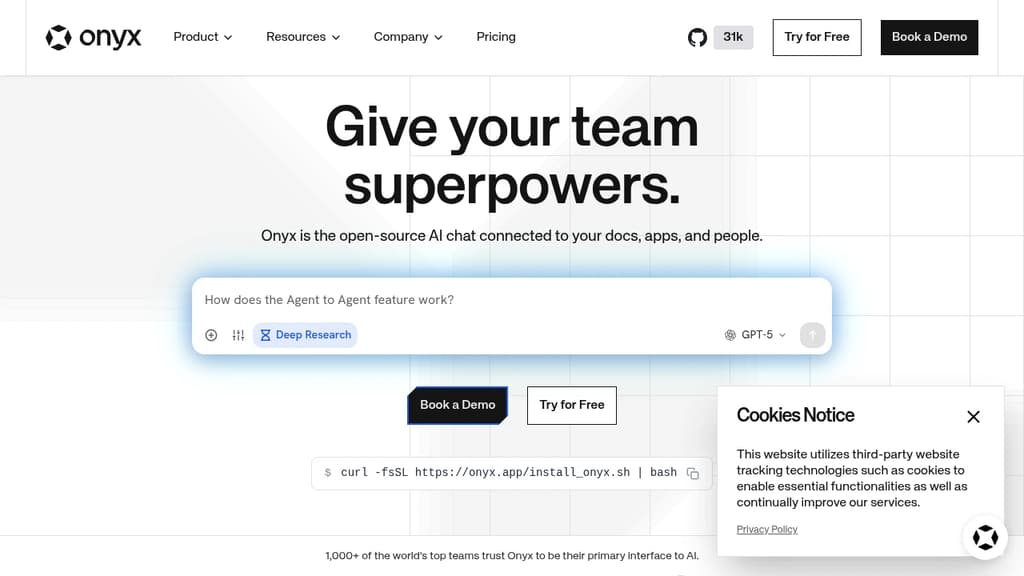
Onyx is a powerful open-source enterprise search platform that transforms how teams find and access information. With seamless integration across 40+ popular business tools like Slack, GitHub, Notion, and Google Workspace, it creates a unified search experience powered by AI.
Key features include:
- AI Workplace Search that helps teams quickly find answers across all connected apps and documents
- AI Assistant capabilities that leverage your organization's knowledge to provide contextual responses
- Developer-friendly APIs for building custom workflows and integrations
- Enterprise-grade security with document-level permissions and optional air-gapped deployment
- Model flexibility allowing you to choose or self-host your preferred AI models
The platform is designed to be highly extensible with modular architecture, making it easy to customize and adapt to your specific needs while maintaining complete control over your data.

Team knowledge base with real-time collaboration, AI-powered search, Slack integration, and self-hosting support for internal docs and wikis.
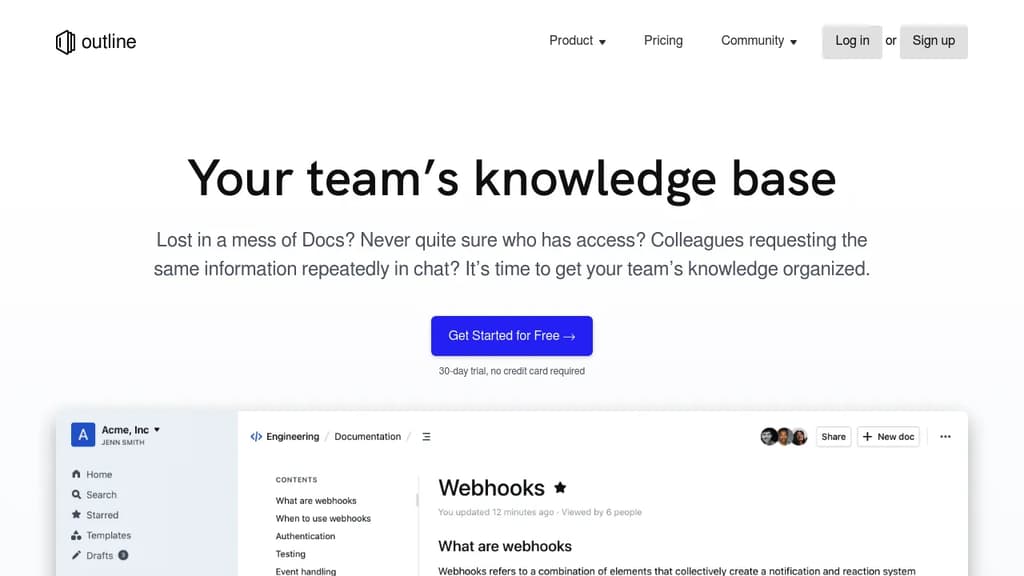
Outline is a team knowledge base built for companies that have outgrown scattered docs, messy shared drives, and repeated Slack questions. It gives teams a single place to write, organize, and find internal documentation, from product specs and onboarding guides to meeting notes and support answers. It's available as a cloud-hosted service or self-hosted on your own infrastructure.
The editor is fast. Documents load instantly, search returns results in milliseconds, and the UI stays snappy even in large workspaces. Writing feels close to plain text, with markdown support and slash commands, but you also get interactive embeds, real-time multiplayer editing, and threaded comments for keeping conversations tied to specific content.
Key capabilities include:
- AI-powered search that lets you ask questions about your documents and get direct answers, not just a list of links
- Slack integration for searching, sharing, and asking questions without leaving chat, plus channel notifications when docs change
- Granular permissions with read/write controls, user groups, guest access, and public sharing via link
- Custom branding with your own domain, colors, and logo
- 20+ integrations including Figma and Loom
- Localization with RTL support and translations in 20 languages
Outline sits in the same space as tools like Docmost or AppFlowy for collaborative wikis, but it's particularly focused on speed and team-wide usability rather than personal note-taking. Unlike personal tools such as Logseq, Outline is designed around shared workspaces with access controls from the start.
The codebase is open source, and self-hosting is a first-class option for teams that need to keep data on their own servers. A cloud-hosted plan with a 30-day free trial is also available for teams that want to get started without managing infrastructure.

Self-hosted wiki platform for enterprise teams with real-time collaboration, built-in AI, SSO, RBAC permissions, and compliance support for ITAR, FedRAMP, and GDPR.
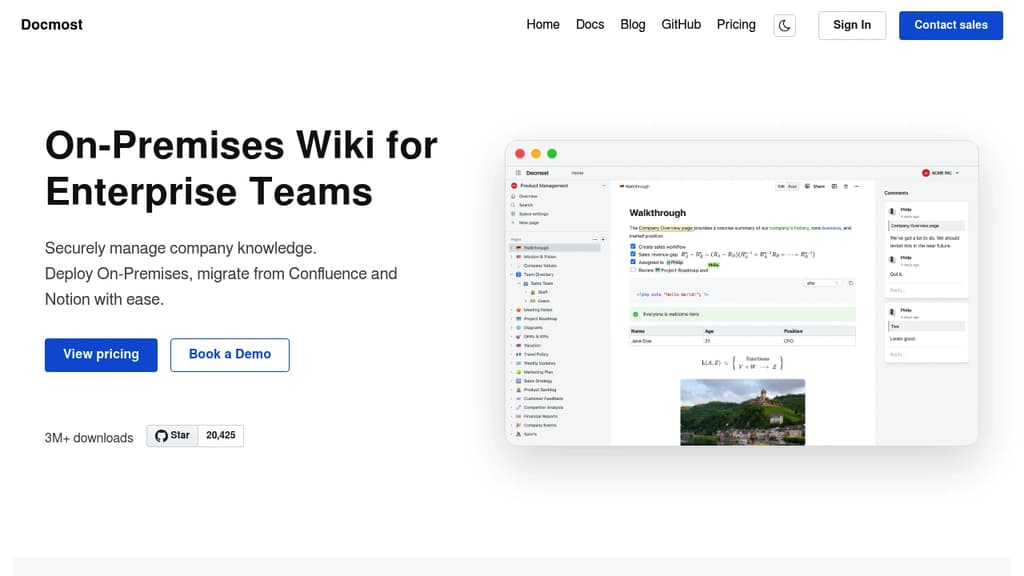
Docmost is a self-hosted wiki platform built for teams that need full control over their data. It's aimed at organizations where compliance isn't optional: defense contractors, regulated industries, and companies subject to GDPR or FedRAMP requirements. You deploy it on your own servers, including air-gapped or isolated environments, and your data never leaves your infrastructure.
The editor supports rich text, tables, code blocks, and real-time collaboration with live cursors. Multiple people can edit the same page simultaneously, with changes syncing instantly across devices. Pages are organized into team spaces, so departments or projects can maintain their own areas without everything bleeding together.
Key capabilities:
- AI assistant that works with self-hosted models (Ollama, vLLM) or cloud providers (OpenAI, Gemini, Azure OpenAI). Chat with your knowledge base, get answers with source citations, and search semantically across all spaces.
- MCP server support exposes your wiki to AI tools like Claude or Cursor via the Model Context Protocol, with no vendor lock-in.
- Built-in diagramming via Draw.io, Excalidraw, and Mermaid, covering everything from UML to quick whiteboard sketches.
- Page verification workflows for tracking reviews and approvals, supporting ISO 9001, ISO 27001, and SOC 2 compliance.
- Enterprise authentication with SAML 2.0, OpenID Connect, LDAP, and MFA.
- RBAC permissions with granular control over who can view, edit, or administer content.
Teams migrating from Confluence or Notion can import existing content directly, including HTML and Markdown files. Integrations cover Figma, Airtable, Google Drive, Miro, Loom, and others, so pages can embed content from tools teams already use.
Docmost sits in the same space as Outline and XWiki, but its combination of self-hosted AI, MCP support, and compliance-focused deployment options makes it a strong fit for organizations that need a collaborative knowledge base without relying on third-party cloud infrastructure.

Self-hostable enterprise AI platform that unifies business data across apps, powers a knowledge graph for cited answers, and lets teams build AI agents across their stack.
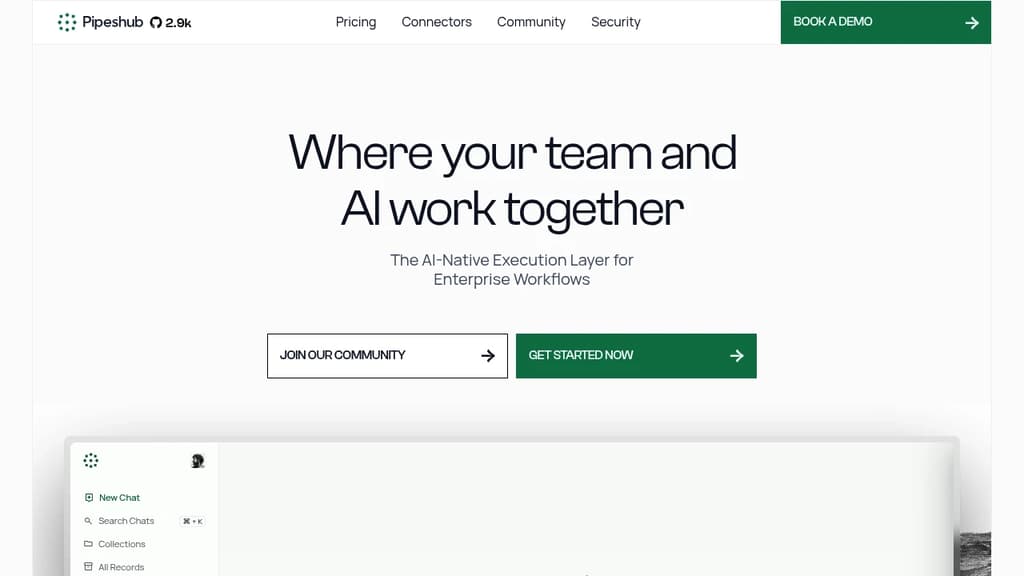
PipesHub is an open-source enterprise AI platform built for teams that need accurate, explainable answers from their internal knowledge, without shipping sensitive data to a vendor's cloud. It positions itself as a self-hostable alternative to Glean, giving organizations full control over their infrastructure, models, and data.
At its core, PipesHub builds a knowledge graph across your connected apps, so queries return structured, reasoned results rather than fuzzy keyword matches. Every answer comes with pinpoint citations: page numbers, paragraph references, and direct links back to the source document. Confidence levels are surfaced explicitly, so users know when an answer is well-supported versus tentative.
Key capabilities include:
- Connectors for Google Drive, Slack, Jira, Notion, GitHub, Salesforce, Gmail, Confluence, Outlook, and Teams, all syncing in real time with permissions inherited from the source app
- Collections to organize documents by team or project, with role-based access control enforced end-to-end
- AI agent builder with a no-code interface and SDKs for Python, Go, and TypeScript, supporting event-driven and scheduled workflows across connected tools
- Model flexibility: bring API keys for OpenAI, Anthropic, Google, or Mistral, or run fully local with Ollama. No opaque per-query charges
- MCP server to expose your knowledge graph to Claude, Cursor, VS Code, or your own product
- Deployment options spanning cloud, VPC, on-premise, and air-gapped environments
The platform is Apache 2.0 licensed, so every line is auditable. SOC 2 Type I compliance is in place, with ISO 27001 and VAPT certifications also covered. If a user can't see a document in Drive, they can't surface it through PipesHub either, permissions aren't re-implemented, they're inherited.
Agents can be scoped per department, triggered by events, and wired to take actions like creating Jira tickets from emails, syncing notes to Confluence, or sending Slack alerts. The platform scales horizontally and handles millions of indexed documents from a single Docker deployment up to full enterprise infrastructure.

XWiki is a flexible, feature-rich wiki software that helps organizations structure and share knowledge efficiently.
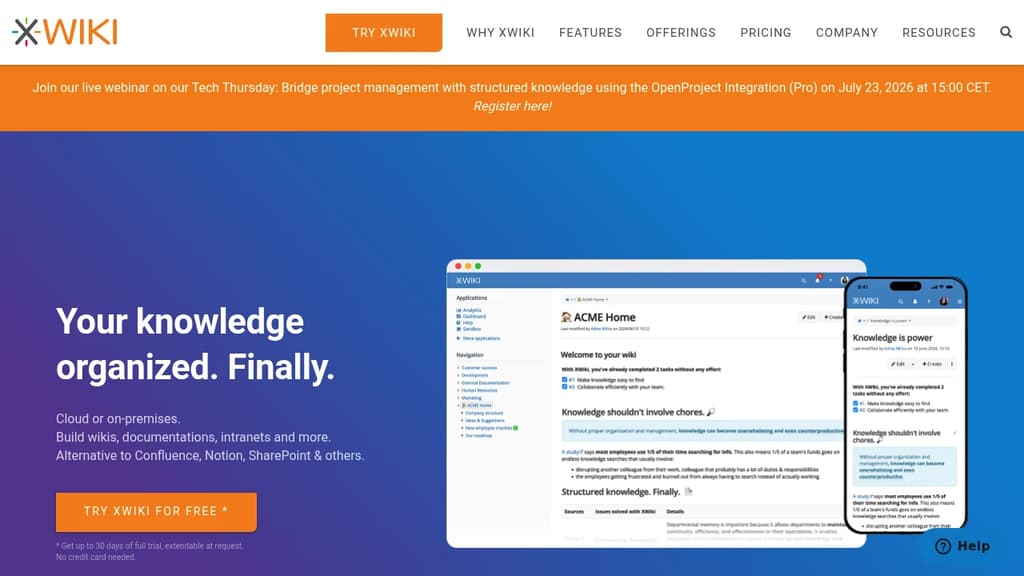
XWiki is an enterprise-grade, open-source platform for knowledge management and collaboration. It offers a unique "Structured Wiki" concept, combining the flexibility of wikis with powerful organization features.
Key benefits include:
-
Structured Knowledge: XWiki goes beyond traditional wikis by allowing users to create structured content, making information easier to organize and find.
-
Customization: The platform is highly adaptable, supporting custom applications and workflows to meet specific organizational needs.
-
Collaboration Tools: XWiki provides robust features for team collaboration, including real-time editing, comments, and version control.
-
Security and Access Control: Granular permissions and access controls ensure that sensitive information remains protected.
-
Integration: XWiki can integrate with various third-party tools and systems, enhancing its functionality and fitting into existing workflows.
-
Open Source: As an open-source solution, XWiki offers transparency, community support, and freedom from vendor lock-in.
-
Scalability: XWiki is designed to handle large amounts of data and users, making it suitable for organizations of all sizes.
-
Multiple Deployment Options: Available as a cloud service or for on-premises installation, providing flexibility in deployment.
XWiki is trusted by over 800 teams worldwide, including major organizations like Amazon, SNCF, and CNFPT. It's particularly well-suited for creating knowledge bases, managing procedures, building intranets, and developing custom collaborative applications.
Whether you're looking for a standard solution or a custom-tailored platform, XWiki offers the tools and services to streamline your organization's knowledge sharing and collaboration processes.

People are looking for alternatives to...
View all alternatives
Claude Code

Spotify

CapCut

Claude

Notion

Lovable
 Docmost – Open-source wiki software with real-time collaboration, diagrams, AI, SSO, RBAC permissions and more.
 Windshift