Open Source Glide Alternatives
A curated collection of the 9 best open source alternatives to Glide.
The best open source alternative to Glide is Baserow. If that doesn't suit you, we've compiled a ranked list of other open source Glide alternatives to help you find a suitable replacement. Other interesting open source alternatives to Glide are: Dify, NocoDB, Budibase, and AITable.
Glide alternatives are mainly Low-Code/No-Code Platforms but may also be Database Tools & GUIs or Collaborative Workspaces. Browse these if you want a narrower list of alternatives or looking for a specific functionality of Glide.

Written by Piotr Kulpinski


Open-source platform for building databases, internal apps, and automated workflows without writing code. Available on cloud or self-hosted.
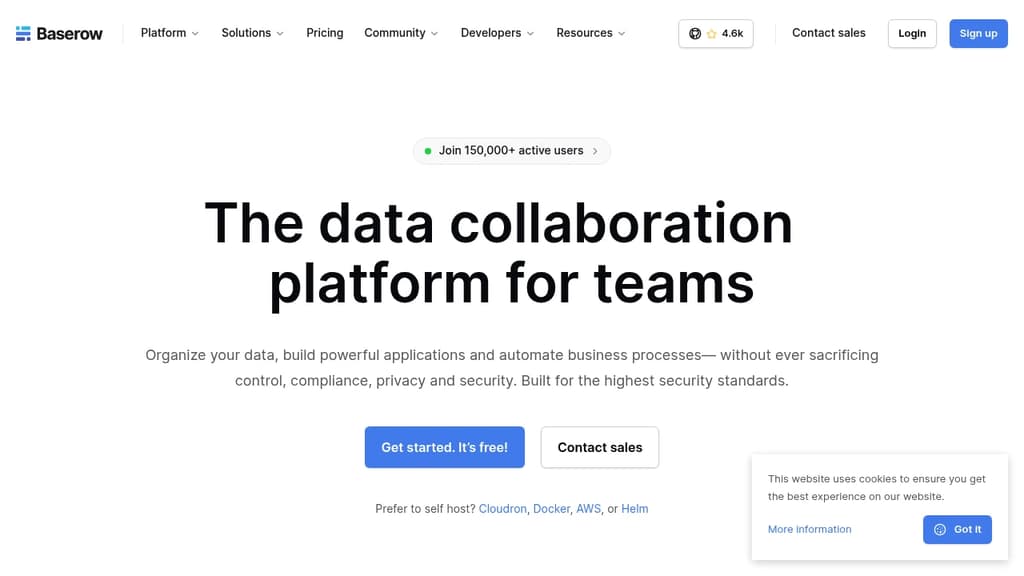
Baserow lets teams organize data, build internal applications, and automate workflows without writing code. It works as a structured database with multiple view types (grid, kanban, calendar, timeline, form, and survey), so different teams can work with the same data in whatever way suits them.
On top of the database layer, you can build full applications using a visual page and dashboard composer. These apps sit directly on your data, so there's no need to export or sync between tools.
Automation is built in. You can create workflows with triggers, branches, conditions, and loops, and connect them to HTTP requests, email, webhooks, or third-party services. An audit log keeps a record of actions for compliance purposes.
Baserow is a popular Airtable alternative. It covers similar ground but adds self-hosting, an MIT open-source license, frontend and backend plugin support, and compliance certifications for GDPR, HIPAA, and SOC 2 Type II. Row limits and API restrictions that frustrate Airtable users at scale are not a factor when self-hosting.
An AI assistant called Kuma can generate database structures from a plain-language description, which speeds up initial setup. AI fields and agent support are also available for adding AI steps inside workflows.
Teams that want NocoDB- or Teable-style open-source flexibility but need a more complete app-building layer will find Baserow covers more ground. It's a practical fit when you need to keep data on your own infrastructure, avoid per-user pricing at scale, or meet stricter data governance requirements.

Visual platform for building agentic workflows, RAG pipelines, and LLM-powered apps. Supports hundreds of models, MCP integration, and self-hosted deployment.
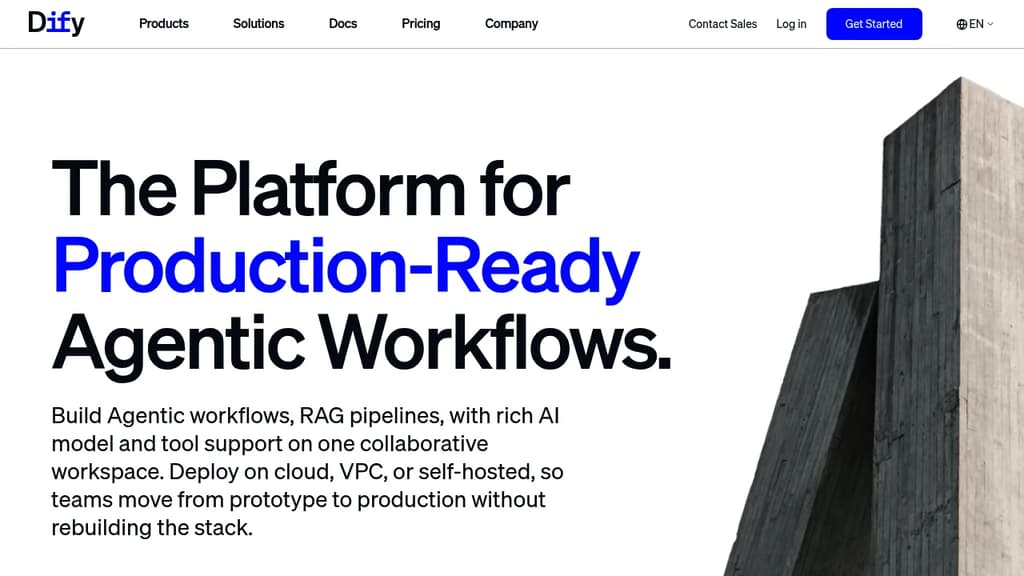
Dify is an open source platform for building production-ready AI applications without writing boilerplate infrastructure. It targets developers and teams who want to move from idea to deployed app quickly, using a visual workflow builder rather than assembling everything from scratch.
The core of Dify is its agentic workflow builder: a drag-and-drop canvas where you connect LLM calls, tools, conditional logic, and data sources into multi-step pipelines. These aren't toy demos. The platform is designed to handle real production traffic, with enterprise-grade security and scalability built in from the start.
Key capabilities include:
- RAG pipelines: ingest documents, connect knowledge bases, and make your data queryable by any LLM with minimal setup
- Multi-model support: connect to hundreds of global LLMs, including OpenAI, Anthropic, and locally-hosted models via Ollama or OpenAI-compatible APIs
- MCP integration: native support for the Model Context Protocol, both consuming external MCP servers and publishing your own app as an MCP server
- Plugin marketplace: extend functionality with community plugins without touching source code
- Observability: built-in monitoring so you can iterate based on real usage data
Teams can self-host the entire platform, which matters for organizations with strict data residency or compliance requirements. The no-code interface makes it accessible to non-engineers, while the underlying API and plugin system give developers room to build complex, custom logic.
Dify is used across industries from biomedicine to automotive. Ricoh built internal tooling on it; Volvo Cars uses it for rapid AI validation. Over a million applications run on Dify deployments worldwide.

Convert any database into a no-code platform with spreadsheet interface. Connect PostgreSQL/MySQL or use hosted database. Scale to millions of rows effortlessly.
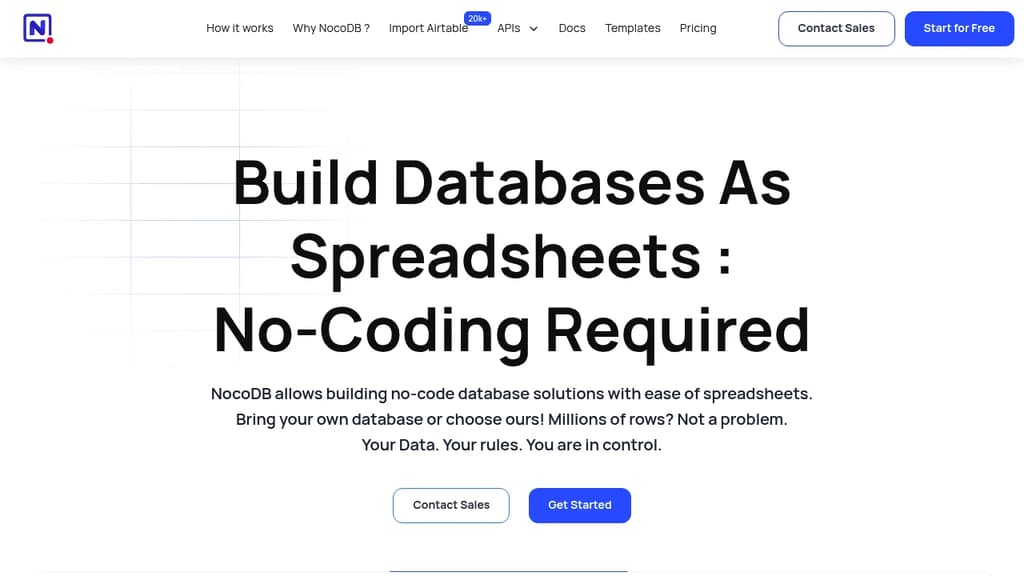
Transform any database into a powerful no-code platform with the simplicity of spreadsheets. Whether you bring your own PostgreSQL/MySQL database or use the hosted solution, NocoDB makes database management accessible to everyone.
Key features include:
- Multiple data views: Grid, Kanban, Gallery, and Form views to visualize data your way
- Massive scalability: Handle millions of rows without performance issues
- Rich integrations: Connect external databases, import from Airtable/CSV/Excel
- Team collaboration: Share projects, invite team members, and work together seamlessly
- API-first approach: Full REST API access with webhooks for custom automations
- Visual schema management: ERD diagrams for easy database structure visualization
Perfect for diverse use cases including CRM, project management, operations, and inventory management. The platform serves organizations of all sizes - from startups to enterprises - with complete data ownership and no artificial limitations.
Built on open-source foundation with a thriving community of 20k+ APIs and trusted by 23,000+ organizations. Access your data through intuitive interfaces while maintaining full control over your information.

Low-code platform for creating custom business applications quickly. Design, automate, and deploy with ease.
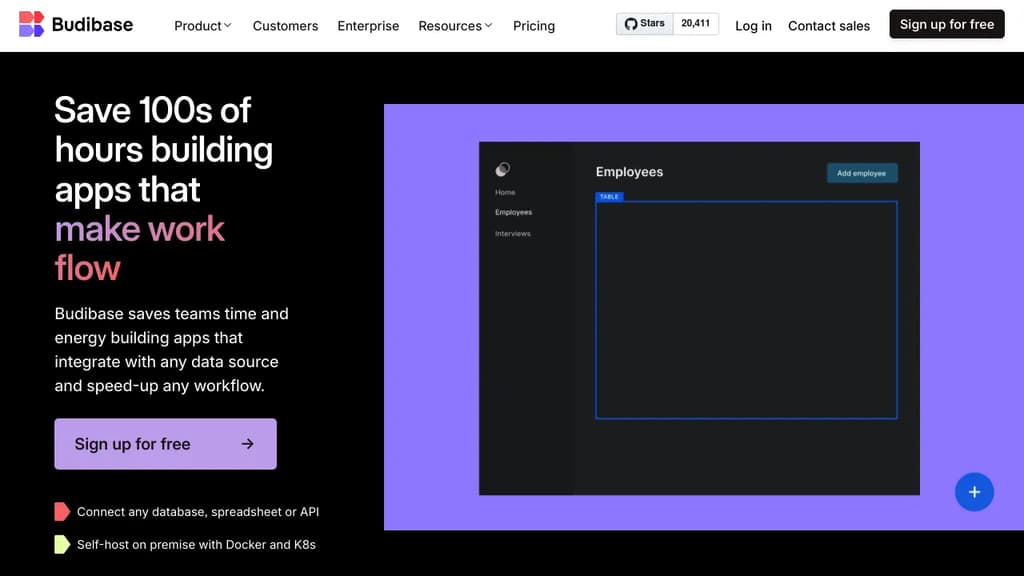
Budibase is a revolutionary low-code platform that empowers businesses to create custom web applications without extensive coding knowledge. With its intuitive interface and powerful features, Budibase accelerates the development process and puts the power of app creation in the hands of both developers and non-developers alike.
Key benefits of Budibase include:
- Rapid Development: Build fully functional web apps in hours, not weeks or months.
- Customization: Design unique interfaces and workflows tailored to your specific business needs.
- Data Integration: Connect to various data sources, including PostgreSQL, MySQL, MongoDB, and more.
- Automation: Create complex business logic and automate repetitive tasks with ease.
- Self-hosting: Deploy on-premises for complete control over your data and infrastructure.
- Responsive Design: Build apps that work seamlessly across desktop and mobile devices.
- Open Source: Benefit from a transparent, community-driven development process.
- Extensibility: Leverage JavaScript for advanced customization when needed.
Whether you're creating internal tools, customer portals, or admin panels, Budibase provides the flexibility and power to bring your ideas to life quickly and efficiently. Join thousands of businesses already using Budibase to transform their operations and drive innovation.

AITable.ai offers a visual database platform that simplifies workflow automation and connects to over 6,000 apps through integrations like Zapier and Make.
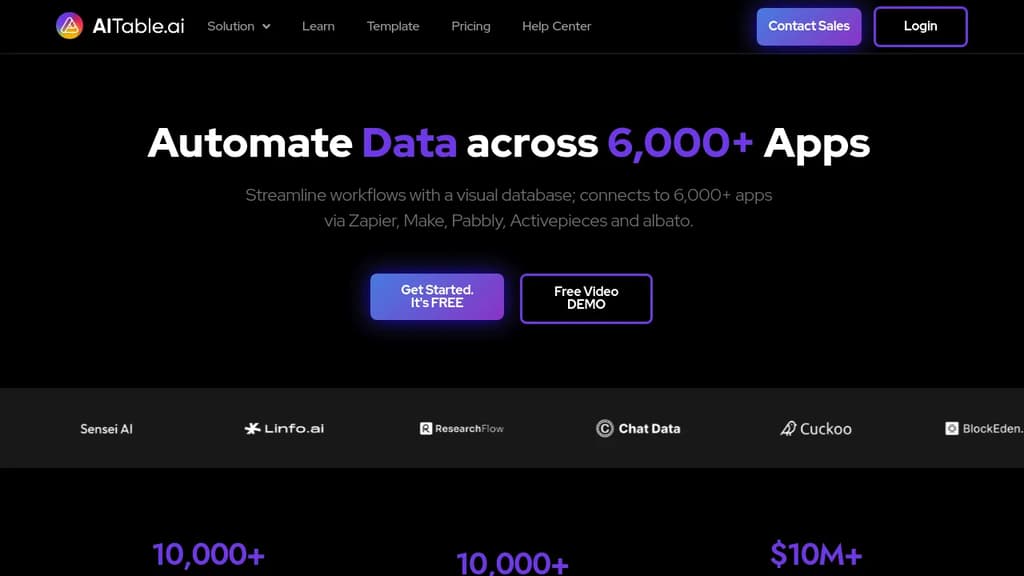
AITable.ai is a powerful visual database platform designed to streamline workflow automation and enhance productivity. With its intuitive interface, users can easily organize and manage data while leveraging powerful automation capabilities.
Key features include:
- Visual database: Combines the simplicity of spreadsheets with the power of databases for flexible data management.
- Extensive integrations: Connect to over 6,000 apps via popular platforms like Zapier, Make, Pabbly, and Activepieces.
- Automated workflows: Create custom automations to streamline repetitive tasks and processes.
- One-click form creation: Instantly generate and integrate forms into websites for efficient data collection.
- AI-powered assistance: Leverage AI capabilities for data analysis, content generation, and workflow optimization.
- Customizable views: Visualize data in various formats including lists, boards, calendars, and Gantt charts.
AITable.ai is ideal for teams looking to improve their project management, CRM, and productivity workflows. Its no-code approach makes it accessible to users of all technical levels, while its powerful features cater to complex business needs.
By centralizing data and automating processes, AITable.ai helps organizations save time, reduce errors, and make more informed decisions. Whether you're managing customer relationships, tracking projects, or analyzing business data, AITable.ai provides a flexible and scalable solution to meet your needs.

A versatile data management platform combining spreadsheet simplicity with relational database capabilities for efficient data organization and analysis.
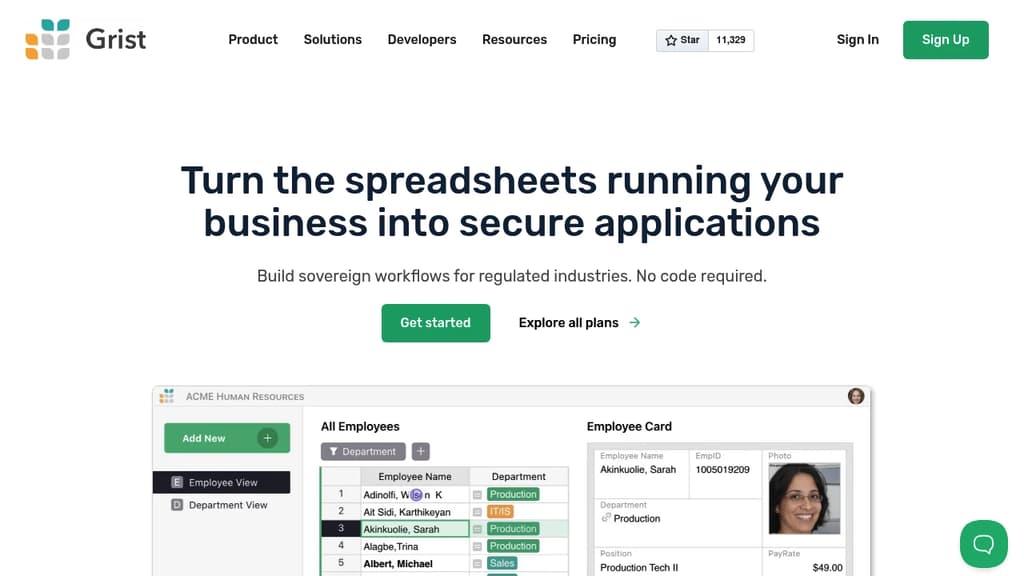
Grist revolutionizes data management by merging the familiarity of spreadsheets with the robustness of databases. This innovative tool offers a unique approach to organizing, analyzing, and visualizing your data.
Key benefits of Grist include:
- Intuitive Interface: Familiar spreadsheet-like grid for easy data entry and viewing
- Relational Power: Create links between tables for complex data relationships
- Custom Views: Generate multiple perspectives of your data with different layouts and filters
- Data Visualization: Build insightful charts and widgets directly from your data
- Formulas and Python: Use spreadsheet formulas or harness Python for advanced calculations
- Access Control: Set granular permissions to manage data visibility and editing rights
- Collaboration: Work together in real-time with team members on shared documents
- API Integration: Connect Grist to other tools and automate workflows
- Version History: Track changes and revert to previous versions when needed
- Self-Hosted Option: Choose between cloud-hosted or on-premises deployment
Whether you're managing projects, analyzing sales data, or organizing research findings, Grist adapts to your needs. Its flexibility allows for creating custom applications without coding expertise, making it an ideal solution for businesses, researchers, and data enthusiasts alike.

Open-source visual editor for building websites and web apps. Connect to any data source, design custom UIs, and ship production React code without leaving your stack.
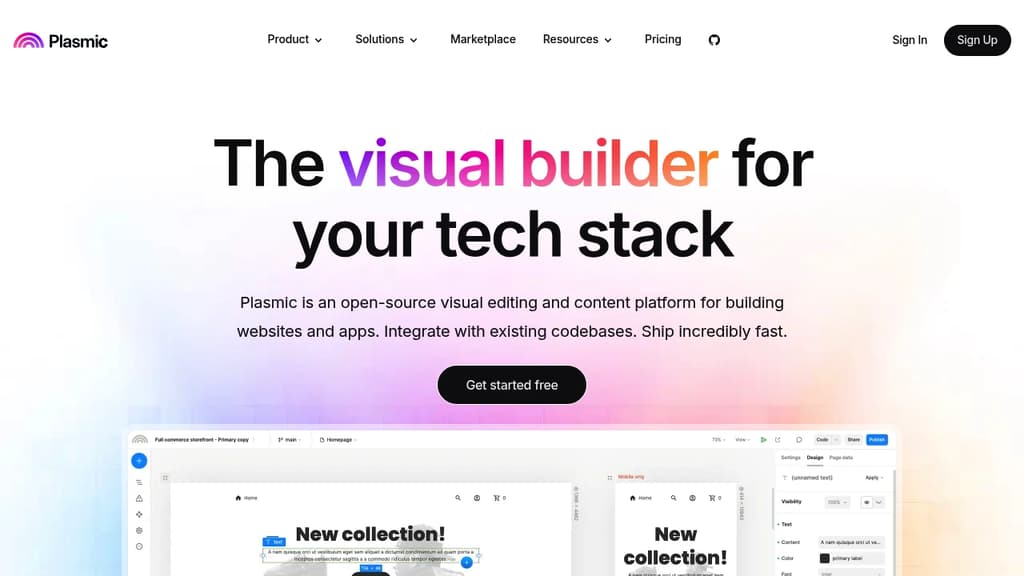
Plasmic is a visual builder and content platform for teams that want to move fast without abandoning their existing codebase. Unlike tools such as Softr or Glide that keep you inside a walled garden, Plasmic generates real React code and integrates directly into your current applications. No iframes, no lock-in.
It's built for mixed teams. Developers can register their own components as drag-and-drop building blocks, then hand the canvas over to designers, marketers, or product managers who can build and publish without filing a ticket. The result is fewer bottlenecks and a smaller backlog.
Key capabilities include:
- Data connectors for Supabase, Contentful, Shopify, and any HTTP or GraphQL API endpoint
- Figma import to turn designs into production React components without manual translation
- Custom component library so your design system stays consistent across every project
- Branching and multiplayer for teams working in parallel without stepping on each other
- Fine-grained permissions to control who can view, edit, or publish within Plasmic and inside your app
- On-premise deployment for organizations that need to keep everything behind a firewall
- SOC 2 compliance and SSO support for enterprise security requirements
Plasmic covers a wide range of use cases: internal tools, customer portals, SaaS products, storefronts, and content-heavy marketing sites. Tools like AppSmith and Builder overlap on internal tools, but Plasmic's Figma-to-code workflow and deep React integration make it a stronger fit for teams that also ship public-facing products.
The free plan has no time limit, and self-hosting is available for teams that need full infrastructure control.

A self-hosted tool that provides an intuitive, spreadsheet-style interface for viewing, editing, and querying PostgreSQL databases without technical expertise.
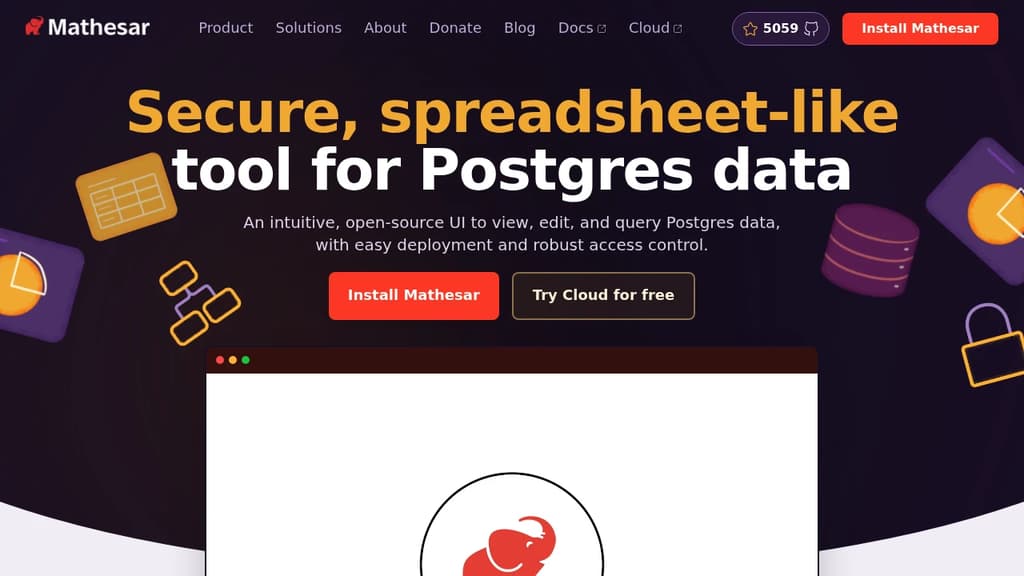
Mathesar transforms PostgreSQL databases into user-friendly workspaces with a familiar spreadsheet interface. The tool stands out with several key features:
- Direct PostgreSQL Integration: Works natively with Postgres permissions, schemas, and tables without additional abstractions
- Enterprise-Ready Security: Self-hosted solution with robust access control using native Postgres permissions
- No Technical Skills Required: Business users can view, edit, and query data through an intuitive interface
- Scalable Performance: Handles databases of any size or complexity, scaling alongside PostgreSQL
- Quick Setup: Installation takes minutes with minimal configuration needed
- 100% Open Source: Maintained by a nonprofit organization, eliminating vendor lock-in concerns
Perfect for teams needing to manage assets, track inventory, create CRUD interfaces, or build data dashboards while maintaining complete control over their data infrastructure.

A low-code platform for creating robust backends, complete with a spreadsheet UI for easy data management and custom functions.
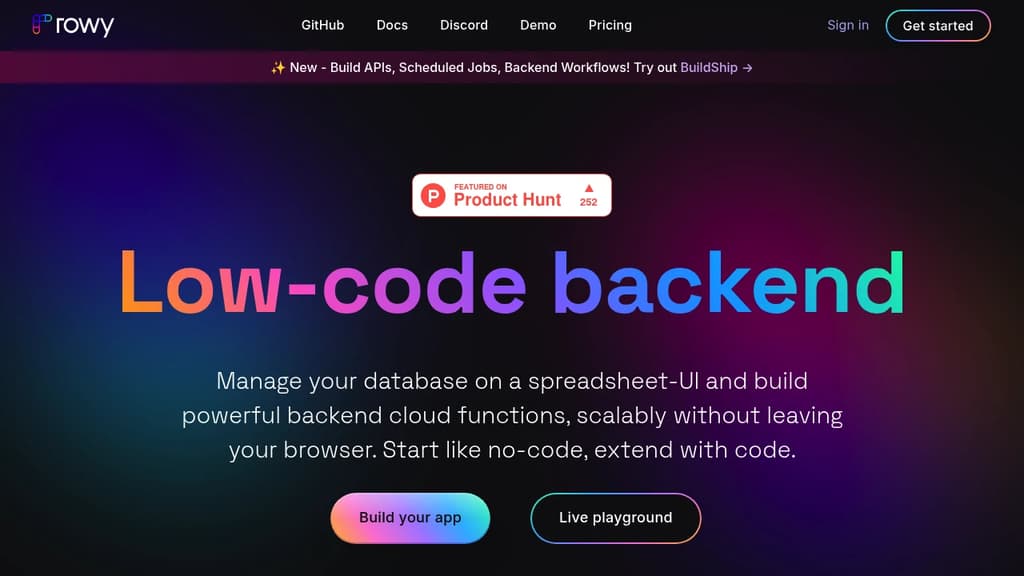
Rowy revolutionizes backend development by combining the simplicity of spreadsheets with the power of serverless architecture. This innovative platform allows developers and non-developers alike to create, manage, and scale their applications effortlessly.
Key benefits of Rowy include:
- Intuitive Spreadsheet Interface: Manage your data with a familiar, spreadsheet-like UI that's easy to use and requires no special training.
- Powerful Serverless Backend: Leverage the scalability and efficiency of serverless architecture without the complexity of setting it up yourself.
- Custom Functions: Write and deploy cloud functions directly from the browser, enabling complex operations and integrations.
- Real-time Collaboration: Work together with your team in real-time, making data management and backend development a truly collaborative process.
- Flexible Data Types: Support for various data types, including rich text, images, and files, allowing for versatile data structures.
- Automatic API Generation: APIs are automatically created for your data, saving time and simplifying frontend integration.
- Seamless Integrations: Connect easily with popular services and APIs to extend your application's capabilities.
- Version Control: Built-in version control ensures you can track changes and revert when necessary.
Rowy empowers developers to focus on building great products rather than wrestling with backend infrastructure. Whether you're prototyping a new idea or scaling an existing application, Rowy provides the tools you need to succeed quickly and efficiently.

People are looking for alternatives to...
View all alternatives
Claude Code

Spotify

CapCut

Claude

Notion

Lovable
 Windshift – The self-hosted platform that replaces Jira.

 Windshift