Open Source Giselle Alternatives
A curated collection of the 6 best open source alternatives to Giselle.
The best open source alternative to Giselle is n8n. If that doesn't suit you, we've compiled a ranked list of other open source Giselle alternatives to help you find a suitable replacement. Other interesting open source alternatives to Giselle are: AutoGPT, Paperclip, LobeHub, and Kortix.
Giselle alternatives are mainly AI Agent Platforms but may also be Workflow Automation Tools or Low-Code/No-Code Platforms. Browse these if you want a narrower list of alternatives or looking for a specific functionality of Giselle.

Written by Piotr Kulpinski


Visual workflow automation platform for building AI agents and business processes, with 500+ integrations, human approval steps, code when needed, and self-hosting.
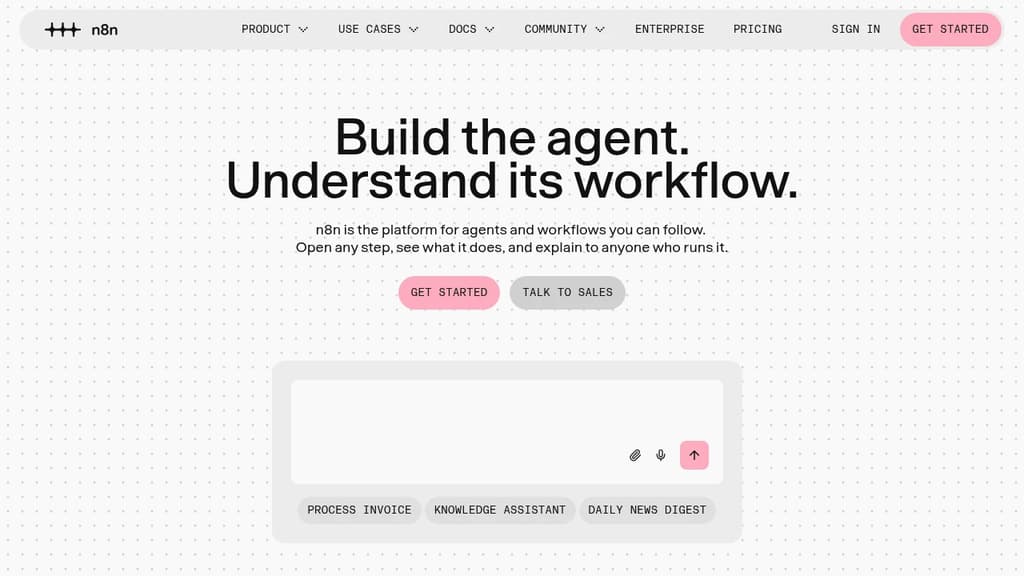
A workflow automation platform for technical teams that want AI agents and business processes in one place. You build in a visual editor, then drop into code whenever a step needs it. Every step is open to inspect, so the workflow itself serves as the documentation.
It suits developers, IT, security and ops teams who need automations other people can read, run and trust.
- 500+ native integrations: connect any API through HTTP, and any agent or coding assistant through MCP.
- Agent visibility: watch agents work live or open any past run inside the same workflow.
- Rules around AI: structured inputs and outputs, human-in-the-loop approvals, guardrails and evaluations.
- Easy recovery: spot an error at a glance and re-run only the step that broke. Replay past runs or mock data to skip waiting on external systems.
- Change tracking: version history shows who changed what, and when.
- Self-hosting: deploy on-prem or with Docker to keep data in your own environment, or use the hosted version. The source code is on GitHub.
For larger organizations, it adds SSO SAML, LDAP, RBAC permissions, encrypted secret stores, audit logs, log streaming to your SIEM, and Git-based version control with isolated environments and workflow diffs.
Examples from its users include onboarding new hires across Slack, Jira and Notion, triaging alerts with an AI agent, investigating security threats across several tools, and qualifying inbound leads. Huel reports saving 1,000 hours, and Vodafone uses it for security operations.

Platform for building, deploying, and running AI agents that automate repeatable digital work across research, outreach, content, and support without writing code.
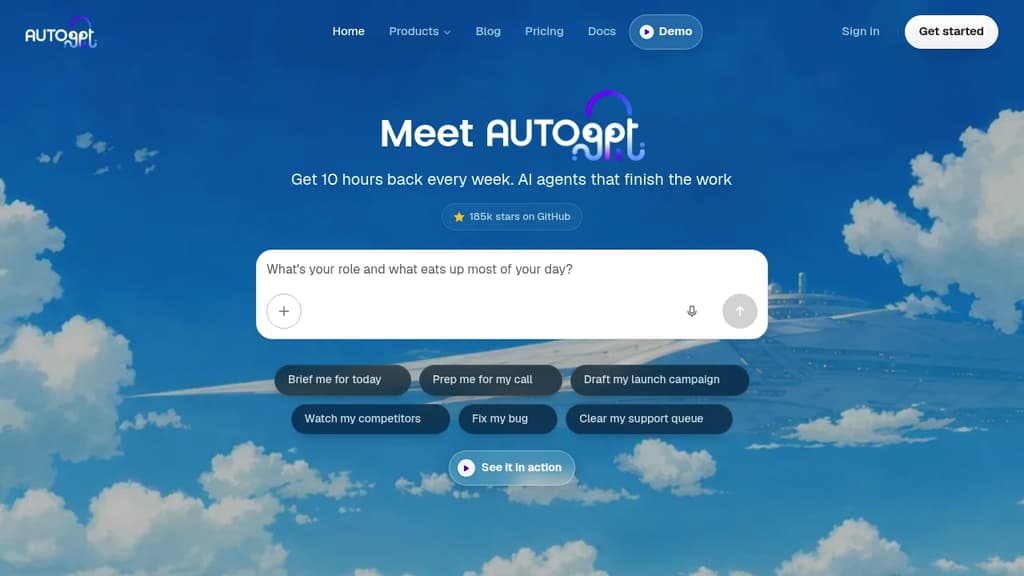
AutoGPT is an AI agent platform for people who want to hand off recurring work entirely, not just get help with a single task. You describe the outcome you want, and an agent plans and executes every step: pulling data, calling AI models, updating spreadsheets, sending messages, and looping back on a schedule. It's built for the kind of work that comes back every day or every week.
There are four ways to interact with the platform:
- AutoPilot lets you describe a job in plain English and builds the agent for you inside the conversation, no flowcharts or prompt engineering required.
- Visual Builder gives you a drag-and-drop canvas of blocks when you need exact control over branching, looping, and routing logic.
- Dashboard shows every agent's status, run history, and spend in one place, with alerts when an agent needs a decision from you.
- Marketplace offers ready-made agents from AutoGPT and the community, browsable without an account and deployable in one click.
On the integration side, the platform ships with dozens of AI models already connected (no API keys needed) and supports services like Gmail, Slack, Google Sheets, Notion, HubSpot, GitHub, and Airtable. Agents can handle chat, image generation, video, transcription, OCR, and more across 45+ platforms.
Common uses include morning briefings assembled from earnings and headlines, prospect research before sales calls, overnight campaign drafts, support ticket triage, and competitor monitoring that only pings you when something actually changes.
AutoGPT is fully open source. Self-hosting is free: you bring your own model API keys and infrastructure and get the same builder and agent runtime as the cloud. The hosted cloud removes the ops burden and covers model usage through a subscription. Teams often prototype in the cloud and move sensitive workloads on-prem later.
For teams that want a visual workflow automation approach rather than agent-based logic, tools like ByteChef or Automa take a different angle. If you're looking for an agent-first experience with a different focus, Eigent is worth comparing. AutoGPT's sweet spot is repeatable, multi-step work you can describe clearly enough to hand to a capable assistant.

Manages teams of AI agents across business functions with org charts, goal alignment, cost tracking, ticket tracing, and board-level governance controls.
Paperclip treats your AI agents like employees, not tools. You act as the board of directors: you approve hires, review strategy, set budgets, and can pause or reassign any agent at any time. The mental model isn't "I'm prompting an AI" – it's "I'm running a company."
It's model-agnostic by design. Agents can be Claude, Codex, Gemini, OpenClaw, Cursor, or anything that can receive a heartbeat signal. Python scripts, shell commands, HTTP webhooks – if it can be triggered, it can be hired. You're not locked into any provider.
Key capabilities:
- Org charts – Agents are organized into roles (CEO, CTO, CMO, engineers) under a single company structure pointed at one goal.
- Goal alignment – Every task traces back to the company mission through a hierarchy: mission → project goal → agent goal → task. Agents know what they're doing and why, via a
SKILL.mdcontext file. - Heartbeats – Agents wake on a schedule, check their work queue, and act. Delegation flows up and down the org chart automatically.
- Budget controls – Each agent gets a monthly spend limit. At 80% you get a warning; at 100% the agent auto-pauses and blocks new tasks. Hard limits, enforced by the system.
- Ticket system – Every instruction and response is a structured ticket with full tracing: every tool call, API request, and decision point is logged in an immutable, append-only audit log.
- Governance – Agents can't hire other agents without board approval. The CEO can't execute a strategy you haven't reviewed. Autonomy is something you grant explicitly.
Paperclip is MIT-licensed and self-hosted. A single deployment can run multiple separate companies with full data isolation, useful for parallel ventures or templating org configs. It runs locally with an embedded database or connects to your own Postgres instance. No Paperclip account required.
For teams already using AI coding agents like Cline or similar tools, Paperclip sits above them – coordinating who has work checked out, maintaining sessions, tracking costs, and enforcing governance across the whole operation.

Add AI agents to Slack, Discord or Telegram that pick up requests, hand coding to Claude Code or Codex, report back in thread, and learn from your corrections.
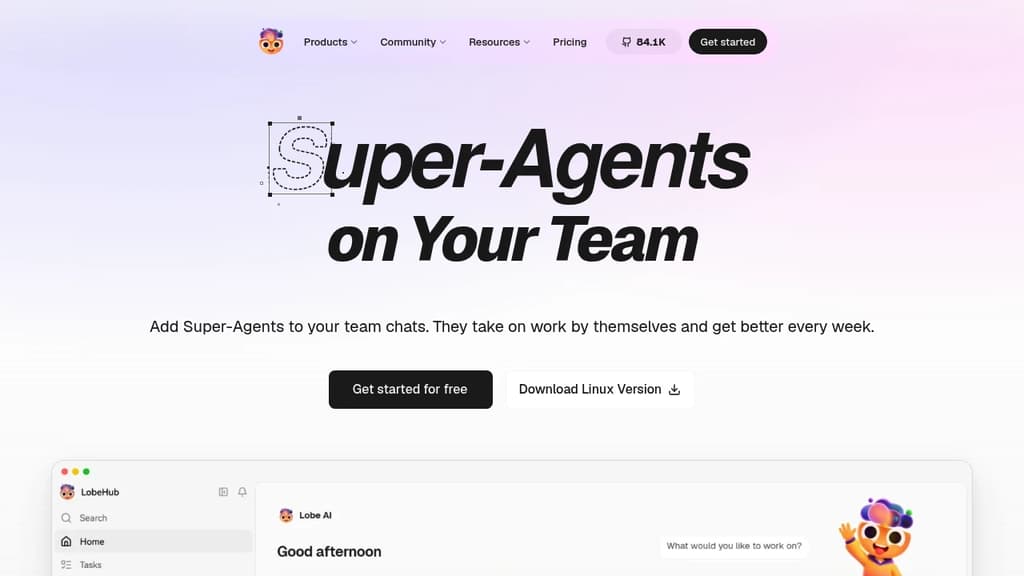
LobeHub is a collaborative agent platform where AI agents join your team chats and take on work. You add an agent to Slack, Discord or Telegram, and it reads the channel history, docs and code before it does anything. It's built for teams that want routine requests handled without someone assigning every task.
The agent can act on its own. With the "speak up on its own" setting on, it spots a feature request that several people have +1'd, creates a task, and starts work without being tagged.
- Coding handoff: it passes the build to Claude Code or Codex and tracks the task
- Acceptance checks: each delivery comes with screenshots or recordings, and you can send back any check that's off
- Pull requests: the PR merges only after you accept
- Thread replies: it tells the people who asked once the work is live
- Permissions: you decide what it can do, for example opening PRs freely while deploys need your OK
- Daily brief: a home page lists what finished, what's running, and what needs your decision
The agent also learns. A Self-evolving page shows each area it practices, the lessons you've taught it, and how often it gets things right. Mistakes become lessons, and a rule it keeps breaking is flagged so you can teach it again.
You can start with one agent and add more later, such as separate agents for design, releases and docs. Each teammate can have their own too. Agents remember team preferences, like sending pricing copy to a specific person for sign-off.

Manages a team of AI agents across your company, with every agent, skill, memory, and connector stored as versioned files in a git repo you own and self-host.
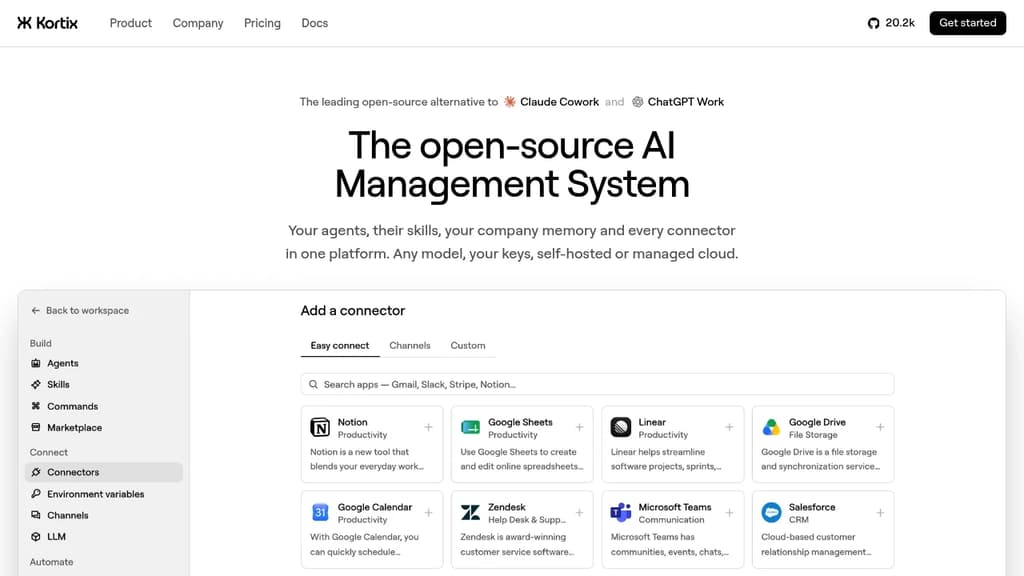
Kortix is a platform for running AI agents across an entire company, where the whole setup lives in a single git repo you own. Agents, skills, memory, connectors, triggers, and permissions are all plain files. You can grep the company, diff any change, and roll anything back. No settings locked in someone else's database.
It fits teams that want AI agents doing real, multi-step work across sales, engineering, finance, marketing, and ops, not just answering questions. Agents start from Slack, MS Teams, the web, a CLI, a cron schedule, or a signed webhook. Work lands back in the repo as a change request you read as a diff before it merges.
The platform is built in six layers that work together:
- Git repo as the source of truth.
kortix.yamldeclares the machine image, connectors, and triggers. Agents and skills are markdown files. Memory accumulates as files over time. - Connectors. 3,000+ app integrations plus MCP, OpenAPI, GraphQL, and raw HTTP. Credentials are brokered server-side and never reach the agent's machine. Each tool call can be set to allow, ask, or block, down to the specific arguments passed.
- Model-agnostic runtime. Pick any model per agent, per session, or per message. Bring your own API keys, use a ChatGPT subscription you already pay for, or point it at any OpenAI-compatible endpoint.
- Agent harness powered by OpenCode. Turns a model into an agent that plans, uses tools, and finishes multi-step runs. Permissions are set per tool in the agent file, so a
git pushcan be blocked until a human reviews the change request. - Isolated sandboxes. Each session boots its own Linux machine with the repo and tools already loaded. Thousands run in parallel with no crossover. Only commits survive.
- Unified control plane. Web, Slack, mobile, CLI, and API all start the same session type. Cron and webhooks start sessions with no human involved.
Practical examples from the source: an engineering agent reads error logs each morning, reproduces the top failure on its own machine, patches it, and opens a pull request. A finance agent reconciles the ledger, chases missing receipts, and closes the month with the variance explained. A data science agent queries the warehouse on a schedule and posts the chart to Slack before the team wakes up.
Kortix is self-hostable, VPC-deployable, or available as managed cloud. It sits in the AI coding agent orchestrators space but extends well beyond code, covering any business function that can be described as a repeatable job.

Create intelligent automation workflows combining AI agents with your favorite apps and services. Connect, automate, and scale your operations without complex coding.
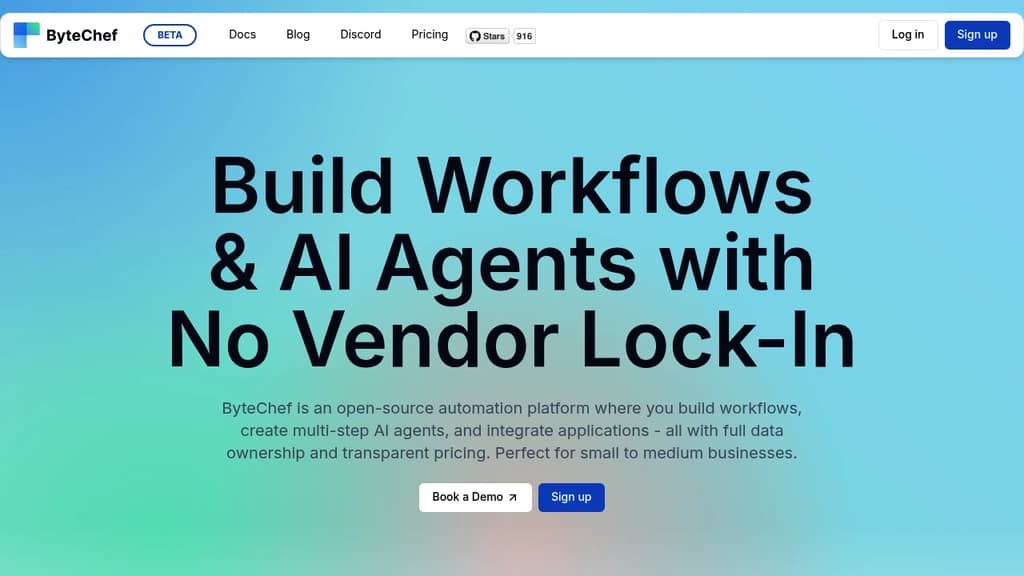
ByteChef is a versatile open-source automation platform that brings together AI capabilities and workflow automation in one powerful solution. The platform excels at creating sophisticated AI agents that can handle multi-step workflows while seamlessly integrating with popular SaaS applications and APIs.
Key features include:
- Support for multiple LLM providers including OpenAI, Groq, and self-hosted options
- Visual workflow builder with optional code customization
- Rich integration library with 20+ popular services like Slack, GitHub, and Salesforce
- Enterprise-grade security and performance capabilities
- Flexible deployment options (cloud or on-premise)
The platform bridges the gap between business teams and developers, offering both no-code visual tools and deep technical customization options. Whether you're building AI-powered chatbots, automating complex business processes, or creating custom integration workflows, ByteChef provides the flexibility and power to handle diverse automation needs.
Real users praise ByteChef for its ability to deliver enterprise-grade automation without complexity, enabling teams to connect applications in minutes and deploy AI-powered workflows in days instead of weeks. The open-source nature ensures continuous community-driven improvements while maintaining high security and compliance standards.

People are looking for alternatives to...
View all alternatives
Spotify

Claude

Claude Code

CapCut

Lovable

Notion
 Stellar Hosted – Managed Open Source software hosting in the EU: secure, compliant, fast.

 Sent