Open Source Garage Alternatives
A curated collection of the 4 best open source alternatives to Garage.
The best open source alternative to Garage is MinIO. If that doesn't suit you, we've compiled a ranked list of other open source Garage alternatives to help you find a suitable replacement. Other interesting open source alternatives to Garage are: Ceph, Storj, and Alarik.
Garage alternatives are mainly Object Storage Servers. Browse these if you want a narrower list of alternatives or looking for a specific functionality of Garage.

Written by Piotr Kulpinski


Open source S3-compatible object storage optimized for cloud-native and AI applications, delivering unmatched performance and scalability
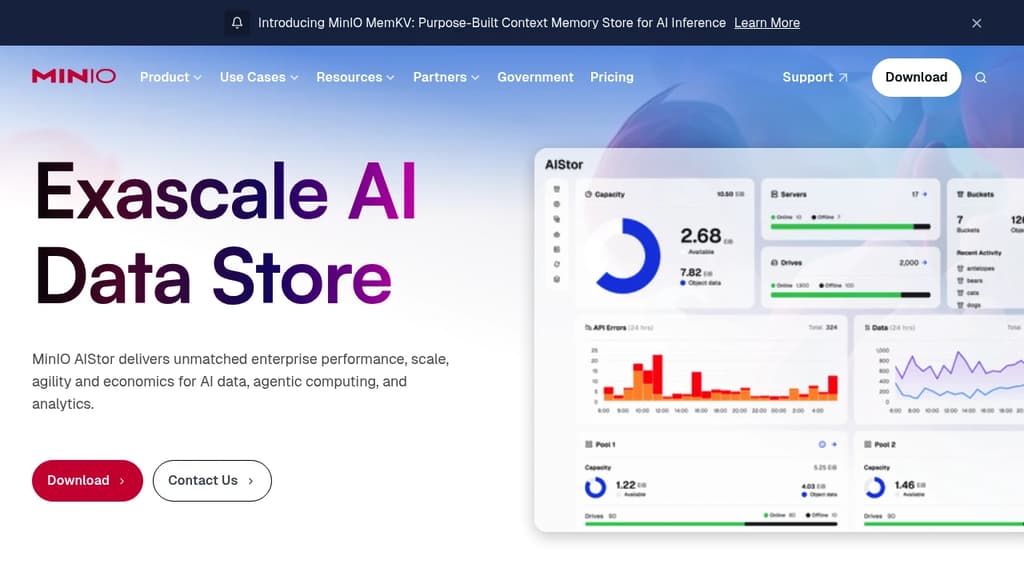
MinIO delivers enterprise-grade object storage built specifically for modern AI and cloud-native workloads. Its key strengths include:
- Industry-leading performance with throughput exceeding 2.2 TiB/s in production environments
- True software-defined architecture that runs on any hardware and supports both ARM and x86
- Enterprise security features including granular encryption, custom key management, and S3-compatible security
- Active-active replication enabling strictly consistent multi-site deployments
- Native integration with the AI/ML ecosystem including popular frameworks and platforms
- Cost-effective scaling with up to 80% savings compared to public cloud alternatives
The platform combines the simplicity of S3 compatibility with advanced features needed for AI workloads like high-throughput data access, distributed processing, and enterprise-grade security controls.

Ceph provides unified object, block, and file storage from a single cluster built on commodity hardware.

Ceph is a powerful open-source distributed storage system designed to provide highly scalable and reliable storage for modern data centers.
Key benefits of Ceph include:
- Unified storage: Ceph offers object, block, and file storage interfaces from a single system, simplifying storage management.
- Scalability: Built to scale to exabytes of data and beyond, Ceph can grow with your organization's needs.
- Reliability: Data is replicated across multiple nodes, ensuring high availability and fault tolerance.
- Flexibility: Ceph runs on commodity hardware, allowing you to build cost-effective storage solutions.
- Self-healing: The system automatically detects and recovers from failures, minimizing downtime.
Ceph's architecture is based on intelligent object storage nodes called RADOS (Reliable Autonomic Distributed Object Store), which handle data replication, failure detection, and recovery automatically. This design allows Ceph to offer seamless scalability and performance as your storage needs grow.
Whether you're building a private cloud, supporting big data applications, or need a robust backup solution, Ceph provides a flexible and powerful foundation for your storage infrastructure.

Storj offers a distributed cloud storage platform with enhanced security, global performance, and significant cost savings compared to traditional providers.
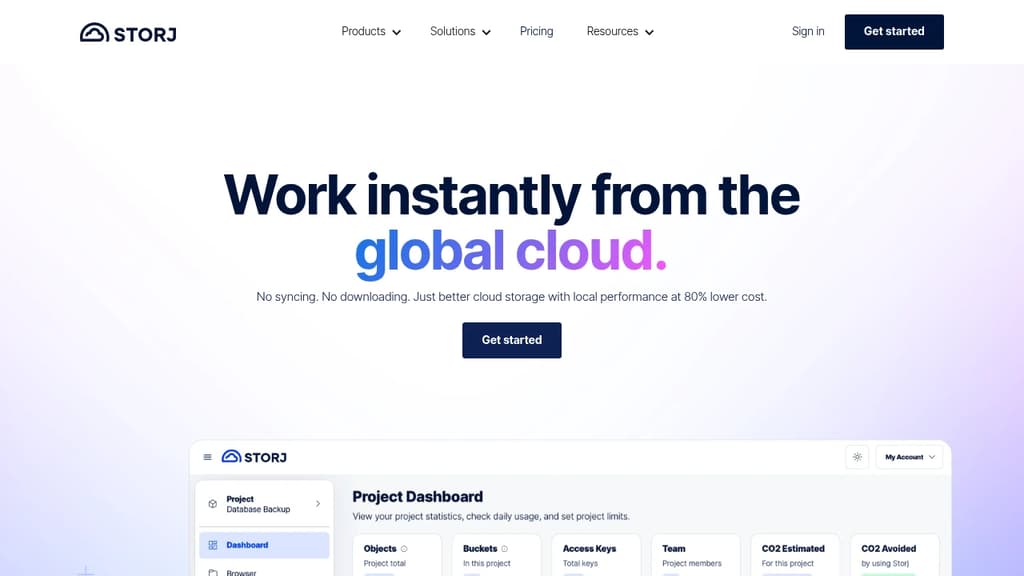
Storj is revolutionizing cloud storage with its innovative distributed architecture. By leveraging a global network of nodes, Storj provides unparalleled security and performance for your data storage needs.
Key benefits of Storj include:
- Enhanced Security: Data is encrypted, split, and distributed across multiple nodes, making it virtually impossible for unauthorized access.
- Global Performance: With nodes located worldwide, data retrieval is fast and consistent regardless of your location.
- Cost-Effective: Storj claims to offer up to 80% cost savings compared to traditional cloud storage providers.
- Eco-Friendly: By utilizing existing storage capacity, Storj reduces the need for new hardware, significantly cutting down on carbon emissions.
- S3 Compatibility: Easily integrate Storj with existing workflows and tools that support the S3 API.
Storj is ideal for businesses looking to improve their data storage strategy while reducing costs and environmental impact. Whether you're handling large media files, backups, or general cloud storage needs, Storj offers a secure, fast, and affordable solution.

Self-hostable, Apache 2.0-licensed object storage with S3 compatibility, a built-in web console, and horizontal scaling from single node to sharded cluster.
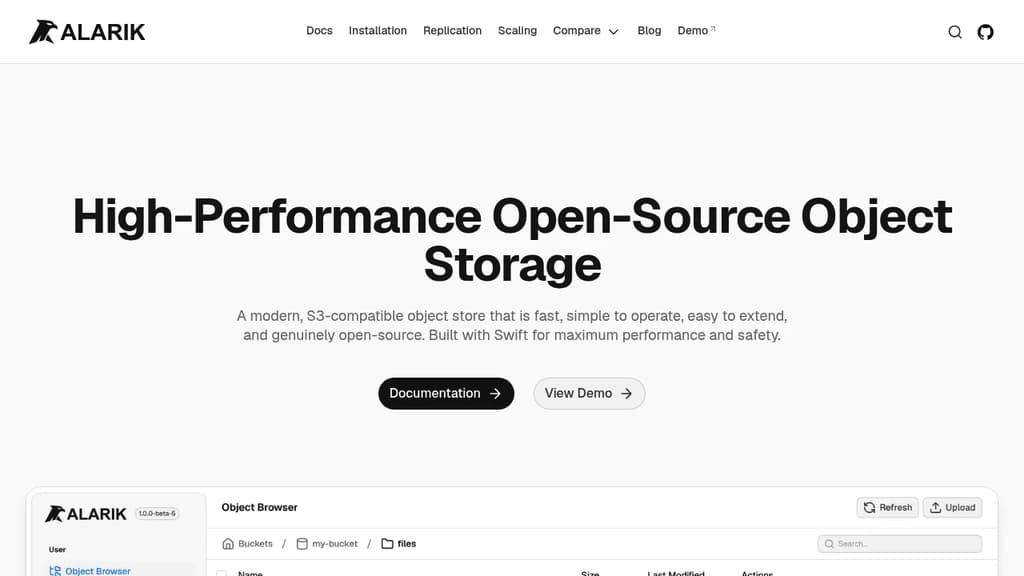
Alarik is a self-hosted Amazon S3 alternative built for teams that want full control over their object storage without depending on managed cloud infrastructure or restrictive licenses. It's written in Swift and SwiftNIO, which gives it low-latency I/O, highly parallel request handling, and no garbage collection pauses. Apache 2.0 licensed, no strings attached.
The S3 compatibility is genuine. Point your existing AWS SDK, rclone, or s3cmd at an Alarik endpoint and it works. No code changes, no adapter layers.
Key capabilities:
- S3-compatible API Drop-in replacement for existing S3 workflows and tooling
- Built-in web console A Nuxt-based UI for managing buckets and objects without touching a CLI
- Single-node to cluster Start with one container; scale to a Postgres-backed, sharded, erasure-coded cluster only when you need to
- Rendezvous hashing Distributes object data across nodes predictably in cluster mode
- Reed-Solomon erasure coding Protects data across shards without full replication overhead
- Memory-safe architecture Swift's ARC model eliminates buffer overflows and use-after-free bugs
Deployment starts with Docker Compose: two containers, one command. There's no configuration sprawl to manage before you can start storing objects. For teams migrating away from MinIO or looking for a lighter alternative to Ceph, Alarik positions itself as actively maintained, genuinely open, and architecturally simpler to start with.
It fits local development environments, application backends handling user uploads and media, backup workflows, and self-hosted replacements for Cloudflare R2 or similar cloud storage. The opt-in scaling model means you're not forced to operate a distributed system until the workload actually demands it.

People are looking for alternatives to...
View all alternatives
Claude Code

Spotify

CapCut

Claude
Notion

Lovable
 c15t – Open-source cookie banner, built for control and lightening fast modern web apps.
 Windshift