Open Source Flowise AI Alternatives
A curated collection of the 3 best open source alternatives to Flowise AI.
The best open source alternative to Flowise AI is Langflow. If that doesn't suit you, we've compiled a ranked list of other open source Flowise AI alternatives to help you find a suitable replacement. Other interesting open source alternatives to Flowise AI are: Sim and CodeZero.
Flowise AI alternatives are mainly AI Agent Platforms but may also be Low-Code/No-Code Platforms or Workflow Automation Tools. Browse these if you want a narrower list of alternatives or looking for a specific functionality of Flowise AI.

Written by Piotr Kulpinski


Build, deploy, and iterate on AI agents, RAG applications, and MCP servers using a drag-and-drop visual interface backed by Python.
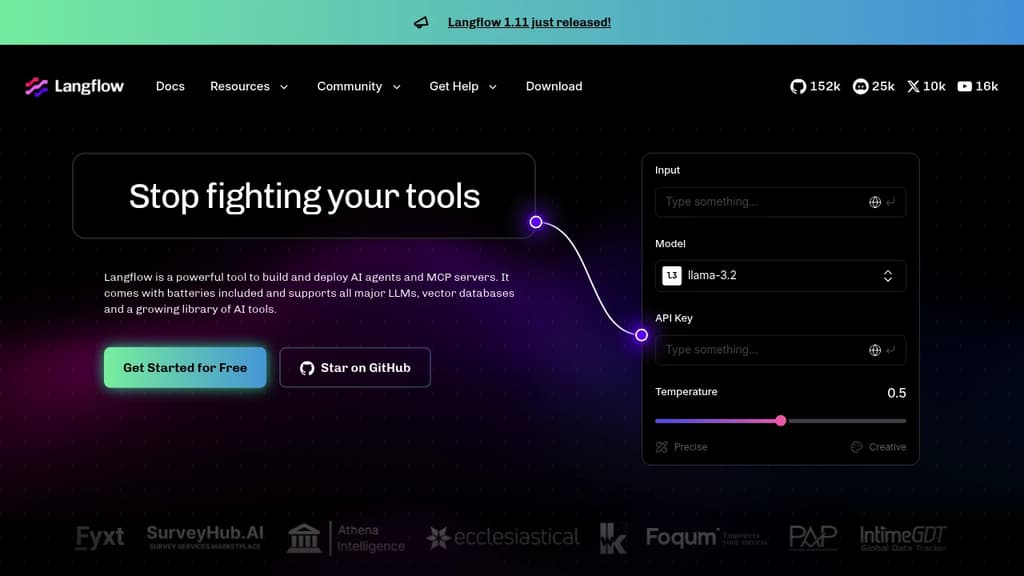
Langflow is a low-code platform for building AI agents and RAG applications visually. It targets developers and AI teams who want to move fast without writing boilerplate, while still having full access to the underlying Python when they need it. The visual canvas lets you wire together models, data sources, and tools by dragging components onto a flow, then deploy that flow as an API with minimal extra work.
The integration library is broad:
- LLMs: OpenAI, Anthropic, Mistral, Meta (Llama), Groq, NVIDIA, Amazon Bedrock, Ollama, HuggingFace, and more
- Vector stores: Pinecone, Milvus, Weaviate, Qdrant, Cassandra, Couchbase, Upstash, Vectara
- Data sources: Google Drive, Confluence, Notion, Gmail, GitHub, Slack, MongoDB, and dozens more
- Agent frameworks: LangChain, CrewAI, Composio
Flows are reusable and shareable. You can pick from a library of pre-built components, swap models mid-flow to compare outputs, and run single agents or coordinated fleets where each agent has access to your components as tools. Every flow exposes itself as an API endpoint, so connecting Langflow to an existing product is straightforward.
Python is always available under the hood. Any component can be customized with code, so the visual layer doesn't box you in. Teams that need observability can pair it with tools like Langfuse for tracing.
Deployment is flexible. Self-host it on your own infrastructure, or use the managed cloud option, which runs the same codebase as the open-source version. That parity matters: there's no feature gap to worry about when moving between environments.
Compared to alternatives like Flowise AI or Dify, Langflow leans into Python extensibility and a wide integration surface, making it a practical fit for teams building production-grade agents rather than quick demos.

AI workspace for building agents by chat, visual canvas, or code, with 280+ integrations, every major LLM, spend limits, permission groups, and self-hosting.
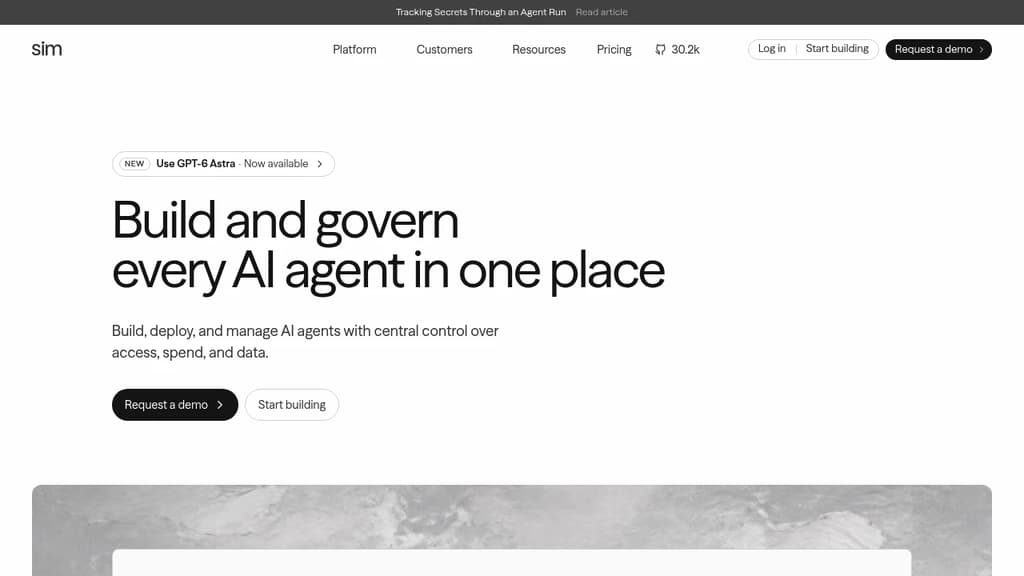
Sim is an AI workspace where teams build, deploy, and manage agents for their organization. It's aimed at companies that want many people creating agents while keeping central control over access, spend, and data. It fits among AI agent platforms and workflow automation tools, and works as an alternative to Microsoft Copilot Studio, Lindy, Zapier or n8n.
There are three ways to build. Describe an agent in Chat and Sim builds it. Use the visual workflow builder, which shows every step. Or write it with code through the API and CLI. Non-technical teams can review and adjust agents without code, and engineers can extend them with custom functions.
- Integrations and models: 280+ integrations with 5,800+ actions and 530+ triggers, plus every major LLM. Local models run through Ollama, vLLM, or LiteLLM.
- Knowledge: agents can work with uploaded files, knowledge bases, and structured tables.
- Deployment: publish an agent as a chat, an API endpoint, or an MCP server. Agents can also run on a schedule or start from event triggers in connected apps.
- Chat access: keep a deployed chat public, or limit it to SSO, specific emails, or a password.
- Monitoring: every run is traced in Logs, with success rate, median run time, and cost.
- Governance: permission groups control which models, integrations, and tools each team can use. Organization and per-member spend limits, audit logs, SSO and SCIM, and configurable data retention are included.
Sim is open source under the Apache 2.0 license. Self-host it with Docker or Kubernetes (npx sim-setup walks through the setup), or use the hosted workspace at sim.ai. A macOS desktop app can connect to either. Enterprise features such as SSO and permission groups are part of the Enterprise plan on Sim Cloud, and self-hosted deployments switch them on through environment variables. Sim has completed a SOC 2 Type II audit covering the Security criterion.

Open-source no-code automation platform for logistics, chatbots, and AI agents. Deploy on cloud, self-host, or hybrid with complete data sovereignty and modular workflow design.
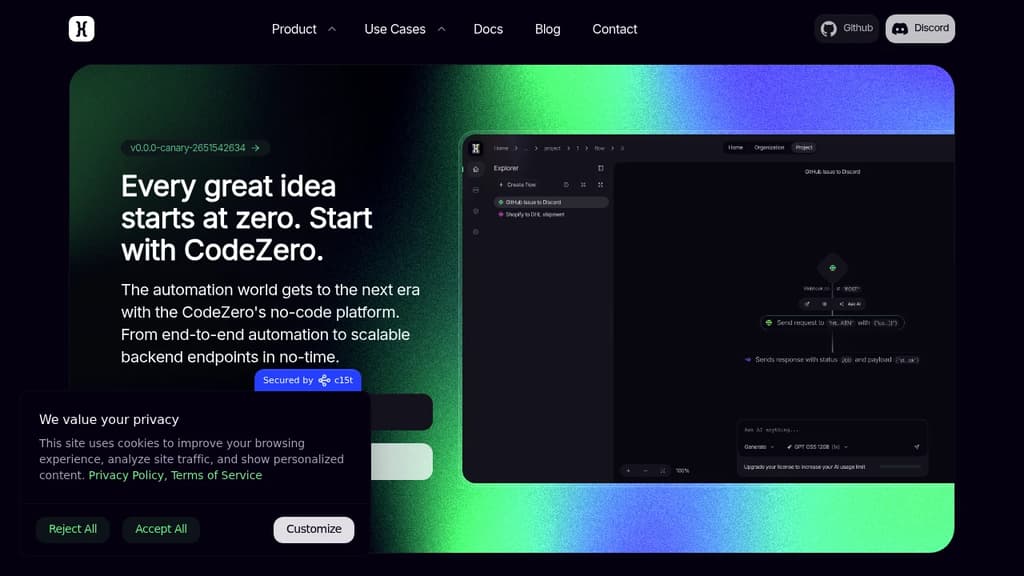
CodeZero is an open-source no-code automation platform that transforms how teams build and deploy complex workflows. Whether you're automating logistics operations, creating intelligent chatbots, or orchestrating AI agents, CodeZero provides a visual interface to design sophisticated automations without writing code.
Key capabilities include:
- Modular automation design - Connect your favorite tools and services through a visual node-based system
- Multiple deployment options - Choose between managed cloud hosting, self-hosted infrastructure, or hybrid dynamic hosting for complete data sovereignty
- AI agent building - Create sophisticated AI workflows with model-agnostic LLM selection and MCP-compatible tool integration
- Team collaboration - Manage projects, organizations, and custom roles with granular permission controls
- Scalable runtime - Launch flows in seconds with built-in monitoring and zero-downtime scaling
- Extensible architecture - Build custom nodes, triggers, and flow types using the Action SDK
Real-world applications:
- Automate shipping operations with label generation and real-time status synchronization.
- Build Discord bots for community management and moderation.
- Create intelligent AI agents that integrate multiple data sources and services seamlessly.
CodeZero eliminates manual data entry, reduces human error, and enables teams to focus on strategy rather than repetitive tasks. The platform supports complex conditional logic, data transformations, and multi-step workflows through an intuitive visual editor.

People are looking for alternatives to...
View all alternatives
Claude

Claude Code

CapCut

Notion

Wispr Flow

Grok Bot
 Postiz – The All-in-One agentic social media scheduling tool

 InfluxDB