Open Source Docker Swarm Alternatives
A curated collection of the 1 best open source alternatives to Docker Swarm.
The best open source alternative to Docker Swarm is dstack. If that doesn't suit you, we've compiled a ranked list of other open source Docker Swarm alternatives to help you find a suitable replacement.
Docker Swarm alternatives are mainly GPU & Compute Platforms. Browse these if you want a narrower list of alternatives or looking for a specific functionality of Docker Swarm.

Written by Piotr Kulpinski


Unified control plane for AI compute that provisions and schedules GPU workloads across any cloud, Kubernetes cluster, or bare-metal server.
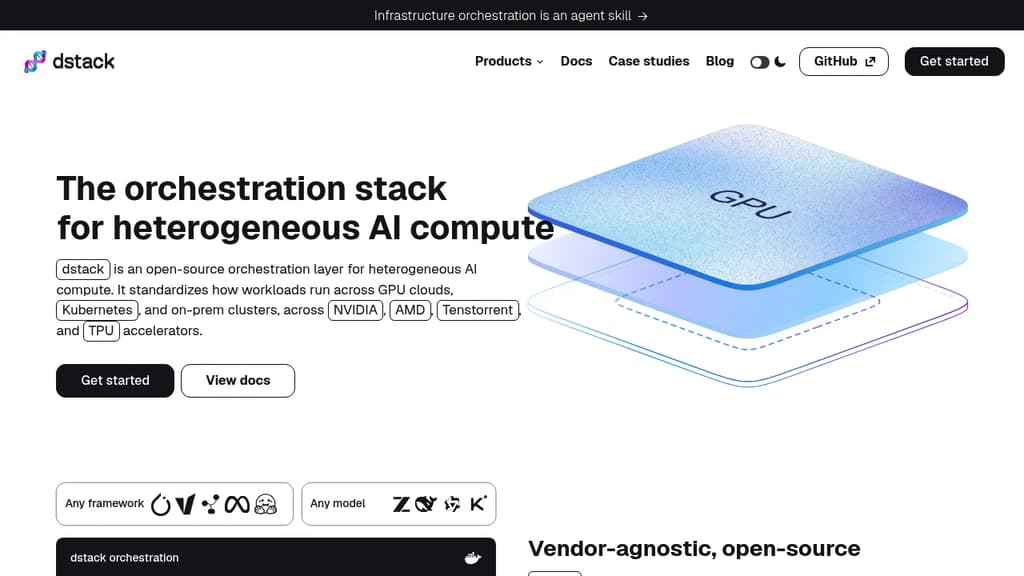
dstack is an open-source orchestration layer built specifically for AI and ML workloads. It gives teams a single control plane to run dev environments, training jobs, and inference services across distributed compute resources, whether those live in AWS, GCP, Azure, Lambda, RunPod, a Kubernetes cluster, or bare-metal servers with SSH access.
The core problem it solves: AI infrastructure is fragmented. Teams end up writing custom glue code for each environment, or fighting general-purpose tools like Kubernetes or Slurm that weren't designed with GPU workloads in mind. dstack abstracts that away with ML-native primitives.
Key capabilities:
- Fleets manage pools of GPU instances with fine-grained controls over spot, on-demand, and reserved capacity, helping reduce effective GPU spend.
- Dev environments let researchers spin up GPU-backed workspaces without touching infrastructure config.
- Tasks support both single-node and distributed training runs across heterogeneous hardware.
- Services handle production inference deployments with the same configuration interface.
- Volumes provide persistent storage that follows workloads across environments.
- Multi-cloud and on-prem support covers NVIDIA, AMD, Tenstorrent, and TPU accelerators in a single workflow.
If you already run Kubernetes, dstack connects to existing clusters via kubeconfig and schedules workloads alongside cloud backends. Bare-metal servers with SSH access work the same way. You can mix cloud accounts, Kubernetes clusters, and on-prem nodes in one project.
For teams without existing cloud accounts, dstack Sky offers a hosted GPU marketplace with access to H100s, A100s, B200s, and other hardware at competitive rates.
Compared to Slurm, dstack is container-first and cloud-native, with built-in support for inference and development (not just batch jobs). Compared to raw Kubernetes, it's purpose-built for ML: you declare what you need in simple configuration, and dstack handles provisioning, scheduling, and cost optimization. It works with any open-source framework and your own Docker images, so there's no lock-in to a specific ML stack.

People are looking for alternatives to...
View all alternatives
Spotify

Claude Code

CapCut

Claude

Notion

Lovable
 c15t – Open-source cookie banner, built for control and lightening fast modern web apps.
 Sent
Sent