Open Source Cozystack Alternatives
A curated collection of the 2 best open source alternatives to Cozystack.
The best open source alternative to Cozystack is Spinifex. If that doesn't suit you, we've compiled a ranked list of other open source Cozystack alternatives to help you find a suitable replacement. Other interesting open source alternative to Cozystack is OpenStack.
Cozystack alternatives are mainly Cloud Computing Services. Browse these if you want a narrower list of alternatives or looking for a specific functionality of Cozystack.

Written by Piotr Kulpinski


Spinifex recreates EC2, S3, EBS, VPC, IAM, and more on your own hardware, so AWS-built software runs unchanged without touching a hyperscaler.
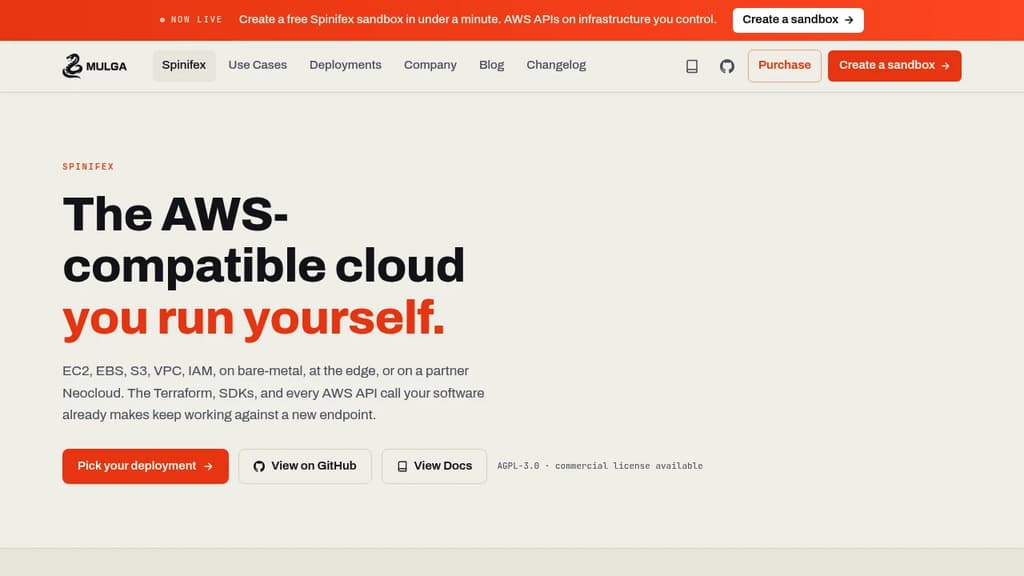
Spinifex is an open-source platform that runs AWS-compatible APIs on infrastructure you own. If your software already talks to EC2, S3, EBS, VPC, or IAM, it keeps working on Spinifex without any code changes. Same AWS SDKs, same Terraform configs, same CLI. You change where the workload runs, not what it is.
The core use case is straightforward: move workloads off hyperscalers, run them on your own racks, at the edge, or on a Neocloud partner, without re-platforming. It's particularly relevant for sectors where data sovereignty, air-gapped deployments, or cost control matter most: defence, healthcare, financial services, energy, and AI/ML teams paying GPU rates to a hyperscaler.
Spinifex didn't just wrap an existing API layer. The engineering underneath was rebuilt from scratch:
- Object storage (S3-compatible): Reed-Solomon erasure coding across nodes for durability without triple-replication costs.
- Block storage (EBS-compatible): Volumes that keep serving when a node drops. Snapshots, attach/detach, and growable volumes included.
- Compute (EC2-compatible): QEMU/KVM on bare metal you own. No hypervisor tax eating into performance.
- Networking (VPC): Built on OVN/OVS.
- Identity (IAM): SigV4 authentication and policy enforcement.
- Kubernetes (EKS): Conformant K8s included in the same stack.
- Container registry and service (ECR/ECS): Available alongside load balancing (ALB/NLB) and managed databases (RDS).
Deployment shapes are flexible. Spinifex runs on a single node, a cluster, an edge box, or an air-gapped rack. The API surface stays the same across all three.
Licensed under AGPL-3.0, the core is auditable and self-hostable. You're not dependent on a vendor's continued goodwill to keep running your own infrastructure.

OpenStack manages compute, storage, and networking across VMs, bare metal, and containers via APIs or a dashboard. Trusted by Walmart, China Mobile, and more.
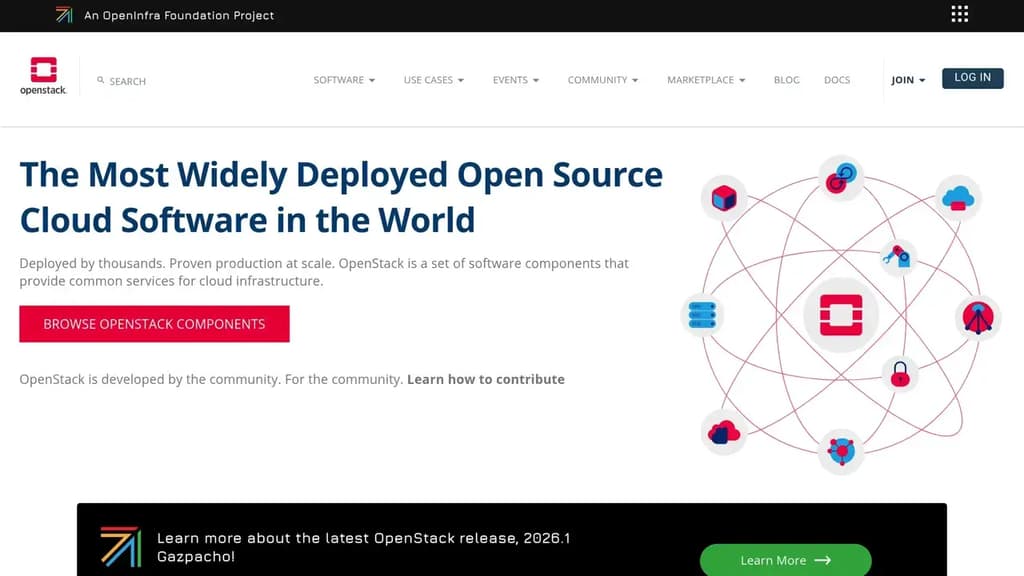
OpenStack is one of the most widely deployed cloud computing platforms in the world. It gives organizations full control over their infrastructure, running on-premises, in public cloud environments, or at the edge. Thousands of organizations run it in production, managing over 40 million cores globally across dozens of industries.
At its core, OpenStack pools compute, storage, and networking resources and exposes them through APIs or a web dashboard. You get standard infrastructure-as-a-service capabilities, plus additional components for orchestration, fault management, and service management to keep applications highly available.
What OpenStack supports:
- Virtual machines, bare metal, and containers - not locked into a single workload type
- Large-scale deployments - Walmart runs over 170,000 cores across 30+ regions on OpenStack
- Telecom-grade infrastructure - China Mobile built its NFV network on OpenStack with 50,000+ servers
- Autoscaling - Blizzard Entertainment uses it to handle variable load for live online games
- Apache 2.0 license - fully open source, no vendor lock-in
OpenStack is a genuine alternative to proprietary cloud platforms like Microsoft Azure when you need to own your infrastructure entirely. It's the right fit for enterprises, telecoms, and service providers that need scale, flexibility, and the ability to run everything on their own hardware.
Storage can be paired with Ceph for distributed block and object storage, and teams working with container-native workloads often combine OpenStack with Kubernetes for orchestration. For infrastructure-as-code workflows, tools like OpenTofu integrate naturally with OpenStack APIs.
The project is backed by the OpenInfra Foundation and has a large, active contributor community. There is a consistent release cadence that keeps the platform current.

People are looking for alternatives to...
View all alternatives
Spotify

Claude Code

CapCut

Claude

Notion

Lovable
 Docmost – Open-source wiki software with real-time collaboration, diagrams, AI, SSO, RBAC permissions and more.
 Sent
Sent