Open Source Continue Alternatives
A curated collection of the 3 best open source alternatives to Continue.
The best open source alternative to Continue is Kilo. If that doesn't suit you, we've compiled a ranked list of other open source Continue alternatives to help you find a suitable replacement. Other interesting open source alternatives to Continue are: Zero and Roomote.
Continue alternatives are mainly AI Coding Agents. Browse these if you want a narrower list of alternatives or looking for a specific functionality of Continue.

Written by Piotr Kulpinski


Open source AI coding agent with 500+ models, bring-your-own-key support, and specialized modes for writing, debugging, and planning code across IDEs and CLI.
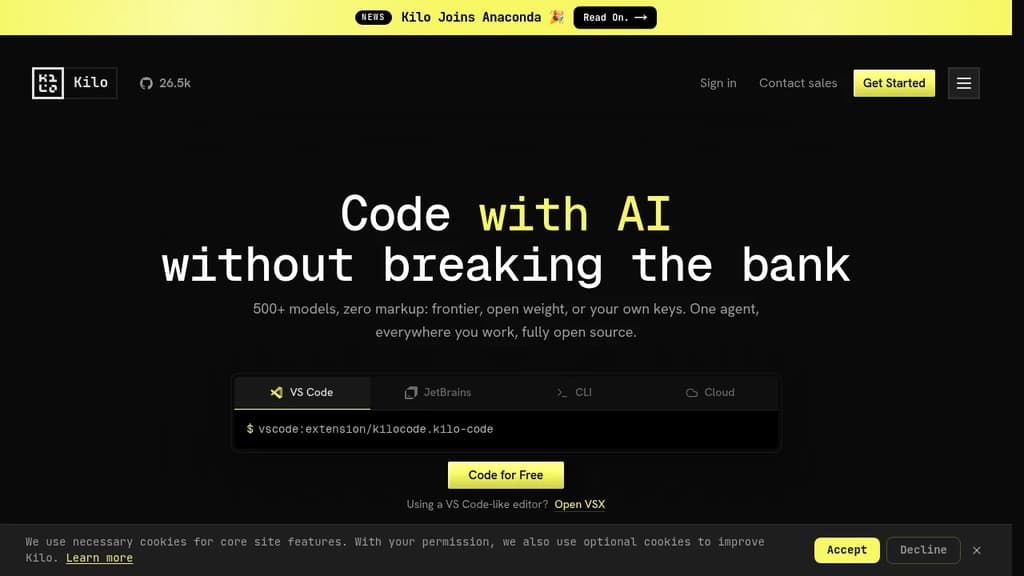
Kilo is an AI coding agent that works inside VS Code, JetBrains, the command line, and a hosted cloud environment. It's built for developers who want full control over their AI setup: bring your own API keys at zero markup, use local models to keep code private, or route through Kilo's model gateway to access 500+ models.
The agent ships with five specialized modes, each suited to a different part of the development workflow:
- Code Mode writes, refactors, and ships production-ready code with full codebase context
- Architect Mode helps plan complex features and structure work before any code is written
- Debug Mode reads errors, traces issues, and suggests targeted fixes
- Ask Mode answers questions about your codebase without making changes
- Custom Mode lets you define your own agent behavior for specific workflows
Switching between modes doesn't mean switching tools. Everything runs in the same agent, in the editor or terminal you're already using.
Kilo also includes KiloClaw, a managed version of the OpenHands open agent platform. It deploys in under 60 seconds with no Docker, SSH, or config files required. Once running, KiloClaw connects to Telegram, Discord, or Slack, handles scheduled tasks and cron jobs, and acts on your behalf autonomously. It's the part of Kilo designed for background work: running tasks while you're away, automating repetitive operations, or handling code review in the cloud.
For teams comparing options, Kilo positions itself against tools like Cline and Roo Code as a more fully integrated alternative with broader model support and cloud agent capabilities built in. The codebase is Apache-2.0 licensed and fully open source.

Open-source AI coding agent for the terminal that works with 25+ model providers, keeps sessions on your disk, and ships as a single Go binary with no telemetry.
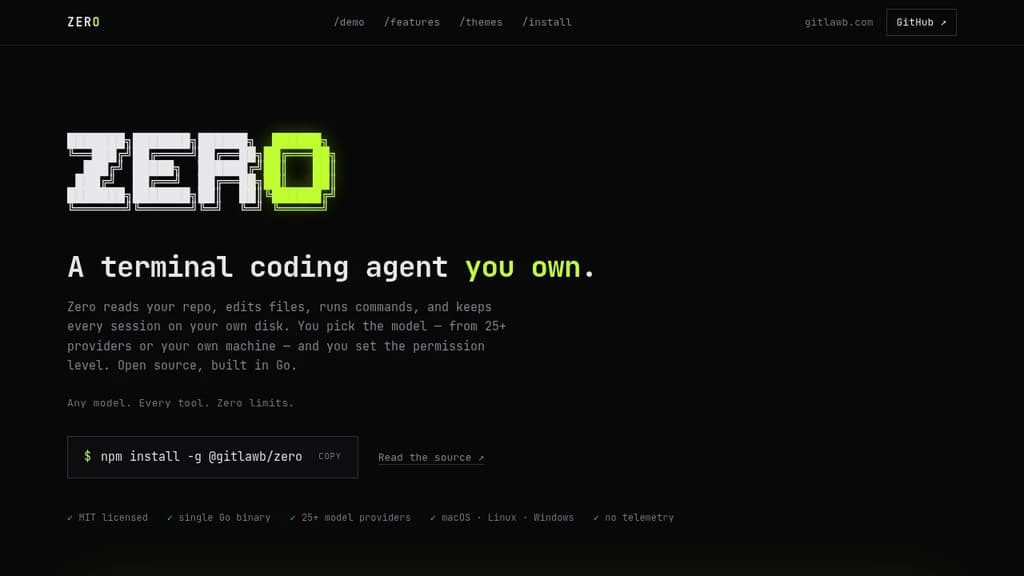
Zero is a terminal coding agent built for developers who want full control over their AI tooling. It reads your repo, edits files, runs commands, and stores every session locally on your disk. No cloud sync, no telemetry, no vendor lock-in on the model side.
The model choice is genuinely open. Zero connects to 25+ providers including OpenAI, Anthropic, Gemini, Mistral, Groq, DeepSeek, Bedrock, Vertex AI, and local options like Ollama and LM Studio. You can switch providers mid-session with /model, or point it at any OpenAI- or Anthropic-compatible endpoint.
Permissions are explicit and visible. Every side effect (file writes, shell commands, network access) is gated, with OS-level sandboxing. Autonomy is an opt-in, not the default. That makes it practical to run in CI as well as interactively.
Key capabilities:
- Headless mode for one-shot or scripted runs with JSON and stream-JSON output, plus reliable exit codes for pipelines
- MCP support in both directions: consume MCP servers over stdio, HTTP, or SSE, or expose Zero itself as an MCP server
- Spec-first runs to draft and review a plan before any file changes
- Specialist subagents to fan work out to focused sub-sessions you can inspect live
- Isolated git worktrees for risky changes you can discard if they don't pan out
- Session history that's searchable, resumable, and forkable from the command line
- Skills and plugins for encoding team conventions in markdown and extending behavior with hooks
- Scheduled agents for recurring jobs like nightly triage or dependency sweeps
- GitHub Action for PR review and CI jobs using the same agent
Sessions live in ~/.config/zero/ and API keys are stored in an encrypted local store. Unlike some other terminal agents, Zero ships as a single Go binary that runs on macOS, Linux, and Windows (x64 and arm64). Twelve contrast-audited themes are included.
It's MIT licensed. You pay your model provider, or nothing at all with a local model.

Source-available, self-hosted AI coding agent that connects to your repo, tools, and chat to investigate issues and open reviewable PRs on your own infrastructure.
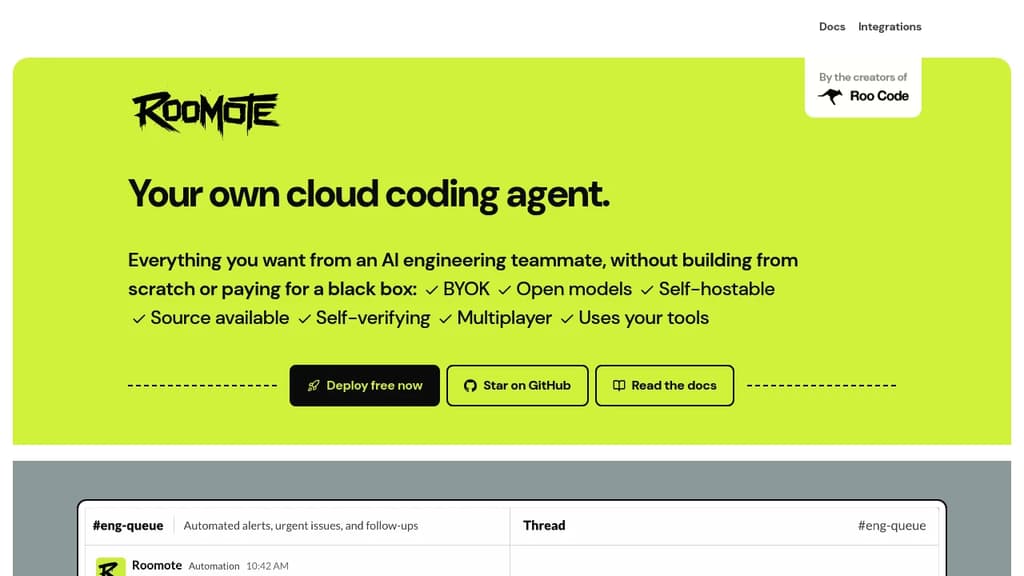
Roomote is a self-hosted, source-available AI coding agent built for engineering teams that want autonomous coding work without handing their code, prompts, or data to a vendor's black box. It connects to the tools your team already uses and returns reviewable pull requests through your normal review workflow.
Unlike IDE-based tools like Cline or local agents, Roomote runs in the cloud on your own infrastructure. You assign it work from Slack, an issue tracker, GitHub, or the web. It investigates, plans, and ships changes, then opens a PR your team can read end to end. You keep full control of what merges.
What it can do:
- Full lifecycle tasks. Repo-backed answers, scoped fixes, database migrations, bug investigations, and reviewable PRs. Not just code suggestions.
- Self-review loops. Before marking work done, it runs the actual app, reviews its own changes, and attaches previews or screenshots as proof.
- Live preview URLs. Reviewers get a running instance to inspect, not just a diff.
- Parallel tasks. Multiple teammates can run unlimited tasks simultaneously, including live multi-user sessions on the same issue.
- Model-agnostic. Bring Claude, GPT, or any open-weight model. Swap providers without changing your workflow.
- Broad integrations. Connects to Jira, Linear, Sentry, Grafana, Supabase, BigQuery, Snowflake, Figma, Notion, PostHog, Vercel, and more.
Roomate uses OpenCode as its underlying harness, which keeps it token-efficient compared to first-party vendor agents.
Every prompt, decision path, and line of the agent is in the repository. You can read it, fork it, and adapt it for your team's needs. The license lets you self-host, modify, and redistribute it for internal use, education, and professional services. Competing commercial products built on top of it are the main restriction.
It's a practical fit for engineering leaders who want model choice and deployment control, and for solo developers who want a cloud agent they own and can run cheaply on open-weight models. Non-engineering teammates can also assign work through familiar interfaces without any local setup.

People are looking for alternatives to...
View all alternatives
Claude Code

Spotify

CapCut

Claude

Notion

Lovable
 Sent – A unified API for sending messages across SMS, RCS, and apps like WhatsApp.
 ScreenshotOne