Open Source ChatGPT Work Alternatives
A curated collection of the 7 best open source alternatives to ChatGPT Work.
The best open source alternative to ChatGPT Work is LobeHub. If that doesn't suit you, we've compiled a ranked list of other open source ChatGPT Work alternatives to help you find a suitable replacement. Other interesting open source alternatives to ChatGPT Work are: Goose, OpenWork, MausBot, and Eigent.
ChatGPT Work alternatives are mainly AI Agent Platforms but may also be AI Personal Assistants or AI Coding Agents. Browse these if you want a narrower list of alternatives or looking for a specific functionality of ChatGPT Work.

Written by Piotr Kulpinski


Add AI agents to Slack, Discord or Telegram that pick up requests, hand coding to Claude Code or Codex, report back in thread, and learn from your corrections.
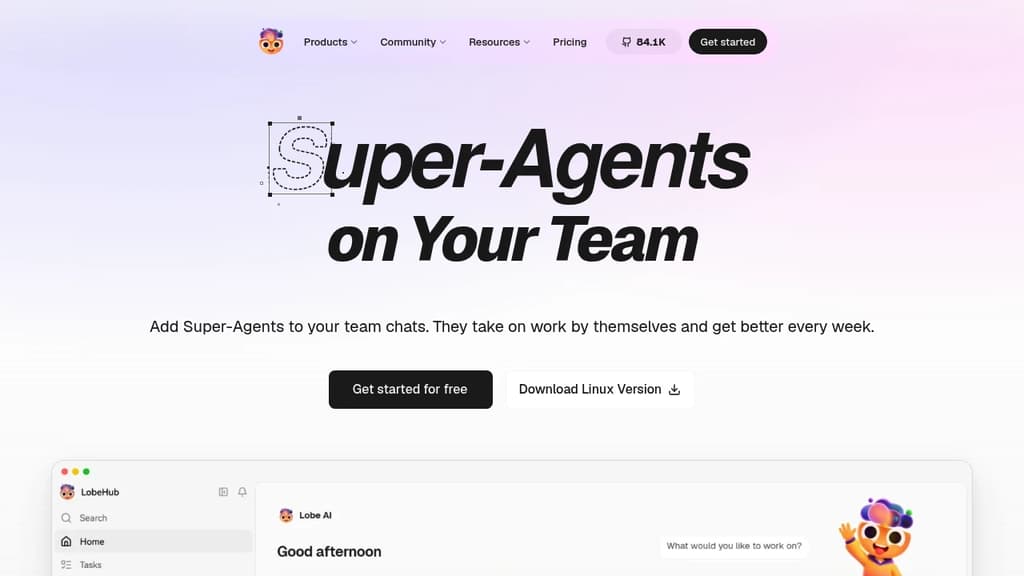
LobeHub is a collaborative agent platform where AI agents join your team chats and take on work. You add an agent to Slack, Discord or Telegram, and it reads the channel history, docs and code before it does anything. It's built for teams that want routine requests handled without someone assigning every task.
The agent can act on its own. With the "speak up on its own" setting on, it spots a feature request that several people have +1'd, creates a task, and starts work without being tagged.
- Coding handoff: it passes the build to Claude Code or Codex and tracks the task
- Acceptance checks: each delivery comes with screenshots or recordings, and you can send back any check that's off
- Pull requests: the PR merges only after you accept
- Thread replies: it tells the people who asked once the work is live
- Permissions: you decide what it can do, for example opening PRs freely while deploys need your OK
- Daily brief: a home page lists what finished, what's running, and what needs your decision
The agent also learns. A Self-evolving page shows each area it practices, the lessons you've taught it, and how often it gets things right. Mistakes become lessons, and a rule it keeps breaking is flagged so you can teach it again.
You can start with one agent and add more later, such as separate agents for design, releases and docs. Each teammate can have their own too. Agents remember team preferences, like sending pricing copy to a specific person for sign-off.

Local AI agent with a desktop app, CLI, and API that connects to 15+ LLM providers and 70+ extensions for code, research, automation, and data tasks.
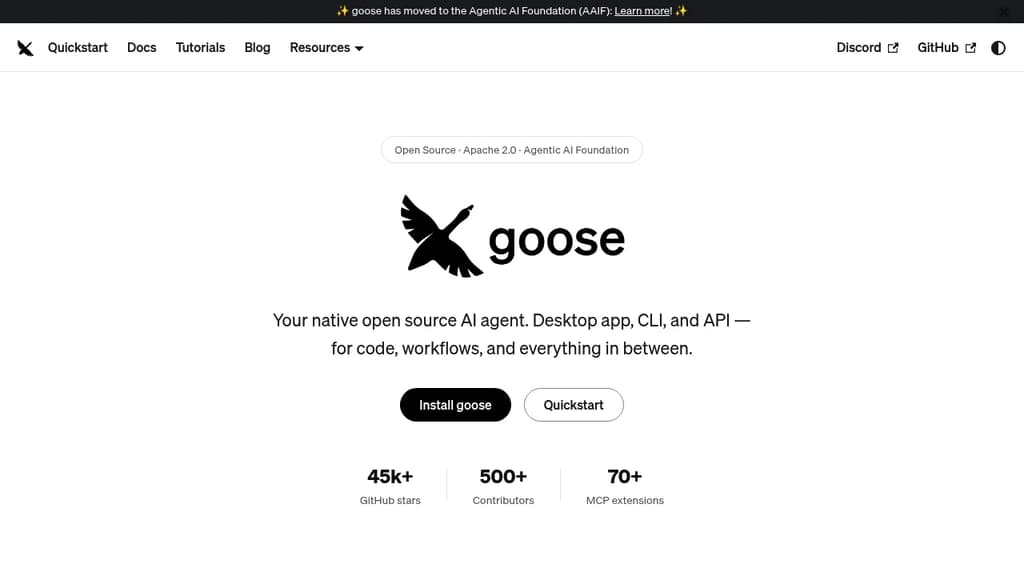
Goose is a general-purpose AI agent that runs natively on your machine. It's not narrowly focused on coding: you can use it for research, writing, data analysis, browser automation, or any multi-step task you'd otherwise piece together manually. It ships as a desktop app for macOS, Linux, and Windows, a full CLI for terminal-first workflows, and an API for embedding it in other tools.
The LLM support is broad. Goose works with 15+ providers, including Anthropic, OpenAI, Google, Ollama, LocalAI, OpenRouter, Azure, and Bedrock. You can use API keys or connect through existing Claude, ChatGPT, or Gemini subscriptions, so you're not locked into a new billing relationship just to try it.
Extensibility is central to how goose works:
- 70+ MCP extensions connect it to databases, APIs, browsers, GitHub, Google Drive, and more via the open Model Context Protocol standard
- MCP Apps let extensions render interactive UIs inside the desktop app, including buttons, forms, and visualizations
- Recipes let you capture repeatable workflows as portable YAML configs, shareable with a team or runnable in CI
- Subagents can be spawned to handle tasks in parallel, keeping the main conversation focused
- Security controls include prompt injection detection, tool permission controls, and a sandbox mode
Goose also implements the Agent Client Protocol, which means it works as an ACP server you can connect from editors like Zed, JetBrains, or VS Code. It can use Codex and similar agents as providers through the same standard.
The project sits under the Agentic AI Foundation at the Linux Foundation, which keeps it vendor-neutral and community-governed. Built in Rust for performance, it has attracted 500+ contributors and 45k+ GitHub stars. If you want a self-hostable, provider-agnostic agent that works across interfaces and integrates deeply with the MCP ecosystem, goose covers a lot of ground.

Desktop app for teams to run AI agents across 50+ LLMs, share skills and MCP servers org-wide, and automate browser tasks with your own keys.
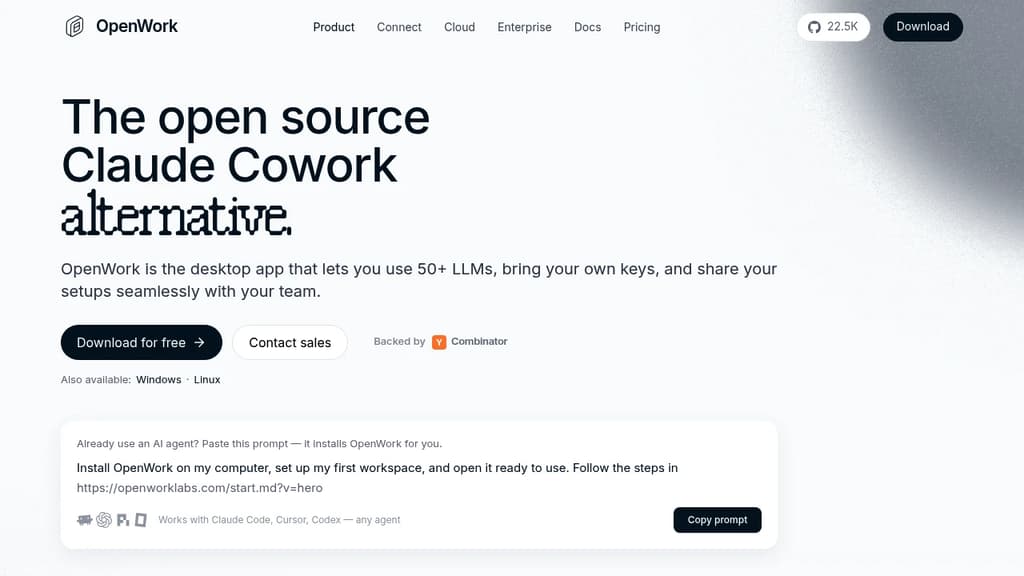
OpenWork is a desktop app (and browser-based workspace) that lets individuals and teams run AI agents against their own files, tools, and data. It's built on OpenCode and positions itself as an open alternative to Claude Cowork, supporting 50+ LLMs from providers like OpenAI, Anthropic, Google, Mistral, and local models, rather than locking you to a single vendor.
The core idea: bring your own API keys, wire in the tools your team already uses, and package everything into reusable setups that anyone can import in one click. No terminal required.
Key capabilities:
- Multi-model support – switch between OpenAI, Anthropic, Gemini, Bedrock, Azure AI Foundry, Mistral, OpenRouter, or local models. Connect your own keys or use a managed provider on cloud plans.
- Browser automation – describe a task in plain language and the agent executes it in a real browser. Like replies, extract data, fill forms, and save results to your machine.
- OpenWork Connect (MCP gateway) – add an MCP server or skill once, and every teammate gets it instantly across desktop, web, and any MCP-compatible client like Claude Code or Cursor. One URL covers your whole org, with auth, roles, and policies applied in transit.
- Skill and plugin sharing – Anthropic-compatible plugins and SKILL.md files work as-is. Teams package skills, configs, and MCP servers into a single shareable link.
- Local-first privacy – in desktop mode, files stay on your machine. Prompts go directly to the LLM provider you choose. Cloud workers are optional and sandboxed.
- Self-host or managed – run it on your own infrastructure or use OpenWork Cloud for central seat management, SSO, and bring-your-own inference.
For teams migrating from Claude Cowork, existing SKILL.md files and MCP servers import without modification. The free desktop app needs no account to start. Team plans add API access and the Extension Marketplace at $10 per seat per month after the first five free seats.

Run a team of AI agents locally on your own API keys and subscriptions, with scheduled tasks, computer use, and Gmail, GitHub and Slack integrations.
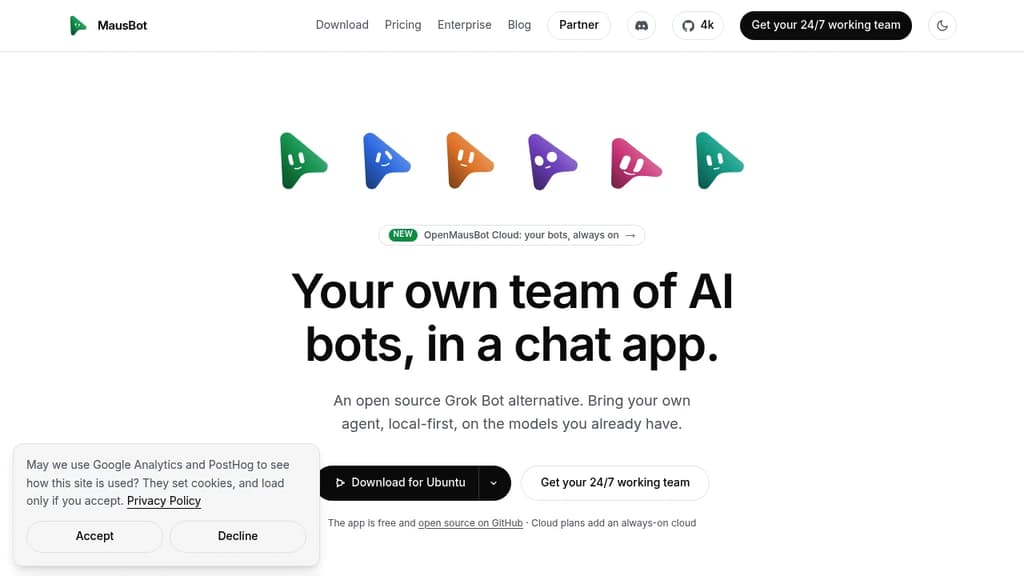
MausBot is a local-first Grok Bot alternative that lets you run a team of AI agents from a familiar chat interface. Each bot gets its own model, its own computer, and access to your connected apps. They work in parallel, come back when something needs your attention, and never proxy your credentials through a third party.
It runs on Mac, Windows, and Linux under Apache 2.0. Your transcripts, keys, and events stay in a local folder on your own disk. Local-first isn't a setting; it's the default.
Key capabilities:
- Model per bot. Assign Claude, Codex, or other models to individual bots and switch mid-conversation.
- Computer use. Each bot gets a desktop it can see and click, either a cloud desktop from a provider you connect or your local machine directly.
- Scheduled tasks. Inbox sweeps, weekly reports, competitor watches, PR reviews, and support triage all run on a calendar you define.
- Connected apps. Gmail, Slack, GitHub, Notion, Linear, and hundreds more via Composio. Authenticate once and every bot on the team can use them.
- Voice. Hit call and the bot hears you, narrates its work, and asks for approvals out loud.
- Playbooks. A whole team, its routines, and its app connections ship as a single Markdown file. Connections stay off until you approve them.
- Manage bots like contacts. Pin, duplicate, mark unread, hide, or delete. The interface is a messaging app, not a dashboard.
For teams that want bots running around the clock without leaving a laptop on, Cloud plans add always-on workspaces with scheduled tasks and voice included. You still bring your own Claude or ChatGPT account; MausBot never sits between you and the model provider.
Compared to other AI chat interfaces, MausBot is built specifically for multi-agent workflows where each agent has persistent tasks, tool access, and its own compute rather than just a shared conversation window.
Self-hostable desktop app that runs a coordinated team of AI agents to browse the web, manage files, execute terminal commands, and complete complex workflows.
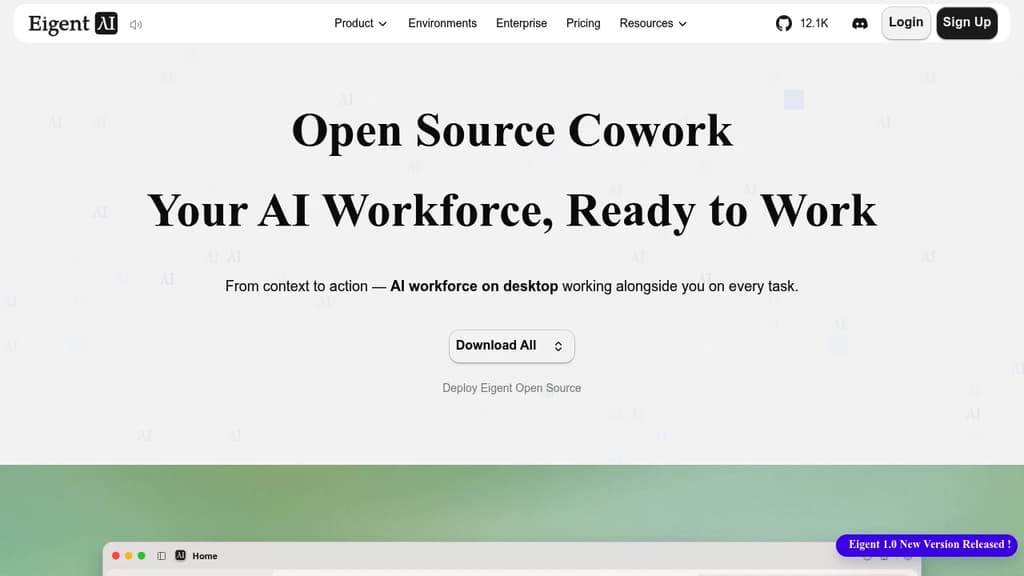
Eigent is a desktop application that puts a multi-agent AI workforce on your machine. You describe a task, and a pool of specialized agents divides it up, works in parallel, and delivers results. It's built for people who want AI to actually finish work, not just assist with it.
The core idea is "cowork": agents operate alongside you in your desktop environment with access to your local files, browser, and terminal. You can run a single focused agent for direct tasks or spin up a full workforce where agents collaborate across steps. A Browser Agent handles web research, a Document Agent reads and writes files, a Terminal Agent runs shell commands, and a Multi-modal Agent processes images and other media.
Key capabilities include:
- Scheduled automation: set recurring workflows so agents run tasks on a timer, even when you're not at your desk
- Local-first execution: files, credentials, and context stay on your machine; nothing has to leave it
- Model agnostic: connect cloud APIs, enterprise model gateways, or local inference. No vendor lock-in
- MCP and skill support: track which tools, skills, and referenced files each agent uses during a task
- Agent folder: every file an agent creates or modifies during a task is surfaced in one place for review
The open source version is fully self-hostable with your own API keys or local models. It's built on CAMEL-AI, a multi-agent framework, and runs on Mac, Windows, and Linux.
For teams doing research-heavy work, competitive analysis, report generation, or any task that involves pulling from multiple sources and producing structured output, Eigent is closer to OpenHands than a simple chat interface. It's designed to complete multi-step work end-to-end rather than hand control back to you at every turn.

Desktop app that lets multiple AI agents collaborate as a team, using your existing ChatGPT, Claude, Gemini, or Grok plans, with workspaces and conversations stored locally.
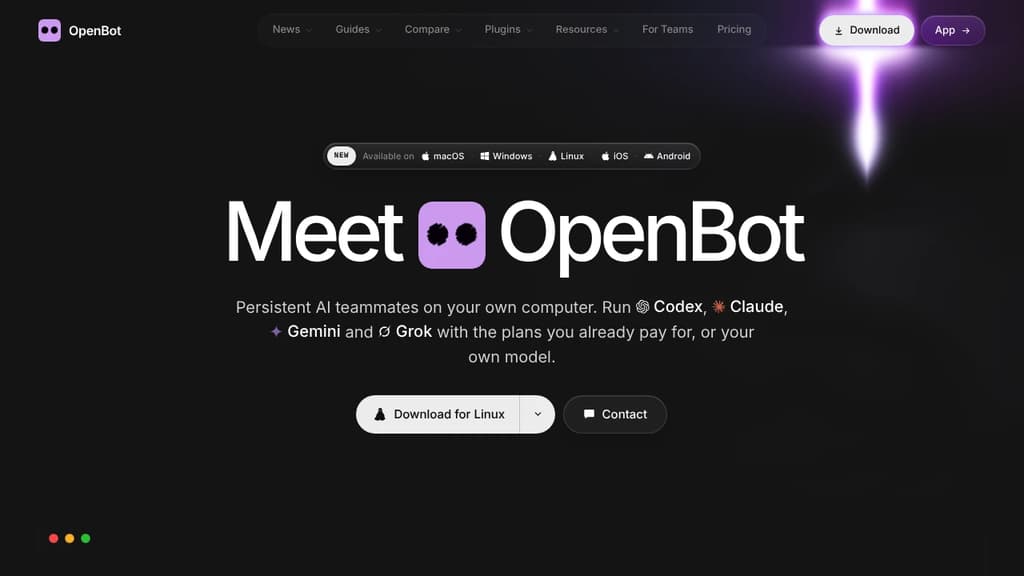
OpenBot turns AI models into a team of persistent agents that work together on your computer. Instead of one chatbot answering questions, you get named agents with individual instructions, workspaces, and conversation histories. They message each other, hand off tasks, and review each other's work, so a bug found by one agent can be fixed by another and merged by a third, without you orchestrating every step.
The app is free for personal use and runs on macOS, Windows, and Linux. Workspaces, conversations, attachments, and browser data live on your machine, though agents still connect to the model providers you choose.
What agents can do:
- Use plans you already pay for. Connect Codex, Claude Code, Gemini, Grok, OpenCode, Cline, Cursor, or any OpenAI-compatible endpoint, including local models via Ollama or LM Studio.
- Built-in browser. Agents open, read, and control web pages inside a browser that's part of the app, so they can interact with live sites without extra setup.
- Task queue. Send more work while an agent is busy. Messages wait in a queue you can pause, resume, or cancel.
- Automatic failover. When a plan hits its usage limit or a provider goes down, an agent switches to a backup model and keeps its chat and workspace intact.
- Agent persistence. An agent keeps its full context when you restart the app or switch it to a different provider.
Each agent has its own name and instruction set. You describe what you want in a prompt, review the generated instructions, and the agent is ready. Teams grow naturally: add more agents and they coordinate around whatever work is in flight.
For teams that need always-on availability, a managed server option runs OpenBot outside any single laptop, with shared or per-employee environments and custom integrations into existing tools and APIs. The source code is available under the PolyForm Noncommercial license, so you can audit what the app does, but commercial use requires a paid license.

Open-source workspace for building and running AI agents: chat-driven development, scheduling, human-in-the-loop approvals, versioning, and tracing. Self-host or use the cloud.
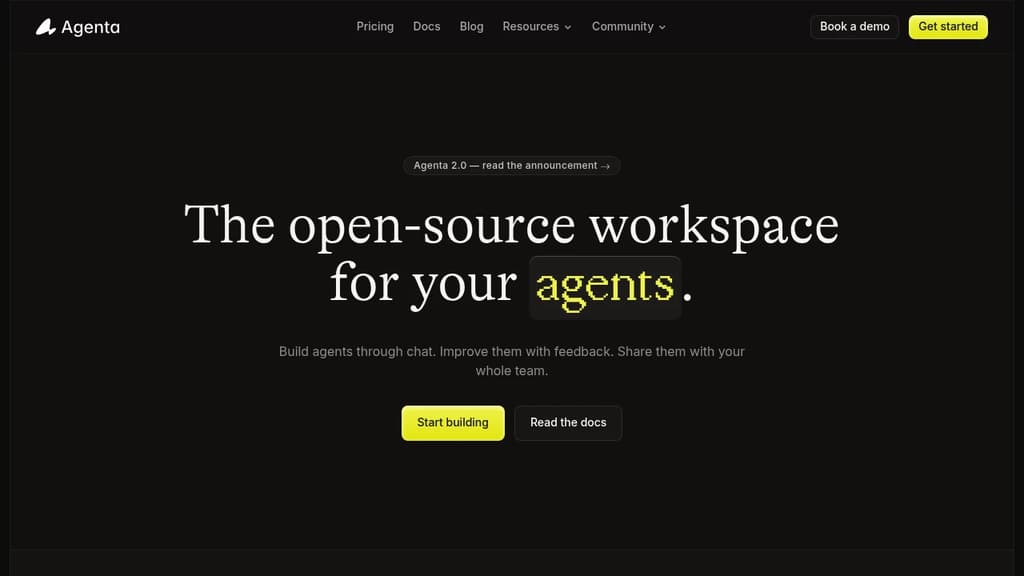
Agenta is a workspace for teams building and operating AI agents. It's built around a simple idea: you should be able to work with an agent in chat, then turn that same conversation into an automated workflow without rewriting anything.
You start by describing what you want done. The agent works with your files, apps, and integrations to get it done. When you're satisfied, you tell it when to run on its own. That's the whole loop.
Key capabilities:
- Chat-first development – build and test agents conversationally, then schedule them to run without you
- Human-in-the-loop controls – consequential actions pause for your approval before anything is sent or changed
- Full versioning – prompts, skills, and tools are versioned like code, with rollback to any point
- Run tracing – every execution shows each step, its cost in tokens and dollars, and where failures occurred
- Continuous improvement – feedback from real runs becomes test cases, and changes are evaluated before they ship
- Open standards – agents are defined as AGENTS.md files with skills and MCP tools, so you can swap the model, harness, or runtime without rewriting the agent
Agenta ships with templates for common jobs: code review, customer support, sales outreach, knowledge retrieval, and operations. The code review agent template, for instance, reads pull request diffs, flags bugs and security issues inline, and tags code owners when sensitive areas like auth or billing are touched.
For teams concerned about data residency, Agenta is MIT-licensed and fully self-hostable. The self-hosted version runs the same code as Agenta Cloud, with no feature gaps or lock-in. When running locally, you can use your existing Claude or ChatGPT subscription rather than paying for a separate API key.
Agenta fits teams that want to move agents from prototype to production without losing visibility into what's actually happening at runtime.

People are looking for alternatives to...
View all alternatives
Spotify

Claude

Claude Code

CapCut

Lovable
Notion
 c15t – Open-source cookie banner, built for control and lightening fast modern web apps.


 c15t