Open Source BugHerd Alternatives
A curated collection of the 3 best open source alternatives to BugHerd.
The best open source alternative to BugHerd is Sentry. If that doesn't suit you, we've compiled a ranked list of other open source BugHerd alternatives to help you find a suitable replacement. Other interesting open source alternatives to BugHerd are: Bugsink and BugPin.
BugHerd alternatives are mainly Error Tracking Tools but may also be Performance Monitoring (APM) Tools or Feedback & Feature Request Management Tools. Browse these if you want a narrower list of alternatives or looking for a specific functionality of BugHerd.

Written by Piotr Kulpinski


Detect, diagnose, and resolve software issues quickly with powerful error tracking, performance monitoring, and release management.

Sentry is a powerful developer-first application monitoring platform that helps teams identify, triage, and resolve software errors and performance issues in real-time. With its comprehensive suite of tools, Sentry enables developers to:
- Catch and diagnose errors instantly: Receive detailed error reports with stack traces, user context, and environment information to quickly pinpoint and fix issues.
- Monitor application performance: Track key metrics, identify bottlenecks, and optimize your code with performance monitoring and profiling tools.
- Streamline release management: Correlate errors with specific releases, track adoption rates, and manage version rollouts effectively.
- Integrate seamlessly: Connect Sentry with your existing workflow using integrations for popular development tools and platforms.
- Customize and scale: Tailor Sentry to your needs with flexible data management, custom alerting, and support for multiple programming languages and frameworks.
By providing real-time visibility into your application's health, Sentry helps teams reduce downtime, improve user experience, and ship better code faster. Whether you're working on web, mobile, or desktop applications, Sentry's robust features and intuitive interface make it an essential tool for modern software development and operations.

Bugsink offers real-time error tracking with self-hosting capabilities, allowing easy installation and connection to any app using Sentry-compatible SDKs.
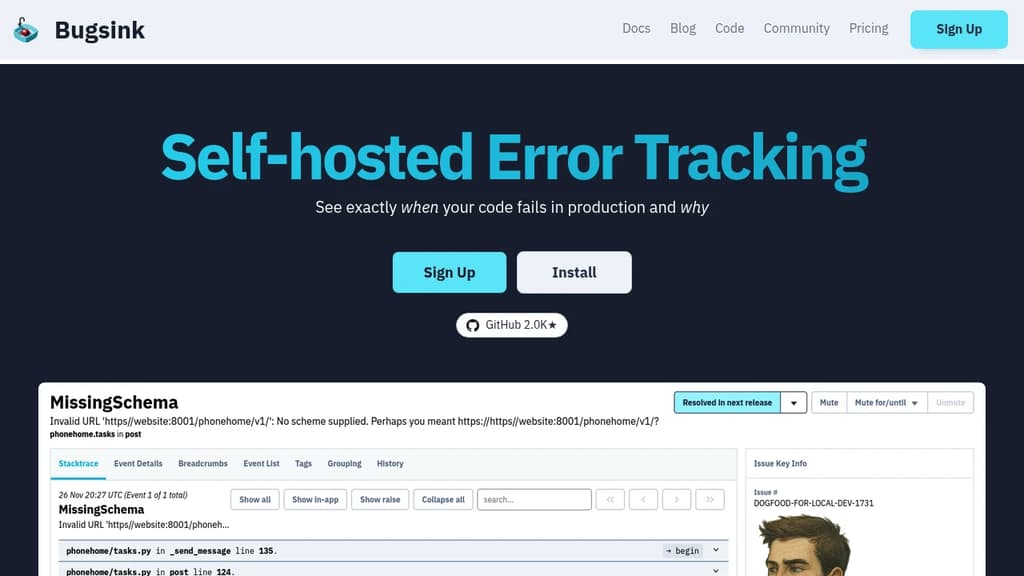
Bugsink is a powerful self-hosted error tracking solution designed for developers who want full control over their error monitoring infrastructure. With Bugsink, you can easily install the platform on your own servers and connect any application using Sentry-compatible SDKs.
Key features of Bugsink include:
- Self-hosted control: Install Bugsink on your own servers for complete data ownership and privacy.
- Real-time error tracking: Get instant notifications about errors in your applications as they occur.
- Sentry SDK compatibility: Seamlessly integrate with most popular programming languages using existing Sentry SDKs.
- Scalable performance: Handle millions of events daily without failure, ensuring reliability when you need it most.
- Comprehensive error details: Access all the information needed to triage and fix errors in one centralized location.
- Easy installation: Follow detailed instructions to get up and running quickly.
Bugsink empowers development teams to maintain high-quality applications by providing a robust, scalable, and self-controlled error tracking solution. Whether you're managing a small project or a large-scale application, Bugsink offers the tools you need to identify, analyze, and resolve issues efficiently.

Embeds a lightweight widget into web apps so users can capture screenshots, annotate issues, and submit reports with console logs and browser metadata included.
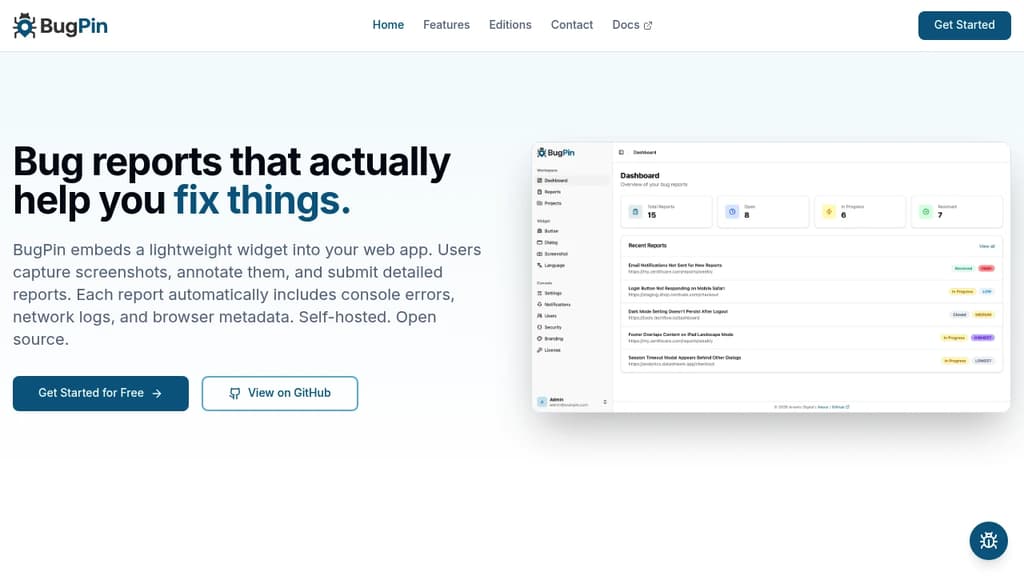
BugPin is a self-hosted bug reporting tool built for web teams who want detailed, visual reports without sending data to a third-party cloud. It embeds a small widget directly into your web app, letting users capture screenshots, annotate them, and submit reports in seconds. Each submission automatically bundles console errors, network logs, and browser metadata, so developers get real context instead of vague descriptions.
The widget is under 150KB gzipped, loads asynchronously, and uses Shadow DOM for complete style isolation. It won't conflict with your app's styles or slow down page load.
Key capabilities:
- Screenshot capture of the full page or visible area, triggered directly from the widget
- Annotation tools including pen, rectangle, circle, arrow, text, and a privacy blur for masking sensitive content
- Automatic metadata attached to every report: console errors, network logs, browser info, and the page URL
- Offline support that caches reports locally and submits them automatically when connectivity returns
- Single script tag integration with customizable widget appearance and webhook support
- SQLite database and Docker deployment, no external dependencies needed
BugPin stores everything on your own servers. There's no per-seat pricing, no usage caps, and no data leaving your infrastructure. The Community Edition is free forever and covers the core feature set. Enterprise adds SSO, webhooks, and white-label branding for teams that need them.
For teams already tracking errors with tools like Bugsink or looking for a self-hosted alternative to Gleap, BugPin fills a specific gap: visual, user-submitted reports with enough technical detail to act on immediately.

People are looking for alternatives to...
View all alternatives
Claude Code

Spotify

CapCut

Claude

Notion

Lovable
 Postiz – The All-in-One agentic social media scheduling tool
 CodeRabbit