Open Source Azure Logic Apps Alternatives
A curated collection of the 5 best open source alternatives to Azure Logic Apps.
The best open source alternative to Azure Logic Apps is n8n. If that doesn't suit you, we've compiled a ranked list of other open source Azure Logic Apps alternatives to help you find a suitable replacement. Other interesting open source alternatives to Azure Logic Apps are: Flowise AI, ActivePieces, Automatisch, and CodeZero.
Azure Logic Apps alternatives are mainly Workflow Automation Tools but may also be Low-Code/No-Code Platforms or AI Agent Platforms. Browse these if you want a narrower list of alternatives or looking for a specific functionality of Azure Logic Apps.

Written by Piotr Kulpinski


Visual workflow automation platform for building AI agents and business processes, with 500+ integrations, human approval steps, code when needed, and self-hosting.
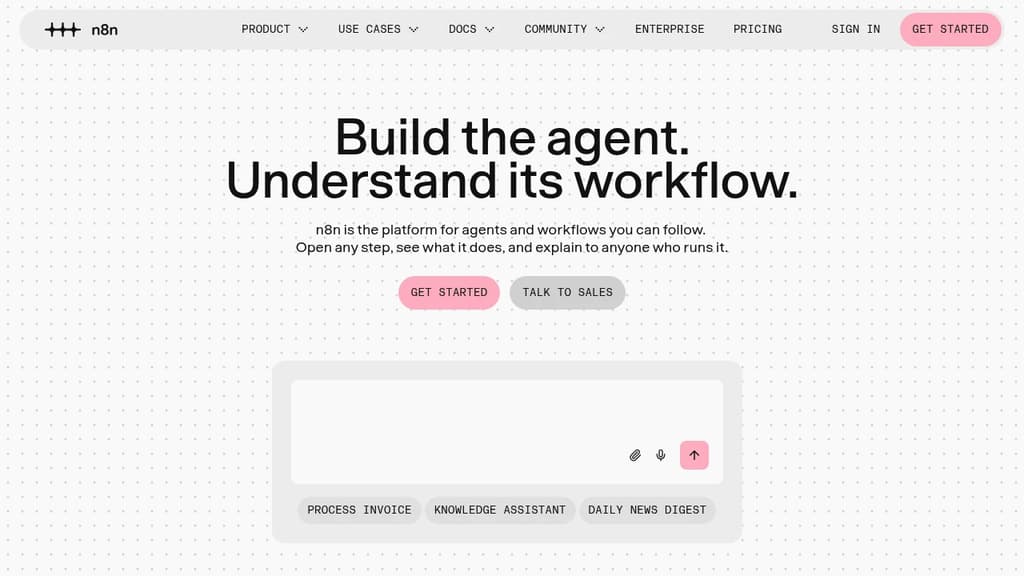
A workflow automation platform for technical teams that want AI agents and business processes in one place. You build in a visual editor, then drop into code whenever a step needs it. Every step is open to inspect, so the workflow itself serves as the documentation.
It suits developers, IT, security and ops teams who need automations other people can read, run and trust.
- 500+ native integrations: connect any API through HTTP, and any agent or coding assistant through MCP.
- Agent visibility: watch agents work live or open any past run inside the same workflow.
- Rules around AI: structured inputs and outputs, human-in-the-loop approvals, guardrails and evaluations.
- Easy recovery: spot an error at a glance and re-run only the step that broke. Replay past runs or mock data to skip waiting on external systems.
- Change tracking: version history shows who changed what, and when.
- Self-hosting: deploy on-prem or with Docker to keep data in your own environment, or use the hosted version. The source code is on GitHub.
For larger organizations, it adds SSO SAML, LDAP, RBAC permissions, encrypted secret stores, audit logs, log streaming to your SIEM, and Git-based version control with isolated environments and workflow diffs.
Examples from its users include onboarding new hires across Slack, Jira and Notion, triaging alerts with an AI agent, investigating security threats across several tools, and qualifying inbound leads. Huel reports saving 1,000 hours, and Vodafone uses it for security operations.

Open source platform for building AI agents, chatbots, and multi-agent systems using a drag-and-drop interface, with support for 100+ LLMs and RAG.
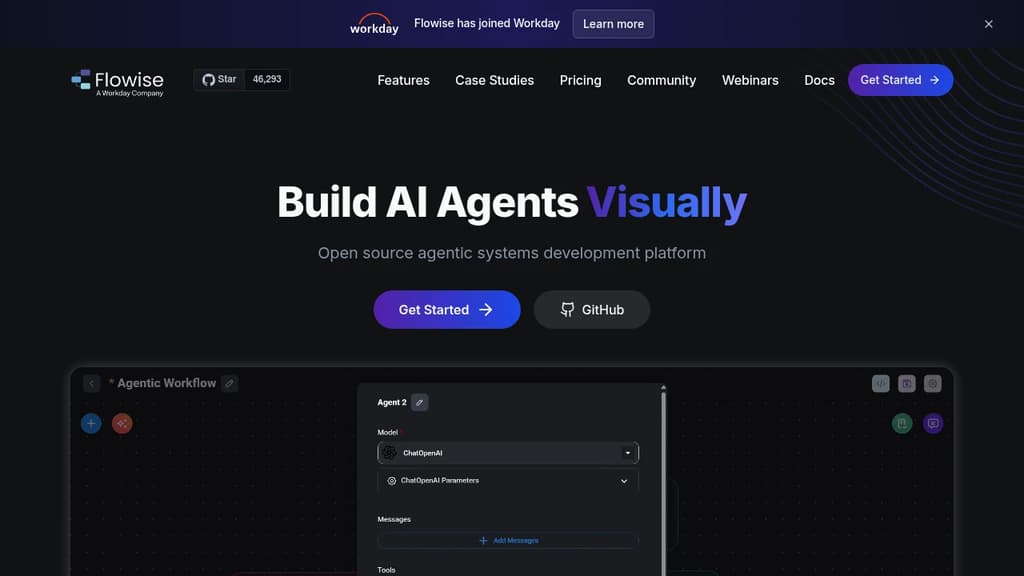
Flowise is an open source platform for building AI agents and LLM-powered applications through a visual, drag-and-drop interface. It targets developers and teams who want to prototype and ship agentic systems without writing orchestration logic from scratch. The core idea is modular: you connect building blocks together visually, then deploy the result as a production-ready API or embedded chat widget.
There are two main flow types. Agentflow handles multi-agent systems where work is distributed across coordinated agents, each with defined roles and tools. Chatflow covers single-agent setups and chatbots, including tool calling and retrieval-augmented generation (RAG) from external data sources. Both support Human in the Loop (HITL), letting a human review or approve agent actions before they proceed.
Flowise connects to over 100 LLMs, embedding models, and vector databases. Finished flows are accessible via REST API, a TypeScript or Python SDK, or an embeddable chat widget. That makes it practical to drop AI functionality into an existing product without rebuilding infrastructure around it. If you've used something like Langflow or Dify, the general approach will feel familiar, though the feature sets differ.
Observability is built in. Full execution traces are available for every run, and the platform integrates with Prometheus and OpenTelemetry for teams that need production monitoring. Horizontal scaling is supported through message queues and workers, and deployment works in both cloud and on-premises environments.
The self-hosted version is fully open source. Flowise also offers a managed cloud with a free tier (2 flows, 100 predictions/month) and paid plans starting at $35/month for individuals who want unlimited flows. The Pro plan adds workspaces, role-based access control, and priority support for larger teams.
Flowise has recently joined Workday, though the open source project continues to be developed and maintained.

Open-source integration platform for seamless workflow automation. Connect apps, automate tasks, and boost productivity effortlessly.
ActivePieces is a powerful, open-source integration platform that empowers users to automate their workflows without writing a single line of code. This versatile tool bridges the gap between various applications and services, enabling seamless connectivity and task automation.
Key benefits of ActivePieces include:
- No-Code Simplicity: Build complex workflows using an intuitive drag-and-drop interface, making automation accessible to users of all technical levels.
- Extensive App Integrations: Connect with popular services like Slack, Google Workspace, Trello, and many more to streamline your daily operations.
- Customizable Triggers: Set up automated actions based on specific events or schedules, ensuring your workflows respond dynamically to your needs.
- Open-Source Flexibility: Benefit from community-driven development, transparency, and the ability to self-host for complete control over your data.
- Time and Resource Savings: Eliminate repetitive tasks and reduce human error, allowing your team to focus on high-value activities.
- Scalable Solutions: Whether you're a small business or a large enterprise, ActivePieces adapts to your growing automation needs.
With ActivePieces, you can create powerful automations that sync data between apps, send notifications, update records, and much more. Its user-friendly interface and robust capabilities make it an ideal choice for businesses looking to optimize their processes and boost overall productivity.

Self-hosted automation tool that connects your apps and services, enabling powerful integrations and efficient data flow across your ecosystem.
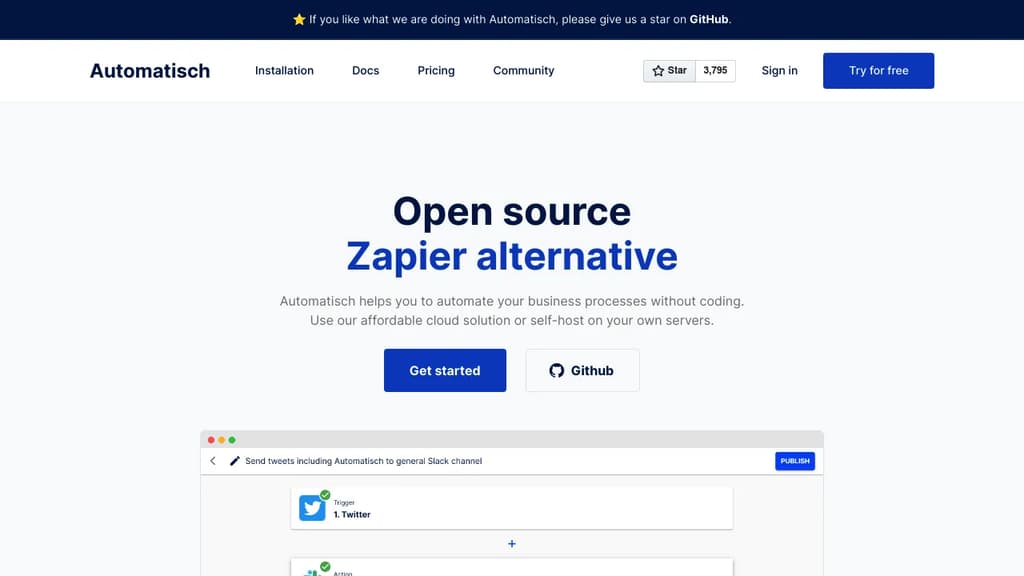
Automatisch is a robust, open-source integration platform that revolutionizes the way you connect and automate your digital tools. By providing a self-hosted solution, it puts you in control of your data and workflows, ensuring maximum privacy and customization.
Key benefits of Automatisch include:
- Seamless Integration: Connect hundreds of apps and services effortlessly, creating powerful automations that streamline your processes.
- Data Sovereignty: Host Automatisch on your own infrastructure, maintaining full control over your sensitive information and complying with data regulations.
- Extensibility: Leverage the open-source nature to add custom integrations and tailor the platform to your specific needs.
- User-Friendly Interface: Design complex workflows with an intuitive, drag-and-drop interface, making automation accessible to both technical and non-technical users.
- Cost-Effective: Eliminate subscription fees for multiple integration tools by using a single, self-hosted solution.
- Community-Driven: Benefit from continuous improvements and updates driven by a passionate community of developers and users.
Whether you're a small business owner, a developer, or an enterprise IT manager, Automatisch provides the flexibility and power to create efficient, automated workflows that save time and reduce errors across your organization.

Open-source no-code automation platform for logistics, chatbots, and AI agents. Deploy on cloud, self-host, or hybrid with complete data sovereignty and modular workflow design.
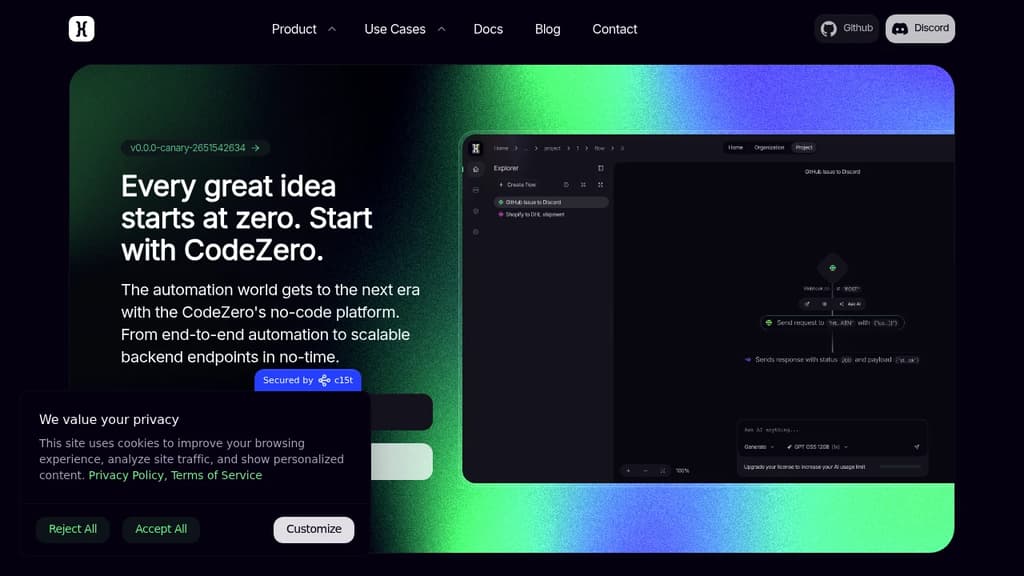
CodeZero is an open-source no-code automation platform that transforms how teams build and deploy complex workflows. Whether you're automating logistics operations, creating intelligent chatbots, or orchestrating AI agents, CodeZero provides a visual interface to design sophisticated automations without writing code.
Key capabilities include:
- Modular automation design - Connect your favorite tools and services through a visual node-based system
- Multiple deployment options - Choose between managed cloud hosting, self-hosted infrastructure, or hybrid dynamic hosting for complete data sovereignty
- AI agent building - Create sophisticated AI workflows with model-agnostic LLM selection and MCP-compatible tool integration
- Team collaboration - Manage projects, organizations, and custom roles with granular permission controls
- Scalable runtime - Launch flows in seconds with built-in monitoring and zero-downtime scaling
- Extensible architecture - Build custom nodes, triggers, and flow types using the Action SDK
Real-world applications:
- Automate shipping operations with label generation and real-time status synchronization.
- Build Discord bots for community management and moderation.
- Create intelligent AI agents that integrate multiple data sources and services seamlessly.
CodeZero eliminates manual data entry, reduces human error, and enables teams to focus on strategy rather than repetitive tasks. The platform supports complex conditional logic, data transformations, and multi-step workflows through an intuitive visual editor.

People are looking for alternatives to...
View all alternatives
Spotify

Claude

Claude Code

CapCut

Lovable

Notion
 Highseat – Cookieless analytics with revenue by source.

 Docmost