Open Source Appian Alternatives
A curated collection of the 8 best open source alternatives to Appian.
The best open source alternative to Appian is n8n. If that doesn't suit you, we've compiled a ranked list of other open source Appian alternatives to help you find a suitable replacement. Other interesting open source alternatives to Appian are: ToolJet, AppSmith, Refine, and Budibase.
Appian alternatives are mainly Low-Code/No-Code Platforms but may also be Workflow Automation Tools or Control Panels. Browse these if you want a narrower list of alternatives or looking for a specific functionality of Appian.

Written by Piotr Kulpinski


Build automated workflows connecting 500+ apps, write custom code, and deploy AI agents with full visibility into every decision. Self-hostable or cloud.
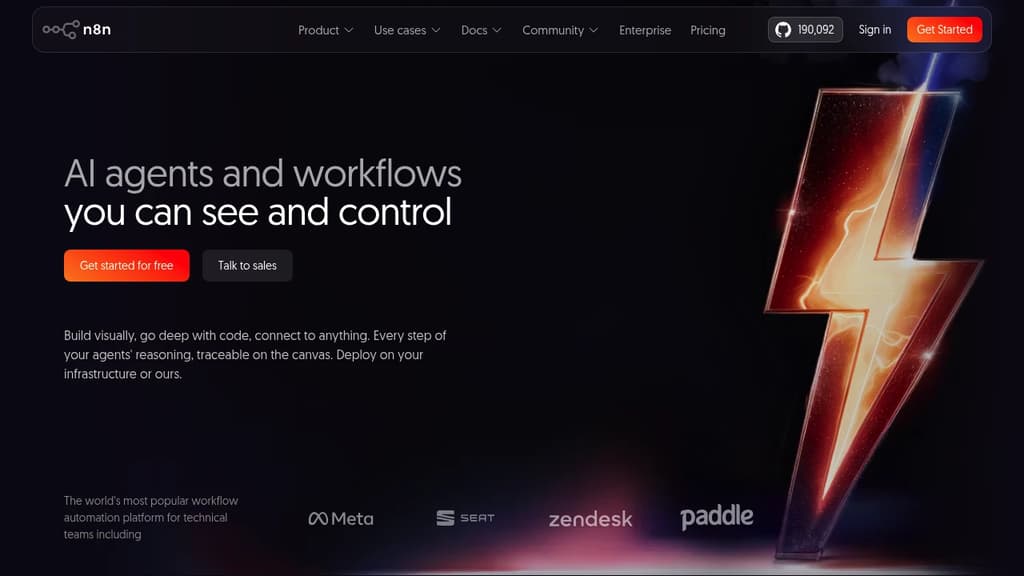
n8n is a workflow automation platform built for technical teams who find no-code tools too limiting but want something faster than building integrations from scratch. It sits in the middle: a visual canvas for building workflows, with the option to drop into JavaScript or Python at any step. That combination is what separates it from tools that force you to pick one or the other.
The platform connects to over 500 apps through pre-built nodes, with custom API support for anything not covered. Common use cases include onboarding automation, security incident enrichment, converting natural language into API calls, and generating customer insights from reviews. IT ops, SecOps, DevOps, and sales teams all show up in the documented use cases.
The AI agent capabilities are a significant part of what n8n has become. You can connect any AI model, including cloud or offline options, and build multi-agent setups and RAG systems. Every reasoning step is visible on the canvas, which matters when you need to audit what an agent actually did. Human-in-the-loop approvals can be inserted at any point, and structured inputs and outputs let you control exactly what data flows to and from AI steps.
Debugging is handled more practically than most tools. You can re-run a single step without replaying the entire workflow, mock external data to avoid waiting on third-party systems, and view logs without excessive clicking. AI workflows can be tested against real data before going to production.
Self-hosting is a first-class option. Full source code is available on GitHub, Docker deployment is supported, and the on-prem path includes SSO with SAML and LDAP, encrypted secret stores, RBAC permissions, audit logs, and Git-based version control. Teams that prefer not to manage infrastructure can use the hosted cloud version instead. If you're evaluating alternatives to n8n, options like ByteChef and Nango cover different parts of the integration and automation space.

Open-source low-code platform for creating custom internal tools, dashboards, and admin panels with a drag-and-drop interface
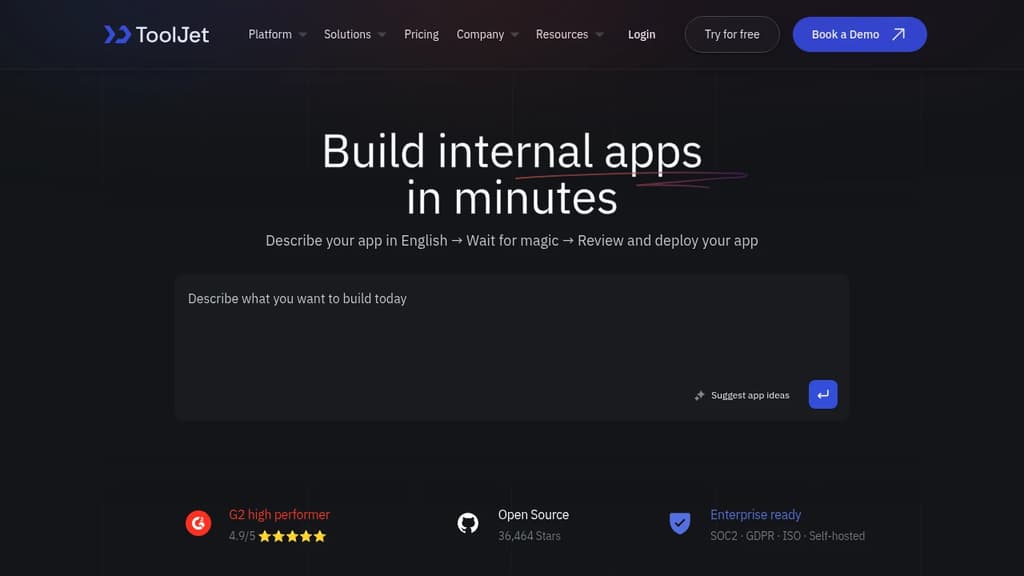
ToolJet is a powerful open-source low-code platform designed to revolutionize the way businesses create internal tools. With its intuitive drag-and-drop interface, ToolJet enables teams to rapidly build custom applications, dashboards, and admin panels without extensive coding knowledge.
Key benefits of ToolJet include:
- Rapid Development: Create functional applications in minutes, not months, accelerating your project timelines.
- Customization: Tailor your tools to fit your exact needs with a wide range of pre-built components and integrations.
- Data Integration: Connect to various data sources, including databases, APIs, and cloud services, to create data-driven applications.
- Collaboration: Foster teamwork with built-in version control and the ability to share and iterate on projects.
- Cost-Effective: Reduce development costs and reliance on external vendors by empowering your team to create internal tools.
- Scalability: Build applications that can grow with your business, from simple forms to complex multi-page tools.
- Security: Ensure data protection with role-based access control and the option for self-hosting.
ToolJet's versatility makes it ideal for startups, SMEs, and enterprises alike, enabling teams across various departments to create the tools they need to optimize their workflows and boost productivity.

Low-code platform for creating powerful internal tools and dashboards with drag-and-drop ease, robust integrations, and customizable workflows.
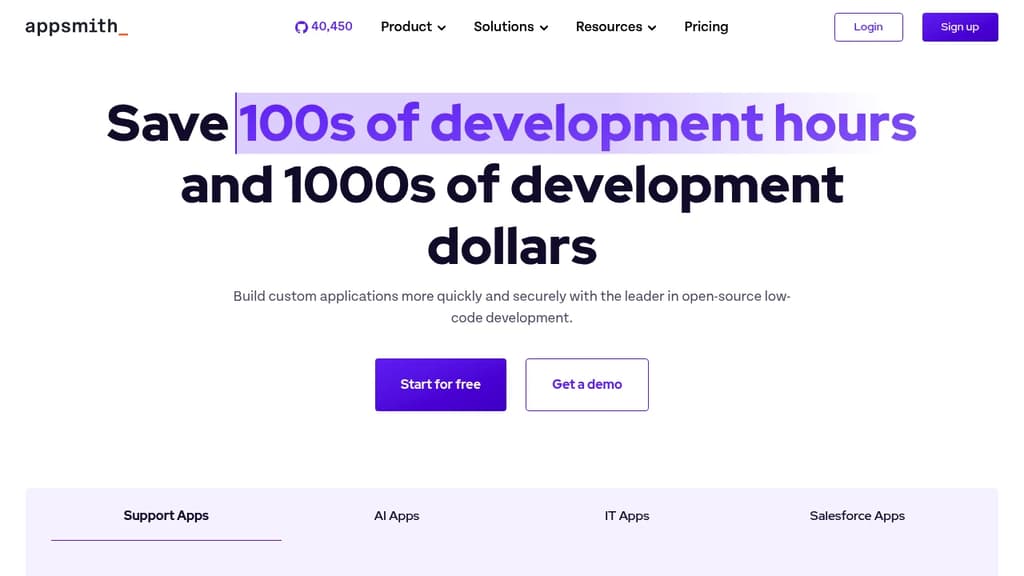
AppSmith is a revolutionary low-code platform that empowers teams to build custom internal tools and dashboards with unprecedented speed and flexibility. Whether you're a developer, product manager, or business analyst, AppSmith provides the tools you need to create powerful applications without extensive coding knowledge.
Key benefits of AppSmith include:
- Rapid Development: Drag-and-drop interface for quick UI creation, coupled with pre-built widgets and templates to accelerate your workflow.
- Powerful Integrations: Connect seamlessly with databases, APIs, and third-party services to create data-driven applications.
- Customizable Workflows: Build complex business logic and automate processes with a visual JavaScript editor and built-in query builders.
- Collaboration Features: Work together efficiently with version control, sharing capabilities, and role-based access control.
- Security and Compliance: Enterprise-grade security measures, including end-to-end encryption and compliance with industry standards.
- Flexible Deployment: Choose between cloud-hosted or self-hosted options to meet your organization's specific needs.
With AppSmith, you can transform your ideas into fully functional applications in hours instead of weeks. Its intuitive interface and robust feature set make it an ideal solution for businesses of all sizes looking to streamline operations, improve productivity, and drive innovation.

A React-based framework for rapid development of internal tools, admin panels, and dashboards with powerful data handling capabilities.
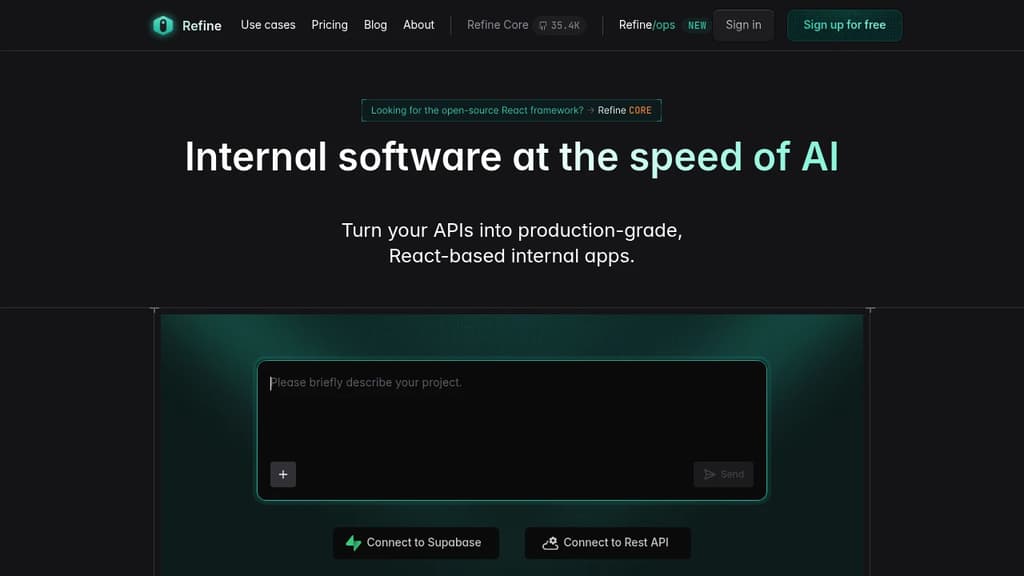
Refine is a powerful React-based framework designed to accelerate the development of data-intensive applications. It offers a unique approach to building internal tools, admin panels, and dashboards by providing a robust set of features while maintaining flexibility and customization options.
Key benefits of Refine include:
-
Rapid Development: Refine's pre-built components and hooks significantly reduce development time, allowing you to focus on business logic rather than boilerplate code.
-
Data Provider Agility: Seamlessly integrate with various data sources, including REST APIs, GraphQL, and real-time backends, without being locked into a specific technology.
-
Customization Freedom: Enjoy full control over your UI with support for any custom design or UI framework, including popular options like Ant Design, Material UI, and Mantine.
-
Authentication & Access Control: Implement secure user authentication and fine-grained access control with built-in providers and easy-to-use hooks.
-
Automatic CRUD Operations: Generate create, read, update, and delete interfaces effortlessly, with the flexibility to customize as needed.
-
Advanced Routing: Utilize a powerful routing system that supports nested resources and dynamic route generation based on your API.
-
Extensibility: Enhance your application with a wide range of plugins and extensions from the Refine ecosystem.
By choosing Refine, developers can create feature-rich, data-centric applications with remarkable speed and flexibility, all while maintaining clean, maintainable code.

Low-code platform for creating custom business applications quickly. Design, automate, and deploy with ease.
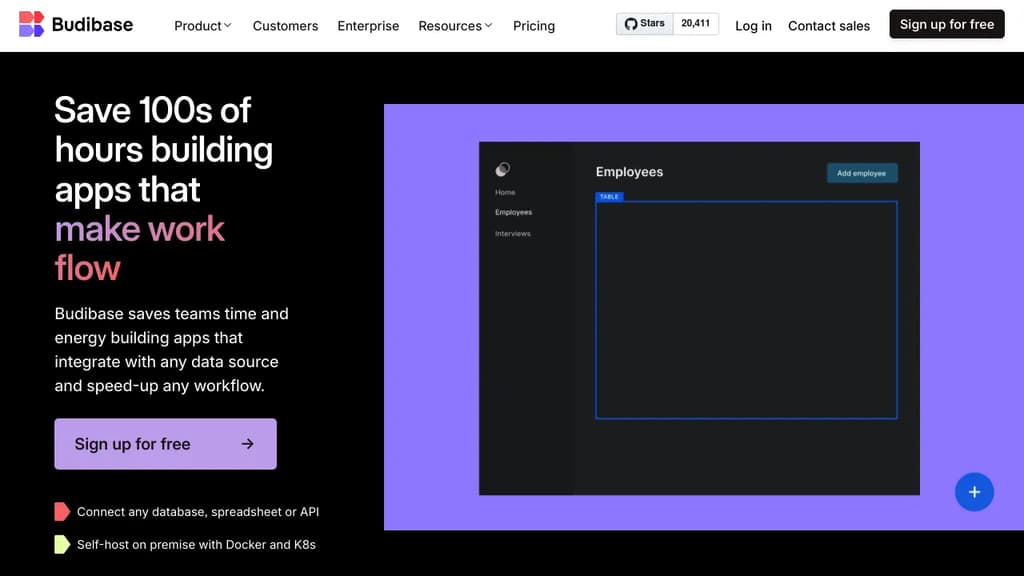
Budibase is a revolutionary low-code platform that empowers businesses to create custom web applications without extensive coding knowledge. With its intuitive interface and powerful features, Budibase accelerates the development process and puts the power of app creation in the hands of both developers and non-developers alike.
Key benefits of Budibase include:
- Rapid Development: Build fully functional web apps in hours, not weeks or months.
- Customization: Design unique interfaces and workflows tailored to your specific business needs.
- Data Integration: Connect to various data sources, including PostgreSQL, MySQL, MongoDB, and more.
- Automation: Create complex business logic and automate repetitive tasks with ease.
- Self-hosting: Deploy on-premises for complete control over your data and infrastructure.
- Responsive Design: Build apps that work seamlessly across desktop and mobile devices.
- Open Source: Benefit from a transparent, community-driven development process.
- Extensibility: Leverage JavaScript for advanced customization when needed.
Whether you're creating internal tools, customer portals, or admin panels, Budibase provides the flexibility and power to bring your ideas to life quickly and efficiently. Join thousands of businesses already using Budibase to transform their operations and drive innovation.

Open-source no-code platform for creating tailored business applications quickly, with full customization and easy deployment options.
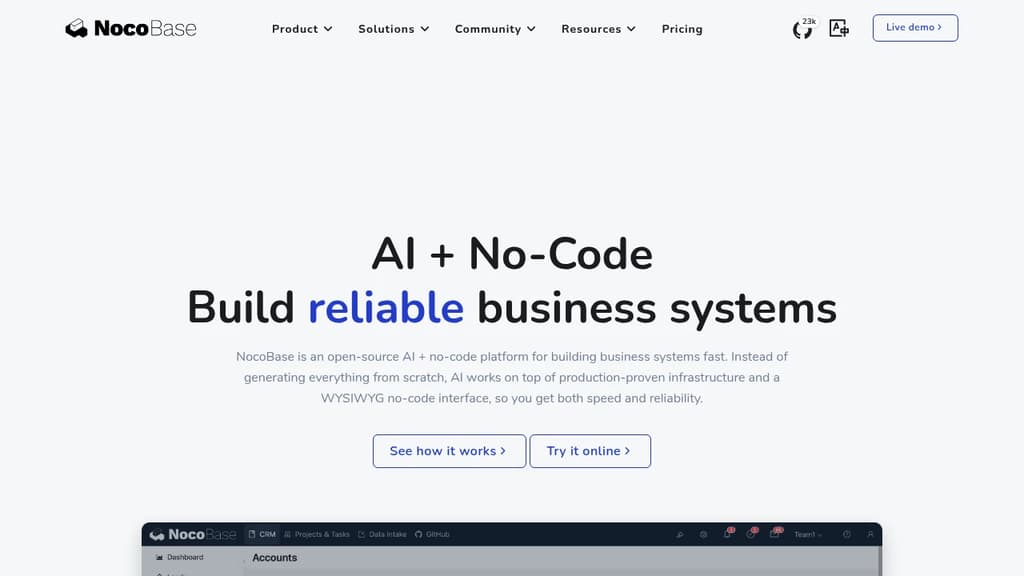
NocoBase is a powerful open-source no-code platform that revolutionizes the way businesses create and deploy custom applications. With its intuitive interface and flexible architecture, NocoBase enables users to build sophisticated, tailored solutions without writing a single line of code.
Key benefits of NocoBase include:
- Rapid Development: Create fully functional applications in hours or days, not weeks or months.
- Ultimate Flexibility: Customize every aspect of your app, from data models to user interfaces and workflows.
- Scalability: Start small and grow your application as your business needs evolve.
- Open-Source Advantage: Benefit from a transparent, community-driven development process and avoid vendor lock-in.
- Self-Hosted or Cloud: Choose between self-hosted deployment for maximum control or cloud-hosted for convenience.
- Extensibility: Leverage a plugin system to add new features and integrate with external services easily.
- Multi-language Support: Build applications that cater to a global audience with built-in internationalization.
- Role-Based Access Control: Ensure data security and privacy with granular permission settings.
NocoBase combines the speed of no-code development with the power of professional software engineering, making it an ideal solution for businesses of all sizes looking to digitize their operations efficiently.

No-code platform for building AI agents and RPA workflows that automate repetitive business tasks across finance, HR, sales, and operations.
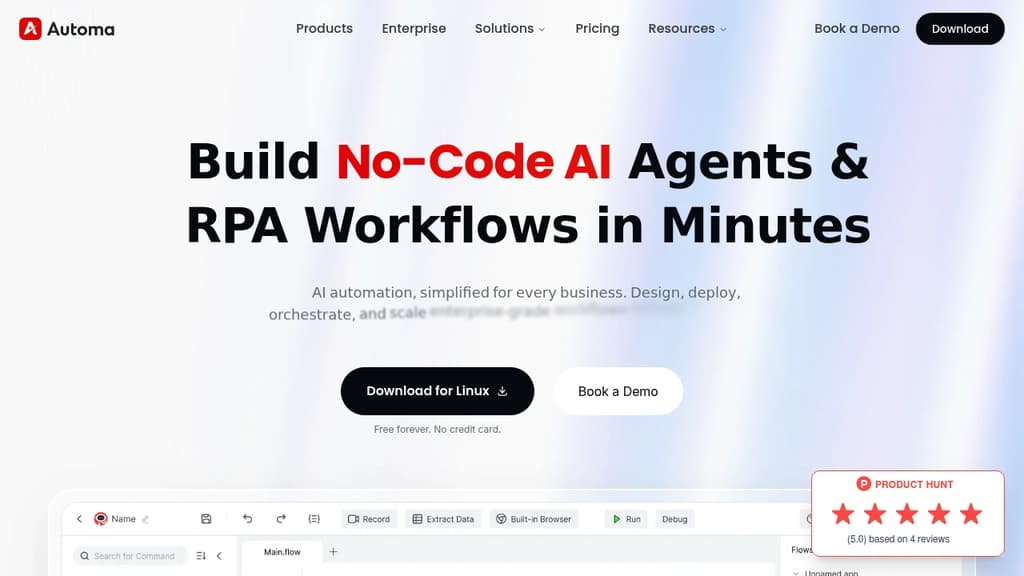
Automa is a no-code automation platform that combines AI agents with robotic process automation (RPA) to handle repetitive business tasks. The idea is straightforward: AI acts as the decision-making layer while RPA handles the actual clicking, typing, and data movement. Teams across finance, HR, sales, and operations use it to replace manual work without needing developers or IT involvement.
The core of the platform is a visual drag-and-drop builder. You connect actions into workflows, set conditions, and deploy agents that run on their own. It connects to tools like SAP and Salesforce, and handles tasks like invoice processing, email management, and spreadsheet work. If you've looked at workflow automation tools before, Automa positions itself at the heavier end, targeting enterprise use cases rather than simple app-to-app triggers.
Key capabilities include:
- Visual workflow builder for designing automation without code, using drag-and-drop logic
- AI-powered decisions so agents can adapt to variable inputs rather than following rigid rules
- RPA execution to interact with desktop apps, web interfaces, and legacy systems
- Cross-platform deployment across different devices and operating systems
- Real-time analytics with live dashboards to monitor workflow performance
- Enterprise security with encryption and compliance controls built in
It covers common departmental workflows out of the box. Finance teams can automate accounts payable and receivable, reconciliation, and month-end close cycles. Customer support, HR onboarding, and CRM data entry are also supported use cases. Tools like n8n or Activepieces focus more on developer-friendly integration pipelines; Automa targets business users who want to build and run agents without touching configuration files.
The platform is built for organizations that want to scale automation across teams without centralizing everything through IT.

Full-stack open source platform combining no-code and low-code studios to build, deploy, and integrate web, mobile, and desktop business applications.
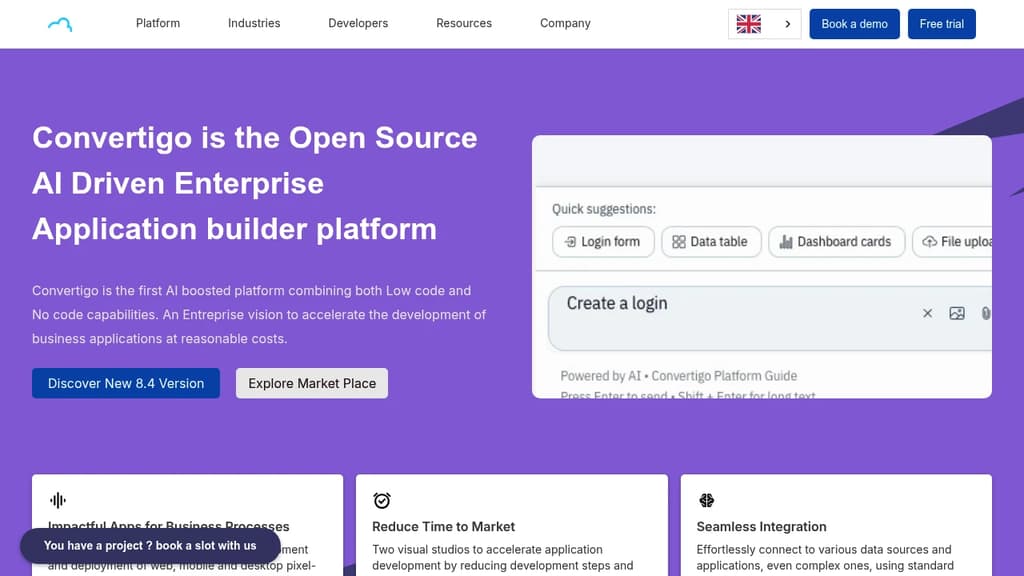
Convertigo is a full-stack low-code/no-code platform built for enterprises that want to ship business applications without vendor lock-in. It runs on your own infrastructure or on a managed cloud, and its open source core means you're never tied to a single provider's pricing or roadmap.
The platform ships two distinct studios aimed at different audiences. Business teams use the no-code studio to build form-based applications connected to secured data sources, without writing a line of code. IT and developer teams use the low-code studio to build more complex, strategic applications, define data sources, and expose controlled actions (like querying SAP or sending emails) that business users can then wire into their own apps. This split is intentional: it kills shadow IT by keeping IT in control of where data lives and who touches it, while still letting non-technical staff move fast.
Key capabilities include:
- Over 300 connectors covering REST, SOAP, SQL, OData, SAP BAPI, LDAP, OAuth, and OpenID
- Full Sync® offline mode that lets apps work without connectivity and syncs automatically when a connection returns
- AI-assisted development using models like ChatGPT and Mistral to generate prototypes and assist with coding tasks
- Pixel-perfect UI so designers aren't constrained by templates
- DevOps integration for teams managing multiple environments and deployment pipelines
- Task scheduling, activity monitoring, and enterprise-grade encryption built in
Compared to tools like AppSmith, Budibase, or ToolJet, Convertigo targets larger organizations that need both citizen-developer tooling and a serious backend integration layer under one roof. It's also a direct open source alternative to OutSystems and Microsoft Power Apps, with clearer per-user pricing and no lock-in.
The free Community Edition supports unlimited apps and on-premises installation. Paid tiers add managed cloud hosting, SLAs, offline data, and enterprise connectors.

People are looking for alternatives to...
View all alternatives
Claude Code

Spotify

CapCut

Claude
Notion

Lovable
 CodeRabbit – The leading AI Code Review platform. Ship better quality code in 50% less time, with 90% fewer bugs.

 Sent
Sent