Open Source Amp Alternatives
A curated collection of the 9 best open source alternatives to Amp.
The best open source alternative to Amp is OpenCode. If that doesn't suit you, we've compiled a ranked list of other open source Amp alternatives to help you find a suitable replacement. Other interesting open source alternatives to Amp are: pi, OpenHands, Cline, and Aider.
Amp alternatives are mainly AI Coding Agents but may also be AI Coding Assistants. Browse these if you want a narrower list of alternatives or looking for a specific functionality of Amp.

Written by Piotr Kulpinski


Open source AI coding agent that works in your terminal, IDE, or desktop app, supporting 75+ LLM providers with no code storage.
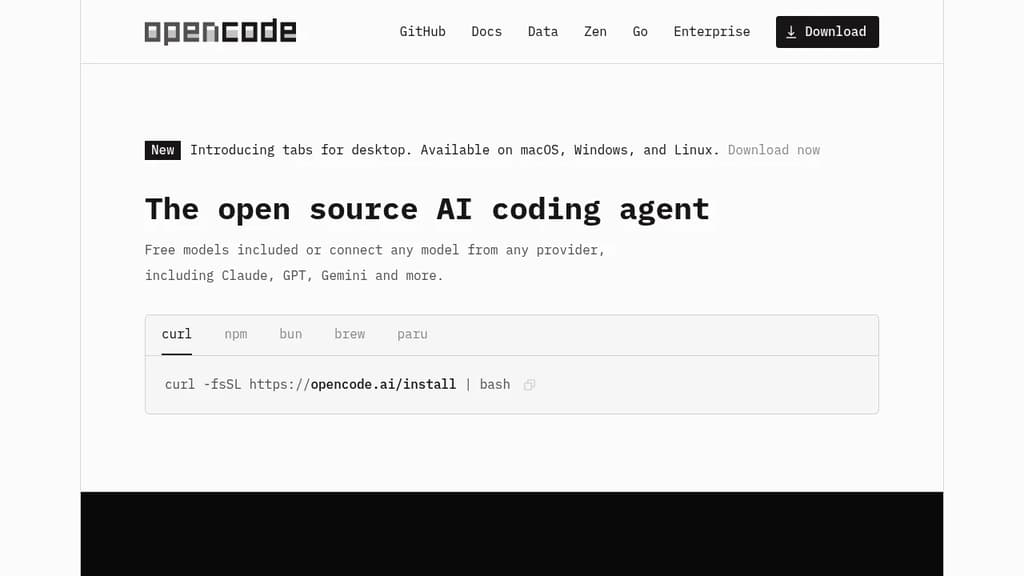
OpenCode is an open source AI coding agent built for developers who want full control over their tools and data. It runs in the terminal, as a desktop app (available in beta on macOS, Windows, and Linux), and as an IDE extension, so it fits into existing workflows without forcing a specific environment.
Model flexibility is a core part of the design. It connects to 75+ LLM providers through Models.dev, including local models, and supports Claude, GPT, Gemini, and others. Developers with existing GitHub Copilot or ChatGPT Plus/Pro subscriptions can log in directly and use those accounts without paying for another service.
LSP (Language Server Protocol) support is built in, meaning OpenCode automatically loads the appropriate language servers for the LLM context. This gives the agent a more accurate understanding of your codebase rather than treating it as plain text. You can also run multiple agents in parallel on the same project, which is useful when working across separate features or debugging threads simultaneously.
Session sharing lets you generate a link to any coding session. That makes it easier to hand off context to a colleague or revisit a debugging thread later.
Privacy is handled by design: OpenCode does not store your code or context data. That makes it usable in environments where sending source code to third-party servers is a concern. Tools like Cline and Continue take similar approaches to local-first AI coding, but OpenCode's combination of desktop, terminal, and IDE support in one package is relatively uncommon.
The project has over 160,000 GitHub stars, 900 contributors, and is used by roughly 7.5 million developers monthly.

Terminal-based coding agent with a minimal core, 15+ LLM providers, tree-structured session history, and a TypeScript extension system for building your own workflows.
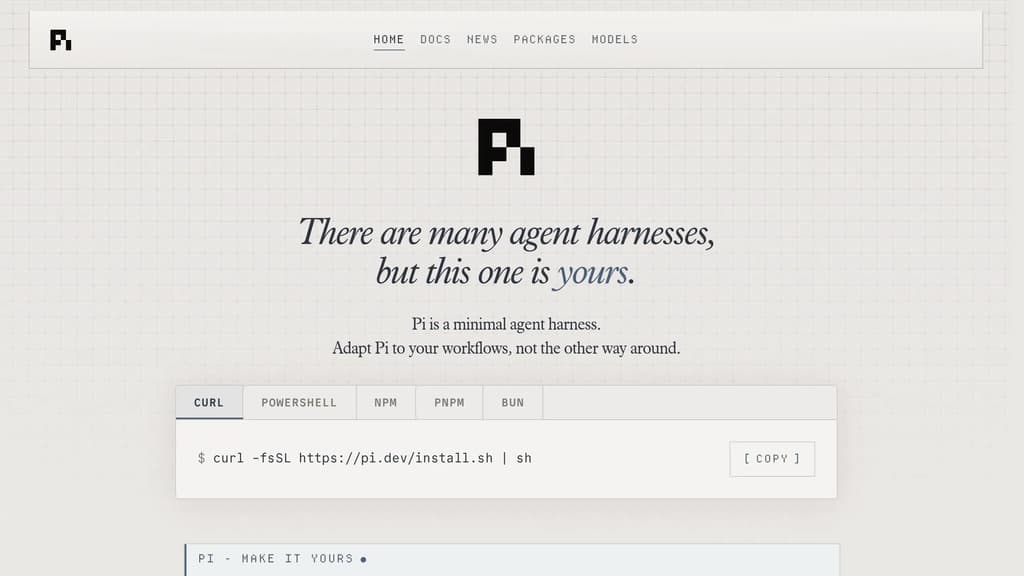
Pi is a terminal coding agent built around a single principle: the harness should adapt to you, not the other way around. Unlike AI coding agents that ship with fixed opinions about plan modes, sub-agents, and permission flows, Pi keeps the core deliberately small and exposes everything through a TypeScript extension system.
The extension model is the real differentiator. You can add tools, commands, keyboard shortcuts, events, custom editors, status bars, and overlays. Bundle those into a package and share it via npm or git. Third-party extensions already exist, including one that turns Pi into a drawing canvas inside the terminal. If you want a feature Pi doesn't have, you ask Pi to build it, hit /reload, and keep going.
Key capabilities:
- 15+ providers including Anthropic, OpenAI, Google, Azure, Bedrock, Mistral, Groq, Cerebras, xAI, Ollama, OpenRouter, and more. Switch models mid-session with
/modelor cycle favorites withCtrl+P. - Tree-structured history so sessions branch rather than scroll. Navigate any prior point with
/tree, export to HTML, or upload to a GitHub gist for a shareable URL. - Context engineering via AGENTS.md (project instructions), SYSTEM.md (custom system prompts), skills (on-demand capability packages), prompt templates, and fully customizable compaction that summarizes older messages before hitting the context limit.
- Steering while running. Press Enter to interrupt the current run with a steering message, or Alt+Enter to queue a follow-up once it finishes.
- Four modes: interactive TUI, print/JSON for scripting, RPC over stdin/stdout for non-Node integrations, and an SDK for embedding Pi in your own apps.
Pi is token-efficient by design. Its system prompt is minimal, and skills use progressive disclosure so you're not burning tokens on capabilities you haven't loaded. Features like Aider or Cline bake more in by default; Pi bets that a smaller, extensible core is more useful to developers who want control over their tooling.
Licensed under MIT and self-hostable.

AI agent platform that runs autonomous coding agents to plan, write, and ship changes across codebases end-to-end, with support for any model and self-hosted deployment.
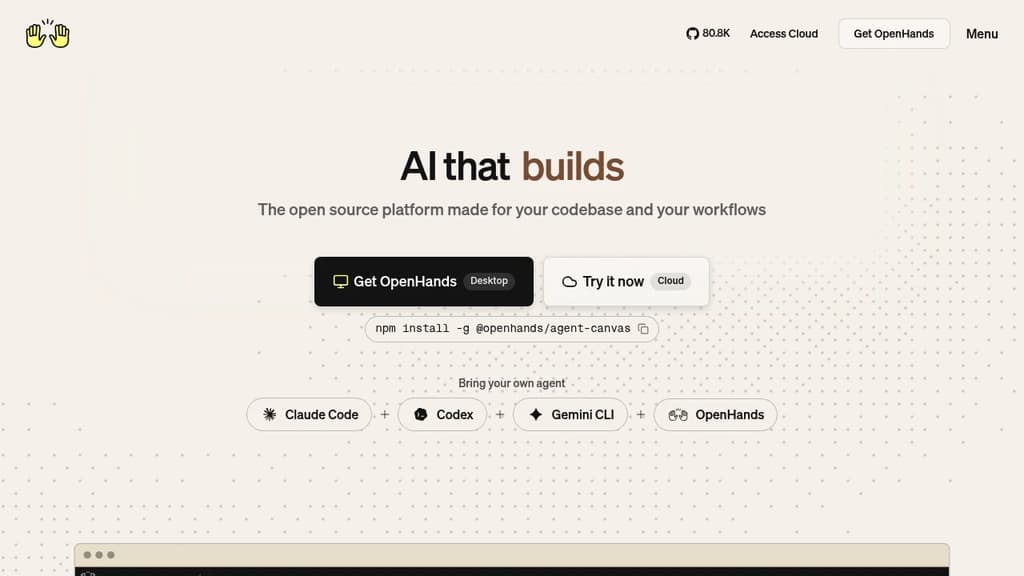
OpenHands is an AI agent platform built for software teams that need more than code suggestions. Instead of autocompleting lines in an editor, it runs autonomous agents that plan, execute, and ship changes across entire codebases. Think: open a GitHub issue, an agent investigates, writes the fix, runs tests, and opens a pull request for review.
It's model-agnostic by design. You can point it at any LLM, swap models as needs change, and integrate it into existing CI/CD pipelines without rearchitecting your workflow. For teams already using self-hosted developer infrastructure, it fits naturally into that setup.
Key capabilities include:
- Vulnerability remediation: Scans repositories, patches security issues, and opens reviewable PRs automatically
- PR review automation: Reviews pull requests for quality, security, and best practices
- Legacy migration: Migrates COBOL systems to Java with testing and validation built in
- Incident triage: Investigates production errors, traces root causes, and posts actionable debugging summaries
- Test coverage expansion: Generates and maintains tests for new features to catch regressions before they ship
- Parallel execution: Runs thousands of agent tasks simultaneously, not just one at a time
The platform runs inside isolated Docker or Kubernetes environments. Your code stays in your environment, on-prem or private cloud, with full auditability over every agent action and artifact. That matters for teams with strict compliance requirements.
A Large Codebase SDK handles dependency mapping across complex systems, letting multiple agents work in parallel without creating conflicts. This makes it practical for large legacy codebases that most AI tools struggle with.
Teams can interact with OpenHands through a web UI, CLI, or SDK. It integrates directly with GitHub, GitLab, Slack, and standard ticketing tools, so agents can be triggered from wherever work already happens. Developers building their own AI-powered tooling can embed the SDK into custom workflows.
OpenHands has accumulated over 75,000 GitHub stars and an active contributor community. The open-source foundation means full visibility into how agents behave, which is a meaningful difference from closed-source alternatives.

AI coding agent that runs inside VS Code and the terminal, supporting multi-file edits, bash execution, and any LLM provider via bring-your-own-key.
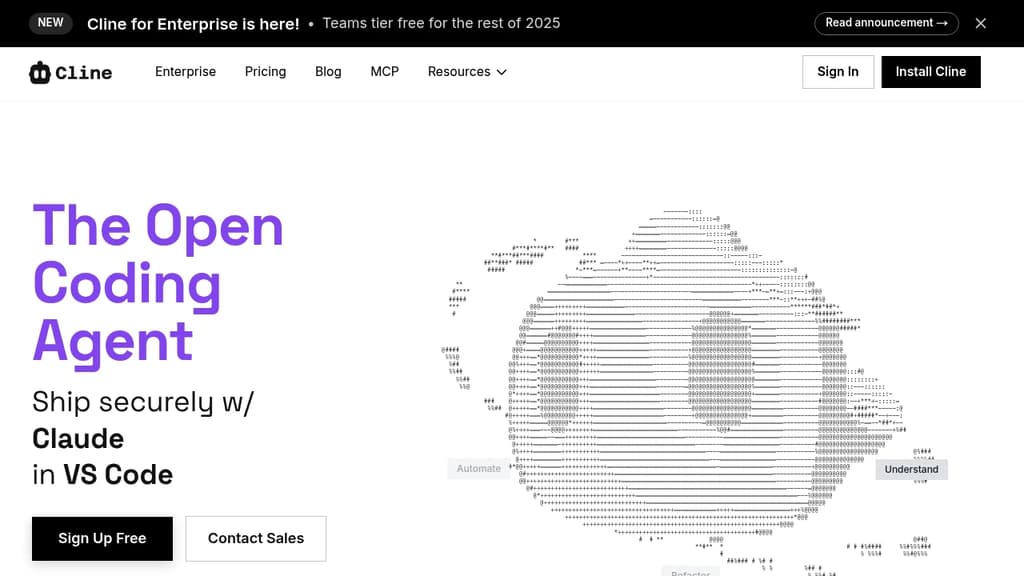
Cline is an open-source AI coding agent that works inside VS Code and the command line. It reads and edits files across a project, runs terminal commands, reacts to their output in real time, and handles long-running processes like dev servers or test suites.
The Plan/Act mode split lets you discuss a strategy with the agent before it touches any code, then switch to Act mode when you're ready to execute. Every step is approvable, or you can enable auto-approve for unattended runs.
Model choice is unrestricted. Claude, GPT, Gemini, local Ollama or LM Studio instances, and any OpenAI-compatible endpoint all work. You bring your own key or your own weights.
For teams, Cline supports multi-agent setups where a coordinator delegates to specialist agents with their own tools and context windows. It also connects to Slack, Discord, Telegram, and Linear, and runs headlessly inside GitHub Actions or GitLab pipelines. Tools like Roo Code and OpenHands take a similar multi-agent approach if you want to compare.
.clinerules files let you ship coding standards, architecture guidelines, and deployment conventions alongside your repo so the agent follows project-specific rules consistently.
Extensibility comes through the SDK and MCP server support, which lets you register custom tools and connect to databases, APIs, or infrastructure. The project is Apache 2.0 licensed with 250+ contributors.

Terminal-based AI coding tool that lets you edit existing codebases or start new projects using LLMs like Claude, GPT, and DeepSeek.
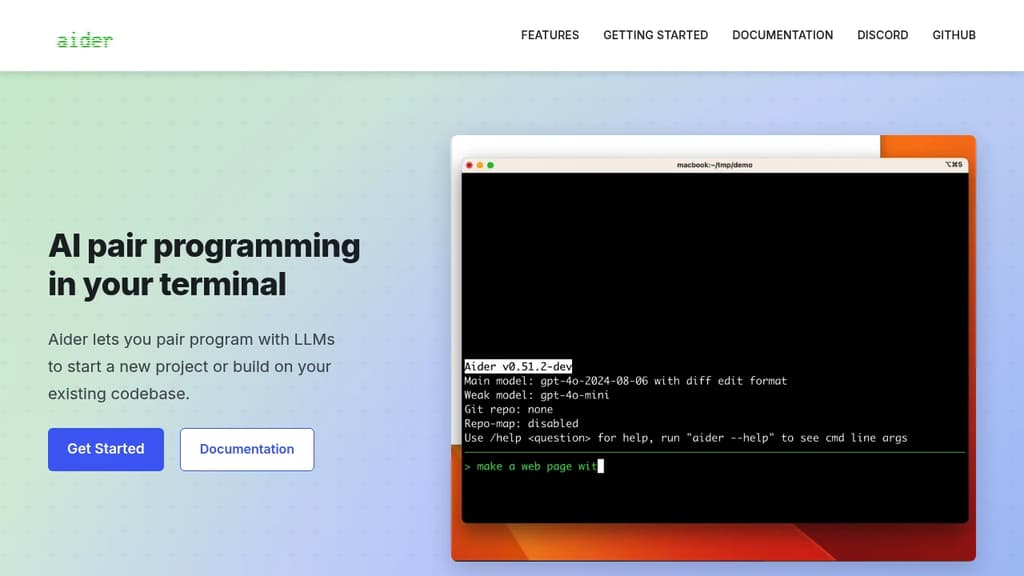
Aider brings AI pair programming directly into your terminal, letting you work with large language models on real codebases. It's built for developers who want to stay in their existing workflow rather than switching to a new editor or browser-based tool.
You point Aider at your project directory and start a conversation. It reads your files, understands the structure, and makes targeted edits across multiple files at once. Changes are applied directly to your code, not pasted into a chat window for you to copy manually.
Key capabilities:
- Multi-model support: works with Claude, GPT-4, o3-mini, DeepSeek, and other LLMs. You bring your own API key.
- Git-aware editing: automatically commits changes with meaningful messages, so every AI-assisted edit is tracked and reversible.
- Multi-file edits: handles changes that span several files in a single request, keeping diffs coherent.
- Existing codebase support: drop it into any project, not just greenfield work. It maps your repo to give the model context.
- Voice input: supports voice-to-code for hands-free coding sessions.
- Linting and test integration: can run your test suite or linter after edits and feed results back to the model for self-correction.
Compared to IDE plugins or browser-based AI coding agents, Aider is lightweight and editor-agnostic. It fits into any setup that has a terminal. The open source model means no subscription lock-in, and you control which LLM backend you use.
It's a practical choice for developers who want AI assistance without giving up their existing tools or paying for a bundled editor.

Terminal-based coding agent powered by Grok 4.5 that plans, builds, tests, and deploys across any codebase with parallel subagents and plugin support.
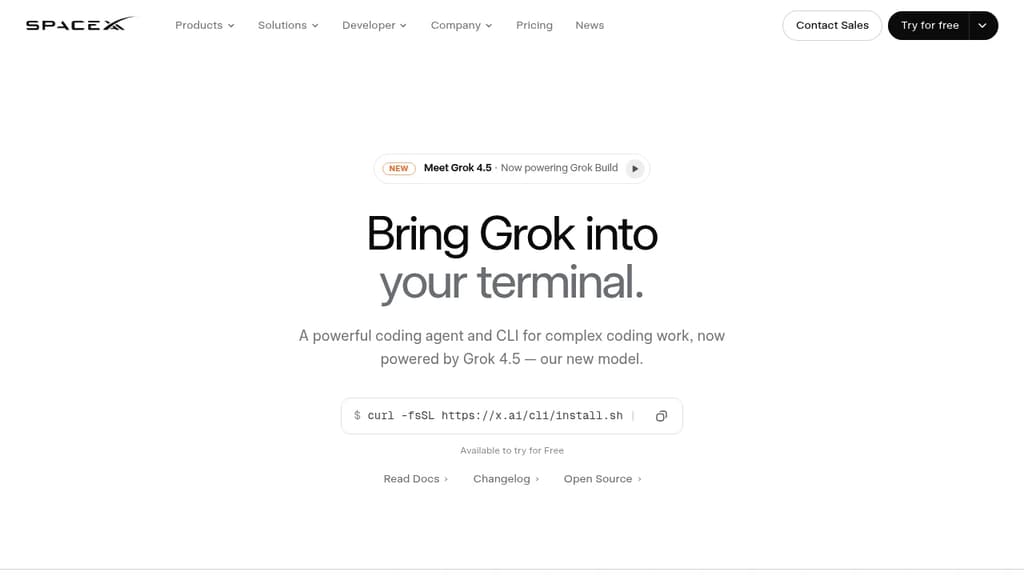
Grok Build is a terminal coding agent built for developers who want serious AI assistance without leaving the command line. It handles the full development cycle: planning, writing code, running tests, committing to git, and deploying. Any language, any codebase.
The tool's Plan Mode sets it apart from simpler autocomplete tools. Before touching a single file, it proposes a structured plan you can approve, comment on line by line, or rewrite entirely. Every approved change appears as a clean diff. Nothing gets written until you say so.
For large tasks, subagents run in parallel, each with its own context window and optionally its own git worktree. Ask it to find a latency regression and it can simultaneously explore your checkout flow, infrastructure, shared libraries, and pricing engine at once.
Key capabilities:
- Skills: reusable slash commands you build from any session using
/skillify, auto-invoked when a task matches - Plugins: bundle skills, agents, hooks, and MCP servers into a single install, shareable via marketplace or a self-hosted git repo
- MCP servers: connect to Cline-style external tools like Linear, Sentry, Grafana, and Postgres
- Hooks: run scripts automatically on file edits or tool calls
- AGENTS.md: set per-directory conventions the agent follows consistently
- Memory: decisions and context persist across sessions
- Headless mode: scriptable in CI/CD pipelines
- Sandboxed execution: run untrusted code in isolation
- Web search: look up docs and packages without switching context
When a task is ambiguous, Grok Build asks targeted multiple-choice questions before starting, so it picks the right framework, schema, or design direction upfront rather than guessing. The fullscreen terminal UI supports mouse input and keyboard-first navigation.
It's free to try, and unlike Grok in a browser chat interface, this is purpose-built for working directly inside your existing development environment.

Open source AI coding agent with 500+ models, bring-your-own-key support, and specialized modes for writing, debugging, and planning code across IDEs and CLI.
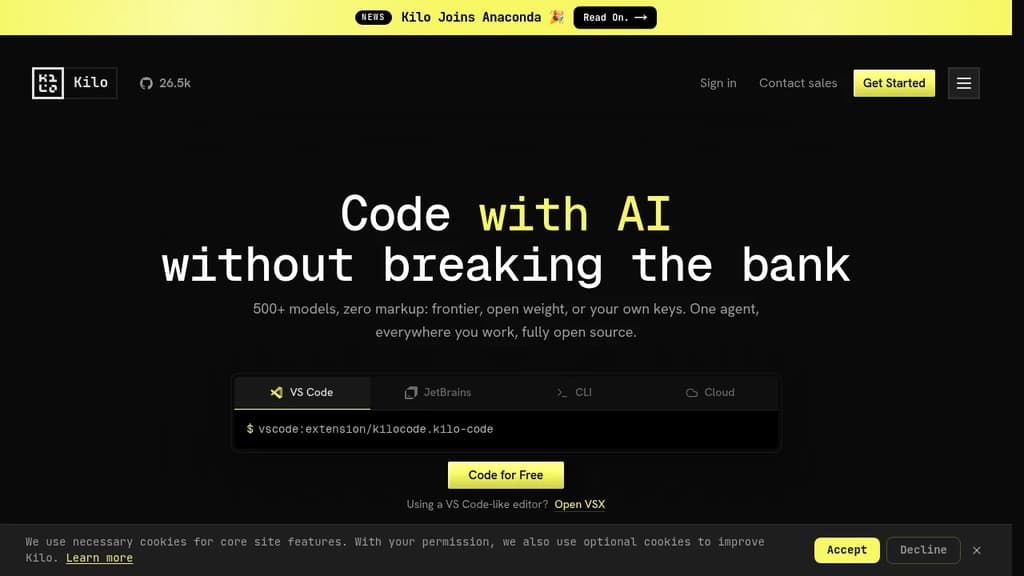
Kilo is an AI coding agent that works inside VS Code, JetBrains, the command line, and a hosted cloud environment. It's built for developers who want full control over their AI setup: bring your own API keys at zero markup, use local models to keep code private, or route through Kilo's model gateway to access 500+ models.
The agent ships with five specialized modes, each suited to a different part of the development workflow:
- Code Mode writes, refactors, and ships production-ready code with full codebase context
- Architect Mode helps plan complex features and structure work before any code is written
- Debug Mode reads errors, traces issues, and suggests targeted fixes
- Ask Mode answers questions about your codebase without making changes
- Custom Mode lets you define your own agent behavior for specific workflows
Switching between modes doesn't mean switching tools. Everything runs in the same agent, in the editor or terminal you're already using.
Kilo also includes KiloClaw, a managed version of the OpenHands open agent platform. It deploys in under 60 seconds with no Docker, SSH, or config files required. Once running, KiloClaw connects to Telegram, Discord, or Slack, handles scheduled tasks and cron jobs, and acts on your behalf autonomously. It's the part of Kilo designed for background work: running tasks while you're away, automating repetitive operations, or handling code review in the cloud.
For teams comparing options, Kilo positions itself against tools like Cline and Roo Code as a more fully integrated alternative with broader model support and cloud agent capabilities built in. The codebase is Apache-2.0 licensed and fully open source.

AI coding harness that runs inside your terminal, mixes LLMs per task, and uses multi-agent architecture to handle large codebases without bloating context.
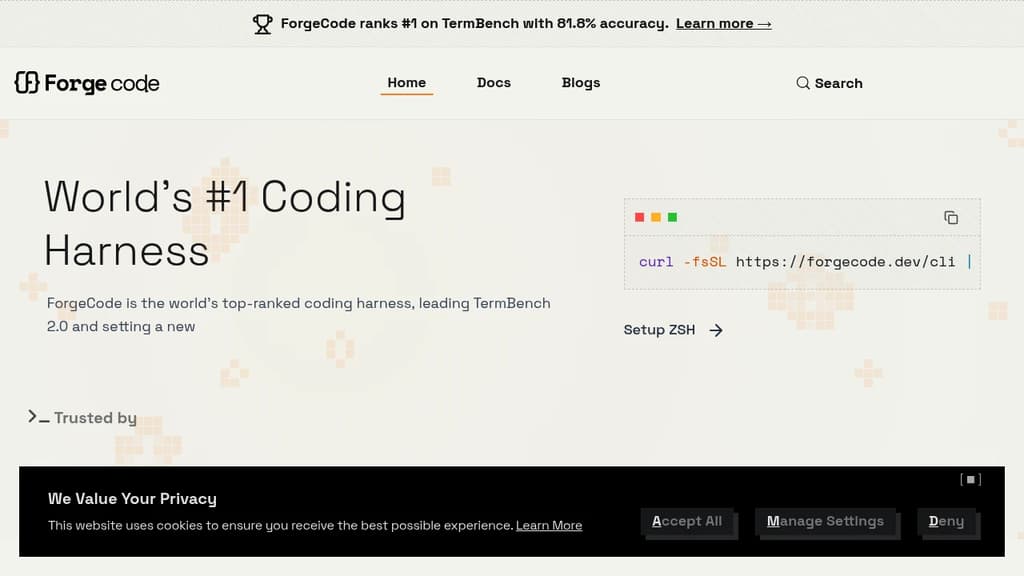
ForgeCode is a terminal-native AI coding agent that sits directly inside your ZSH shell. It's built for developers who want AI assistance without leaving the command line or abandoning their existing setup. Your custom aliases, Oh My Zsh plugins, and shell workflows stay intact. Type : and you're talking to ForgeCode.
What sets it apart from other AI coding tools is how it handles context. Rather than dumping your entire codebase into one prompt, ForgeCode uses a multi-agent architecture with specialized sub-agents for research, planning, and execution. Each agent works on minimal, relevant context, which keeps local models on track and results reliable.
Key capabilities:
- Model mixing per task. Use a thinking model to plan, a fast model to write code, and a large-context model for big files, all within a single session without restarting.
- Codebase understanding at scale. A context engine built for large repos, with fast tool corrections that prevent local models from drifting off course.
- Skills at scale. Handles thousands of skills without bloating the context window.
- Broad LLM support. Connects to hundreds of providers and models natively from the shell.
- Rigorous evaluation. Every change runs through thousands of evaluations across coding tasks and models before shipping.
ForgeCode ranks #1 on TermBench 2.0 with 81.8% accuracy, a benchmark designed specifically for terminal-based coding agents. It processes over 38 billion tokens and 24 million lines of code per day across its user base.
It's fully open source, with over 7,300 GitHub stars and 354 releases, backed by an active community. For teams already living in the terminal, it's a practical alternative to browser-based or IDE-embedded AI coding environments.

Open-source AI coding agent for the terminal that works with 25+ model providers, keeps sessions on your disk, and ships as a single Go binary with no telemetry.
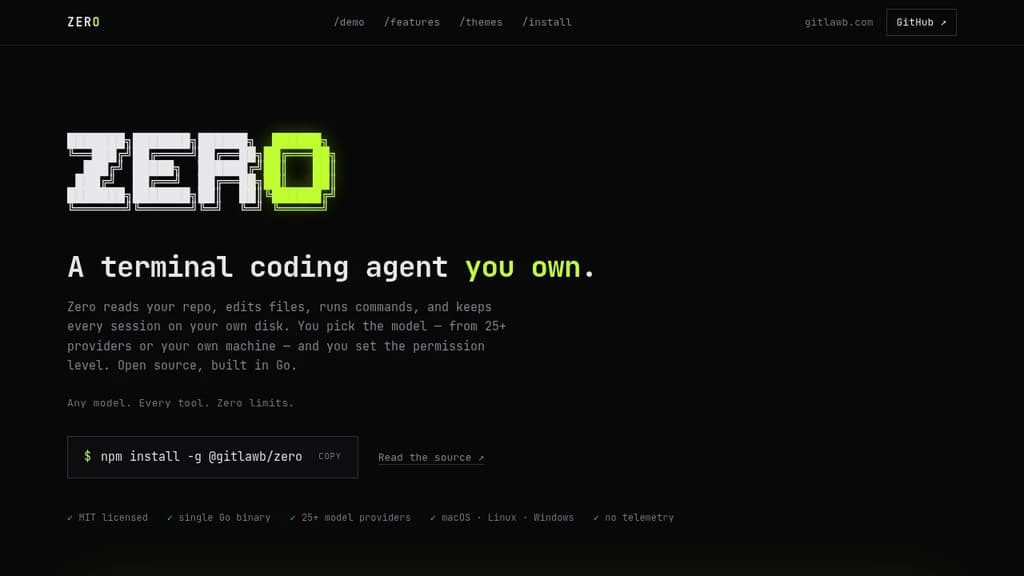
Zero is a terminal coding agent built for developers who want full control over their AI tooling. It reads your repo, edits files, runs commands, and stores every session locally on your disk. No cloud sync, no telemetry, no vendor lock-in on the model side.
The model choice is genuinely open. Zero connects to 25+ providers including OpenAI, Anthropic, Gemini, Mistral, Groq, DeepSeek, Bedrock, Vertex AI, and local options like Ollama and LM Studio. You can switch providers mid-session with /model, or point it at any OpenAI- or Anthropic-compatible endpoint.
Permissions are explicit and visible. Every side effect (file writes, shell commands, network access) is gated, with OS-level sandboxing. Autonomy is an opt-in, not the default. That makes it practical to run in CI as well as interactively.
Key capabilities:
- Headless mode for one-shot or scripted runs with JSON and stream-JSON output, plus reliable exit codes for pipelines
- MCP support in both directions: consume MCP servers over stdio, HTTP, or SSE, or expose Zero itself as an MCP server
- Spec-first runs to draft and review a plan before any file changes
- Specialist subagents to fan work out to focused sub-sessions you can inspect live
- Isolated git worktrees for risky changes you can discard if they don't pan out
- Session history that's searchable, resumable, and forkable from the command line
- Skills and plugins for encoding team conventions in markdown and extending behavior with hooks
- Scheduled agents for recurring jobs like nightly triage or dependency sweeps
- GitHub Action for PR review and CI jobs using the same agent
Sessions live in ~/.config/zero/ and API keys are stored in an encrypted local store. Unlike some other terminal agents, Zero ships as a single Go binary that runs on macOS, Linux, and Windows (x64 and arm64). Twelve contrast-audited themes are included.
It's MIT licensed. You pay your model provider, or nothing at all with a local model.

People are looking for alternatives to...
View all alternatives
Spotify

Claude Code

Claude

CapCut

Notion

Lovable
 Postiz – The All-in-One agentic social media scheduling tool

 Docmost