Open Source Unified Alternatives
A curated collection of the 2 best open source alternatives to Unified.
The best open source alternative to Unified is Nango. If that doesn't suit you, we've compiled a ranked list of other open source Unified alternatives to help you find a suitable replacement. Other interesting open source alternative to Unified is ACI.dev.
Unified alternatives are mainly AI Agent Platforms but may also be API Integration Tools. Browse these if you want a narrower list of alternatives or looking for a specific functionality of Unified.

Written by Piotr Kulpinski


Complete integrations platform with 500+ pre-built APIs, code-first approach, unified data models, and enterprise-grade security. Free tier available.
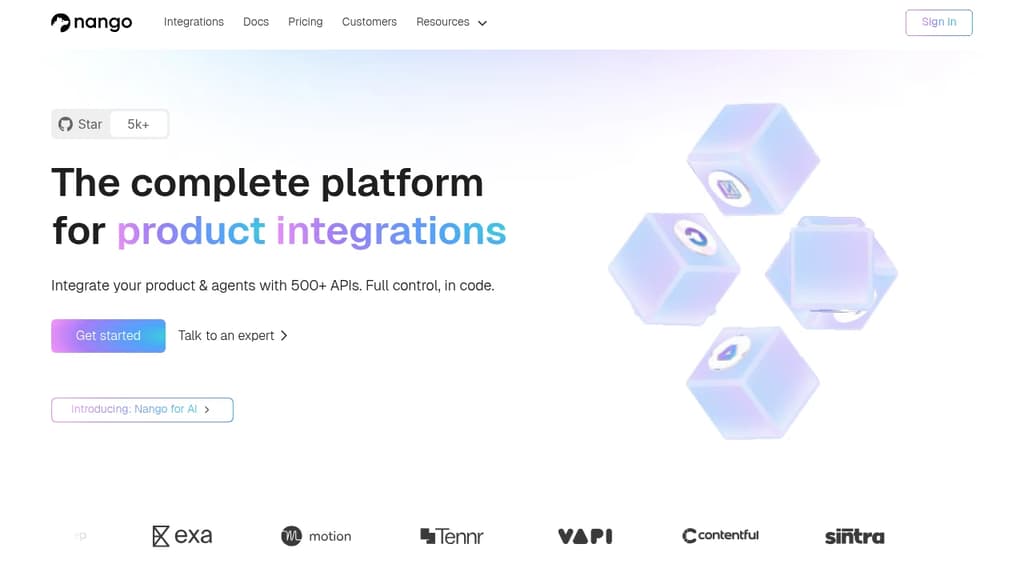
Build product integrations faster with a comprehensive platform that connects your application to 500+ popular APIs. Nango provides a code-first approach that gives you full control while abstracting away API complexities.
Key features include:
- Pre-built integrations for hundreds of popular use cases
- Unified API interface with your own data models
- Authorization handling for all auth types and API quirks
- Two-way data sync to keep apps and APIs synchronized
- Real-time webhooks processing at scale
- UI components for seamless integration experiences
Developer-friendly tools like API-specific pagination, rate limiting, customer-specific configurations, and an AI co-pilot trained on hundreds of integrations. The platform offers enterprise-grade security with SOC 2 Type II compliance, GDPR compliance, data encryption, and granular permissions control.
Scalable infrastructure includes real-time observability, durable execution with automatic retries, invalid credential detection, and comprehensive testing frameworks. Available as open-source with self-hosting options, plus managed cloud service with free tier.

Platform for connecting AI agents to 500+ tools with built-in multi-tenant auth management and granular permissions using either function calling or a unified MCP server
ACI.dev is a powerful platform that enables developers to build production-ready AI agents with seamless tool integrations. The platform provides 500+ pre-built integrations with essential tools like Gmail, Hubspot, Notion, and Slack through either function calling or a unified MCP server connection.
Key capabilities include:
- Multi-tenant authentication and OAuth management
- Natural language-based granular permissions
- Secure agent secrets management
- Dynamic workflow discovery
- Built-in authorization flows for end-users
The platform handles all the complexity of token management, OAuth setup, and permissions, allowing developers to focus on building reliable AI agents that can interact with various tools and services securely.

People are looking for alternatives to...
View all alternatives
Spotify

Claude Code

Claude

CapCut

Notion

Lovable
 Sent – A unified API for sending messages across SMS, RCS, and apps like WhatsApp.
 Bright Data