Open Source Teable Alternatives
A curated collection of the 5 best open source alternatives to Teable.
The best open source alternative to Teable is Baserow. If that doesn't suit you, we've compiled a ranked list of other open source Teable alternatives to help you find a suitable replacement. Other interesting open source alternatives to Teable are: NocoDB, Grist, Mathesar, and Busabase.
Teable alternatives are mainly Low-Code/No-Code Platforms but may also be Database Tools & GUIs or Collaborative Workspaces. Browse these if you want a narrower list of alternatives or looking for a specific functionality of Teable.

Written by Piotr Kulpinski


Open-source platform for building databases, internal apps, and automated workflows without writing code. Available on cloud or self-hosted.
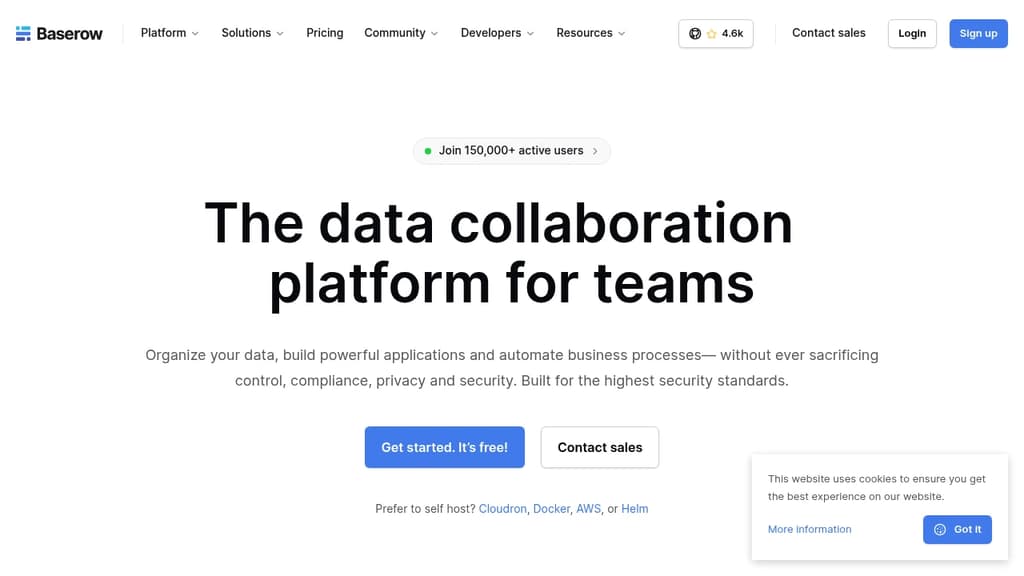
Baserow lets teams organize data, build internal applications, and automate workflows without writing code. It works as a structured database with multiple view types (grid, kanban, calendar, timeline, form, and survey), so different teams can work with the same data in whatever way suits them.
On top of the database layer, you can build full applications using a visual page and dashboard composer. These apps sit directly on your data, so there's no need to export or sync between tools.
Automation is built in. You can create workflows with triggers, branches, conditions, and loops, and connect them to HTTP requests, email, webhooks, or third-party services. An audit log keeps a record of actions for compliance purposes.
Baserow is a popular Airtable alternative. It covers similar ground but adds self-hosting, an MIT open-source license, frontend and backend plugin support, and compliance certifications for GDPR, HIPAA, and SOC 2 Type II. Row limits and API restrictions that frustrate Airtable users at scale are not a factor when self-hosting.
An AI assistant called Kuma can generate database structures from a plain-language description, which speeds up initial setup. AI fields and agent support are also available for adding AI steps inside workflows.
Teams that want NocoDB- or Teable-style open-source flexibility but need a more complete app-building layer will find Baserow covers more ground. It's a practical fit when you need to keep data on your own infrastructure, avoid per-user pricing at scale, or meet stricter data governance requirements.

Convert any database into a no-code platform with spreadsheet interface. Connect PostgreSQL/MySQL or use hosted database. Scale to millions of rows effortlessly.
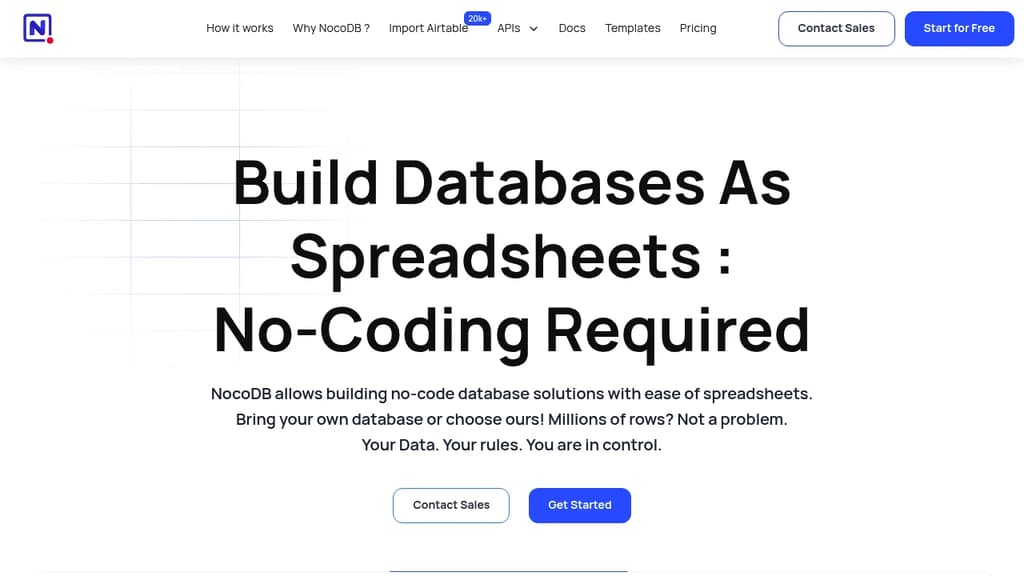
Transform any database into a powerful no-code platform with the simplicity of spreadsheets. Whether you bring your own PostgreSQL/MySQL database or use the hosted solution, NocoDB makes database management accessible to everyone.
Key features include:
- Multiple data views: Grid, Kanban, Gallery, and Form views to visualize data your way
- Massive scalability: Handle millions of rows without performance issues
- Rich integrations: Connect external databases, import from Airtable/CSV/Excel
- Team collaboration: Share projects, invite team members, and work together seamlessly
- API-first approach: Full REST API access with webhooks for custom automations
- Visual schema management: ERD diagrams for easy database structure visualization
Perfect for diverse use cases including CRM, project management, operations, and inventory management. The platform serves organizations of all sizes - from startups to enterprises - with complete data ownership and no artificial limitations.
Built on open-source foundation with a thriving community of 20k+ APIs and trusted by 23,000+ organizations. Access your data through intuitive interfaces while maintaining full control over your information.

A versatile data management platform combining spreadsheet simplicity with relational database capabilities for efficient data organization and analysis.
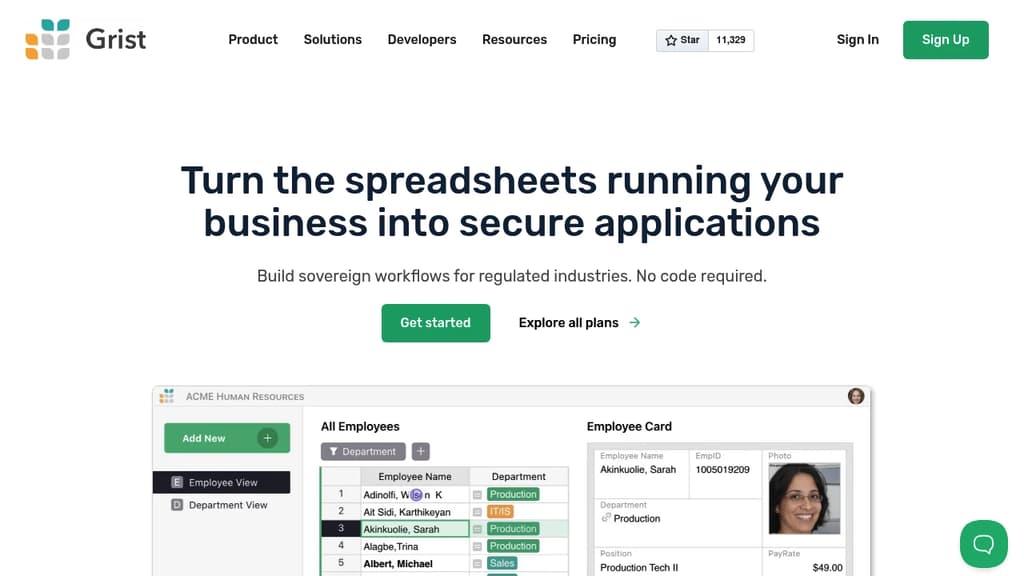
Grist revolutionizes data management by merging the familiarity of spreadsheets with the robustness of databases. This innovative tool offers a unique approach to organizing, analyzing, and visualizing your data.
Key benefits of Grist include:
- Intuitive Interface: Familiar spreadsheet-like grid for easy data entry and viewing
- Relational Power: Create links between tables for complex data relationships
- Custom Views: Generate multiple perspectives of your data with different layouts and filters
- Data Visualization: Build insightful charts and widgets directly from your data
- Formulas and Python: Use spreadsheet formulas or harness Python for advanced calculations
- Access Control: Set granular permissions to manage data visibility and editing rights
- Collaboration: Work together in real-time with team members on shared documents
- API Integration: Connect Grist to other tools and automate workflows
- Version History: Track changes and revert to previous versions when needed
- Self-Hosted Option: Choose between cloud-hosted or on-premises deployment
Whether you're managing projects, analyzing sales data, or organizing research findings, Grist adapts to your needs. Its flexibility allows for creating custom applications without coding expertise, making it an ideal solution for businesses, researchers, and data enthusiasts alike.

A self-hosted tool that provides an intuitive, spreadsheet-style interface for viewing, editing, and querying PostgreSQL databases without technical expertise.
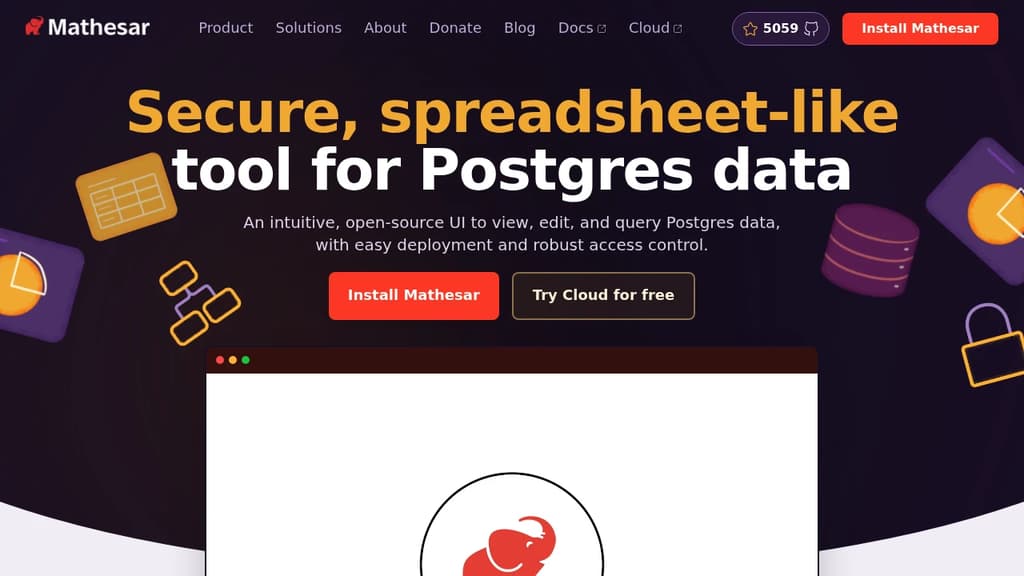
Mathesar transforms PostgreSQL databases into user-friendly workspaces with a familiar spreadsheet interface. The tool stands out with several key features:
- Direct PostgreSQL Integration: Works natively with Postgres permissions, schemas, and tables without additional abstractions
- Enterprise-Ready Security: Self-hosted solution with robust access control using native Postgres permissions
- No Technical Skills Required: Business users can view, edit, and query data through an intuitive interface
- Scalable Performance: Handles databases of any size or complexity, scaling alongside PostgreSQL
- Quick Setup: Installation takes minutes with minimal configuration needed
- 100% Open Source: Maintained by a nonprofit organization, eliminating vendor lock-in concerns
Perfect for teams needing to manage assets, track inventory, create CRUD interfaces, or build data dashboards while maintaining complete control over their data infrastructure.

Busabase gives AI agents a shared database, knowledge base, and skills registry where every proposed change goes through human review before becoming canonical data.
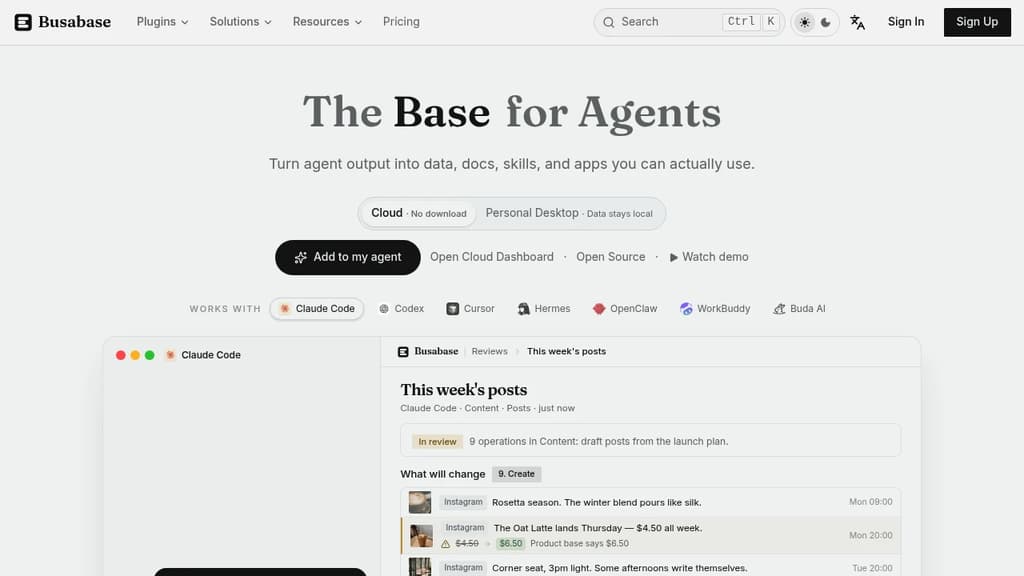
Busabase is a workspace built specifically for AI agents to write into. Instead of agent output disappearing into chat logs or scratch files, it lands in typed databases, documents, and skills that persist across sessions. The core idea: agents propose changes, humans verify them, and only approved records become canonical data that other agents and apps can trust.
The review loop is the product's backbone. Every agent submission arrives as a structured change request with a field-level diff, a source context, and a full message history. Reviewers can approve, request revisions, or reject, and every decision stays attached to the record. Nothing enters your database until a human signs off.
Key capabilities:
- Change request review: inspect field-by-field diffs before any agent write touches your data
- Fact verification: check source context and downstream impact to catch hallucinations before they become business facts
- Audit trail: every submit, approval, and merge is logged with who, when, and why
- Canonical records: approved work becomes the source of truth with full commit history and relationship context
- Graph view: see how customers, content, assets, and business objects connect
- AirApps and dashboards: the same verified data renders directly into usable views without a separate build step
- Agent-first API: any agent that can call a REST API, including Claude Code, n8n, Zapier, or LangChain, can submit structured changes through OpenAPI, MCP, or Agent Skills
Busabase runs locally on PGlite, so your data never leaves your machine on the desktop version. Cloud adds collaboration, hosted APIs, and permission governance across teams. The open-source core is free to self-host; paid tiers add seats, storage, and API access.
It fits teams managing CRM enrichment, content pipelines, training datasets, finance records, or any workflow where AI proposes and humans need to verify before the output becomes institutional truth. The problem it solves is concrete: agent work that used to evaporate into sessions now accumulates into a database every subsequent agent can read and build on.

People are looking for alternatives to...
View all alternatives
Spotify

Claude Code

CapCut

Claude

Notion

Lovable
 Docmost – Open-source wiki software with real-time collaboration, diagrams, AI, SSO, RBAC permissions and more.
 CodeRabbit