Open Source s&box Alternatives
A curated collection of the 3 best open source alternatives to s&box.
The best open source alternative to s&box is Godot. If that doesn't suit you, we've compiled a ranked list of other open source s&box alternatives to help you find a suitable replacement. Other interesting open source alternatives to s&box are: GDevelop and MonoGame.
s&box alternatives are mainly Game Development Platforms. Browse these if you want a narrower list of alternatives or looking for a specific functionality of s&box.

Written by Piotr Kulpinski


Build 2D, 3D, and XR games with a full-featured engine that includes its own scripting language, scene editor, and export tools for multiple platforms.
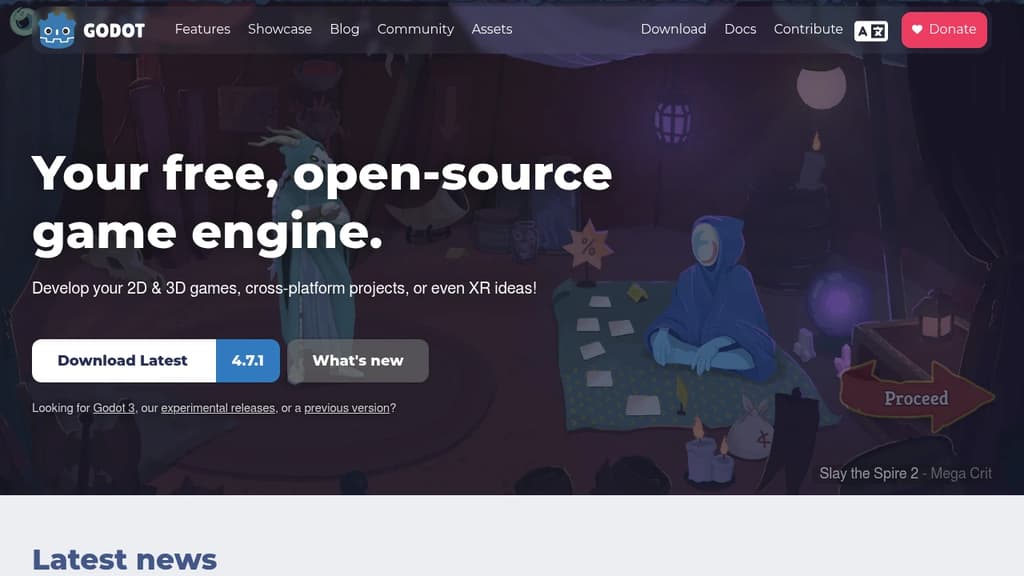
Godot is a full-featured game engine built entirely in the open, with no licensing fees and no royalties. It's aimed at indie developers, hobbyists, and small studios who want a capable tool without the cost or restrictions of commercial engines. The engine handles both 2D and 3D projects, and supports XR development for virtual and augmented reality targets.
At its core, Godot uses a node and scene system. Everything in a game, from a character to a UI element, is a node organized into scenes that can be nested, reused, and instanced. It's a different mental model than many other engines, but it keeps projects organized as they grow.
Key capabilities include:
- GDScript, a Python-like scripting language built specifically for the engine, alongside support for C# and C++ via GDExtension
- Integrated editor with a 2D workspace, 3D viewport, animation tools, tilemap editor, and shader editor all in one place
- Cross-platform export to Windows, macOS, Linux, Android, iOS, and web, from a single project
- Physics engines for both 2D and 3D, with collision shapes, joints, and rigid body simulation built in
- Signals system for event-driven communication between nodes, reducing tight coupling in code
- Visual shader editor for creating shaders without writing GLSL directly
Godot is community-driven and funded through donations and corporate sponsors rather than a commercial entity. The engine's source is available on GitHub, and contributors can submit fixes, features, or documentation improvements.
For developers coming from tools like GDevelop, Godot offers more depth in scripting and 3D capabilities, though it comes with a steeper learning curve. It suits developers who want direct control over game logic through code rather than purely visual event systems.

Free, open-source game engine with visual event system, AI tutor, and one-click publishing to Steam, iOS, Android, and web platforms.
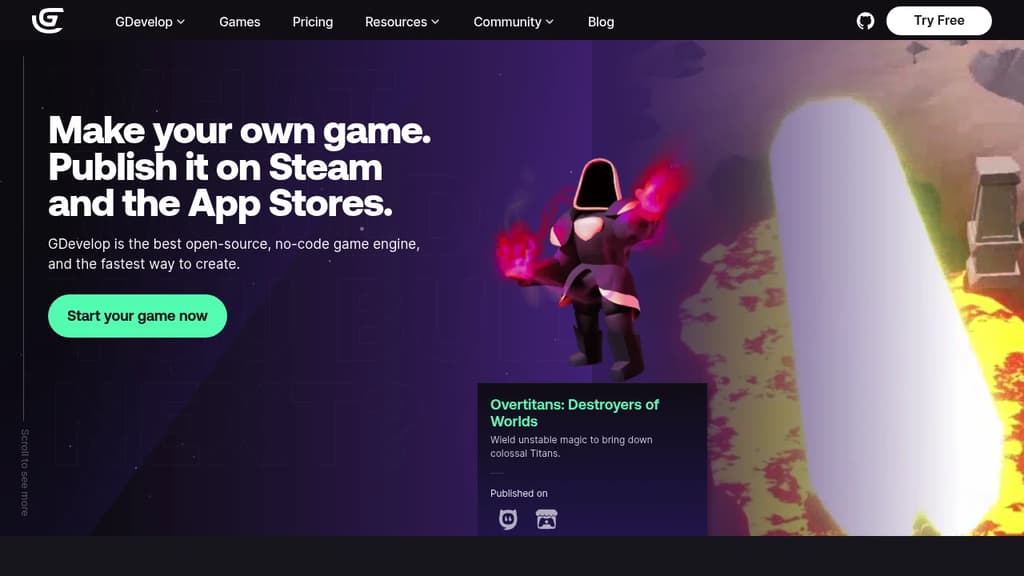
GDevelop is a free, open-source game engine designed to make game creation accessible to everyone—from artists and educators to professional developers. With its intuitive visual event system, you can build complex game mechanics without writing a single line of code.
The platform features AI-assisted development that helps you learn faster and solve problems in real-time. Built-in tutorials and in-app courses guide you from beginner to advanced levels. The engine is lightweight and powerful, delivering fast performance across devices while supporting both 2D and 3D game creation.
Key capabilities include:
- Drag-and-drop interface with visual "what you see is what you get" editing
- Ready-made behaviors for common game mechanics
- One-click exporting to Steam, iOS, Android, web, and desktop platforms
- Multiplayer features with built-in lobbies, leaderboards, and player accounts
- Open-source ecosystem with extensibility through JavaScript and custom extensions
GDevelop has powered successful indie games including award-winning titles, Kickstarter-funded projects, and official promotional games for major brands. The community spans artists, educators, game developers, and businesses, all creating games on a single platform that removes technical barriers while maintaining professional-grade capabilities.

Build games in C# that run on Windows, macOS, Linux, iOS, Android, and major consoles. No royalties, no subscriptions, no runtime fees.
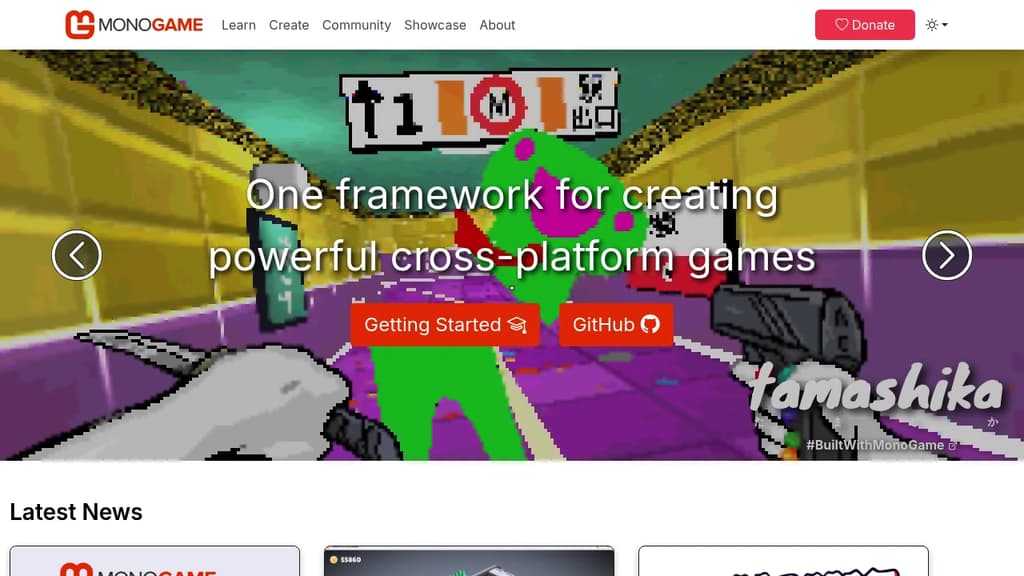
MonoGame is an open-source game development framework built on C# and .NET. It's aimed at developers who want full control over their code without paying engine licensing fees or royalties. Unlike commercial engines, there's no subscription model and no runtime fees, ever.
The framework targets a wide range of platforms from a single codebase:
- Desktop: Windows, macOS, and Linux
- Mobile: Android, iOS, and iPadOS
- Console: PlayStation 4, PlayStation 5, Xbox One, and Nintendo Switch (console access requires approved developer status)
All source code is publicly available. If you hit a platform-specific limitation or want to port to something new, you can modify the framework itself. That's a real advantage over closed tools where you're waiting on a vendor to fix something.
MonoGame is owned by the MonoGame Foundation, a registered non-profit that depends on community donations rather than commercial revenue. That structure keeps the tool free and community-driven rather than tied to a company's roadmap.
It works with the editors developers already use: Visual Studio, Visual Studio Code, and JetBrains Rider. The C#/.NET foundation means you get modern language features, strong tooling, and a mature ecosystem for things like debugging and profiling.
If you're coming from a higher-level engine like Godot and want something closer to the metal with no abstraction layers between you and the rendering loop, MonoGame gives you that. It's a framework, not an editor-driven engine, so you're writing code rather than clicking through a scene graph. That suits developers building custom engines on top of it or porting existing games from XNA, which MonoGame was originally designed to succeed.

People are looking for alternatives to...
View all alternatives
Spotify

Claude Code

Claude

CapCut
Notion

Lovable
 Sent – Messaging Infrastructure for Developers. One API for SMS, WhatsApp, and RCS across 190+ countries.
 Postiz