Open Source Red Hat Ansible Alternatives
A curated collection of the 3 best open source alternatives to Red Hat Ansible.
The best open source alternative to Red Hat Ansible is Harness. If that doesn't suit you, we've compiled a ranked list of other open source Red Hat Ansible alternatives to help you find a suitable replacement. Other interesting open source alternatives to Red Hat Ansible are: OpenTofu and Pulumi.
Red Hat Ansible alternatives are mainly Infrastructure as Code (IaC) Tools but may also be PaaS & Deployment Tools or CI/CD Platforms. Browse these if you want a narrower list of alternatives or looking for a specific functionality of Red Hat Ansible.

Written by Piotr Kulpinski


Streamline code delivery with an open-source CI/CD platform featuring Git integration, fast pipelines, and hosted development environments.

Harness Open Source is a comprehensive software delivery platform that empowers developers to streamline their entire development workflow. From code repositories to deployment, this open-source solution offers a centralized hub for managing your software projects.
Key features include:
- Git Integration: Familiar Git experience with essential features like branching, merging, and pull requests.
- Cloud Development Environments: Pre-configured, ready-to-code environments (Gitspaces™) that eliminate local setup hassles.
- CI/CD Pipelines: Build, test, and deploy your code with fast, customizable pipelines.
- Artifact Registry: Centralize and manage all your artifacts, including Docker images and Helm charts.
- Integrations: Seamlessly connect with your favorite development tools and services.
Benefits:
- Increased Productivity: Reduce setup time and streamline workflows with integrated tools.
- Improved Collaboration: Foster teamwork with shared environments and centralized artifact management.
- Faster Deployments: Accelerate your release cycles with automated pipelines and efficient artifact handling.
- Open-Source Flexibility: Customize and extend the platform to fit your specific needs.
Whether you're a small team or a large enterprise, Harness Open Source provides the scalable features needed to meet your software delivery demands while maintaining developer autonomy and efficiency.

A community-driven, truly open-source fork of Terraform for managing cloud infrastructure through code.
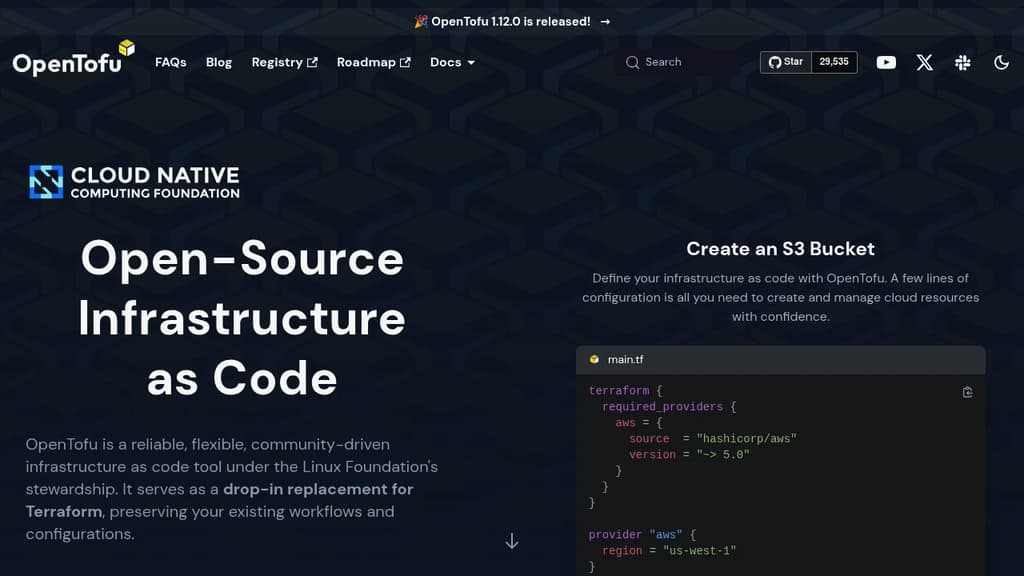
OpenTofu is an open-source infrastructure as code tool, forked from Terraform in response to HashiCorp's license change. It aims to provide a truly open, community-driven alternative for managing cloud resources through code.
Key features and benefits:
-
Truly open-source: Licensed under a well-known, widely-accepted open-source license, ensuring long-term stability and trust for companies.
-
Community-driven: Governed by the community for the community, with regular review and acceptance of pull requests based on merit.
-
Impartial: Features and fixes are accepted based on their value to the community, not influenced by any particular vendor.
-
Layered and modular: Designed with a programmer-friendly structure to encourage building on top and fostering a vibrant ecosystem of tools and integrations.
-
Backwards-compatible: Ensures existing code remains valuable and functional for years to come.
-
Drop-in replacement: Compatible with Terraform versions 1.5.x and most of 1.6.x, allowing for seamless migration without code changes.
-
Production-ready: Suitable for production use cases without exceptions.
-
Strong support: Backed by major companies like Harness, Gruntwork, Spacelift, env0, and Scalr, ensuring long-term development and maintenance.
-
Community-focused development: Encourages contributions and actively listens to community issues and feature requests.
-
Future-proof: Aims to maintain feature parity with Terraform while allowing for community-driven innovations and improvements.
For organizations and individuals looking for a stable, open-source solution for infrastructure as code, OpenTofu provides a compelling alternative to Terraform, ensuring continued access to powerful IaC capabilities without licensing concerns.

Pulumi enables developers to define and manage cloud infrastructure using familiar programming languages instead of domain-specific languages.
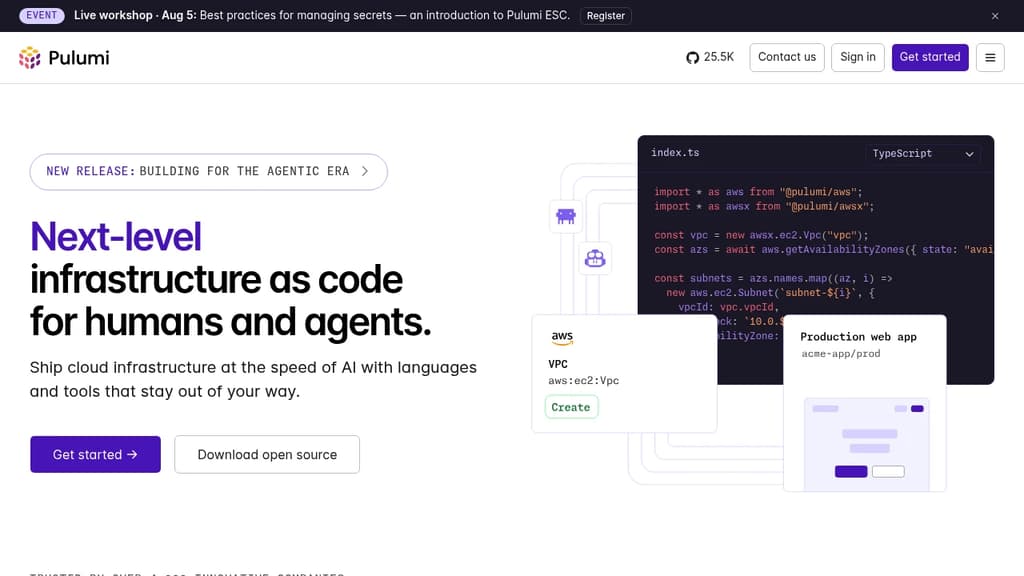
Pulumi is an open source infrastructure as code platform that allows you to define, deploy and manage cloud infrastructure using popular programming languages like TypeScript, Python, Go, C# and Java.
Key benefits of Pulumi include:
-
Use familiar languages and tools: Write infrastructure code in TypeScript, Python, Go, C# or Java. Leverage your existing IDE, testing frameworks and other development tools.
-
Multi-cloud support: Deploy to AWS, Azure, Google Cloud, Kubernetes and 60+ other cloud and SaaS providers from a single workflow.
-
Built-in security: Manage secrets and enforce security best practices across your infrastructure.
-
Automation API: Embed Pulumi into your existing tools and workflows via a language-specific SDK.
-
Open source: Pulumi is open source and backed by a vibrant community of contributors.
With Pulumi, you can:
- Define infrastructure as code using general-purpose languages
- Manage cloud resources across multiple providers
- Enforce security and compliance policies
- Integrate infrastructure provisioning into CI/CD pipelines
- Collaborate on infrastructure using Git and pull requests
Whether you're deploying containers, serverless functions, or entire application stacks, Pulumi provides a consistent workflow for managing cloud infrastructure at scale.

People are looking for alternatives to...
View all alternatives
Claude Code

Spotify

CapCut

Claude

Notion

Lovable
 Stellar Hosted – Managed Open Source software hosting in the EU: secure, compliant, fast.
 Docmost