Open Source Pulumi Alternatives
A curated collection of the 1 best open source alternatives to Pulumi.
The best open source alternative to Pulumi is OpenTofu. If that doesn't suit you, we've compiled a ranked list of other open source Pulumi alternatives to help you find a suitable replacement.
Pulumi alternatives are mainly Infrastructure as Code (IaC) Tools. Browse these if you want a narrower list of alternatives or looking for a specific functionality of Pulumi.

Written by Piotr Kulpinski


A community-driven, truly open-source fork of Terraform for managing cloud infrastructure through code.
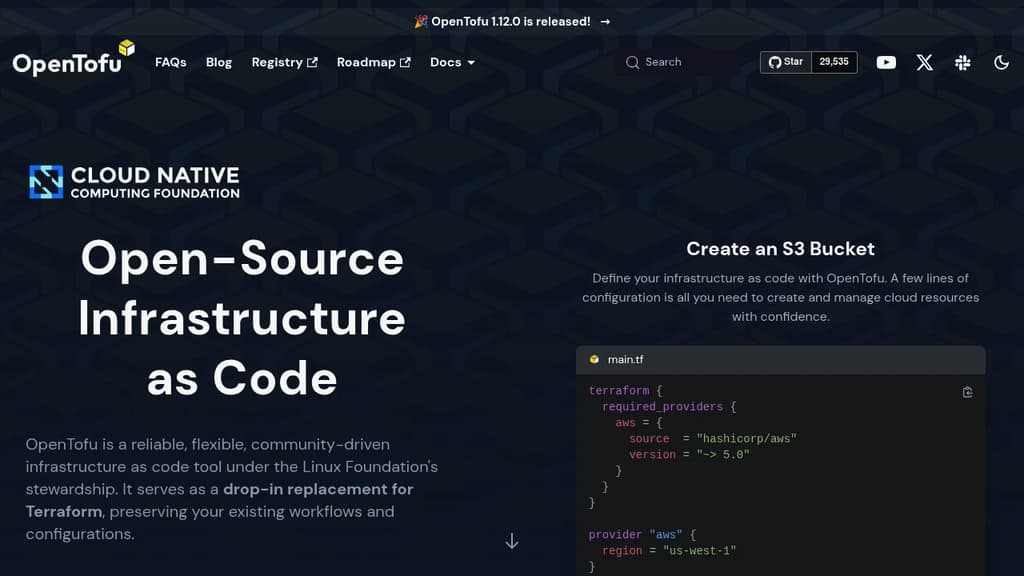
OpenTofu is an open-source infrastructure as code tool, forked from Terraform in response to HashiCorp's license change. It aims to provide a truly open, community-driven alternative for managing cloud resources through code.
Key features and benefits:
-
Truly open-source: Licensed under a well-known, widely-accepted open-source license, ensuring long-term stability and trust for companies.
-
Community-driven: Governed by the community for the community, with regular review and acceptance of pull requests based on merit.
-
Impartial: Features and fixes are accepted based on their value to the community, not influenced by any particular vendor.
-
Layered and modular: Designed with a programmer-friendly structure to encourage building on top and fostering a vibrant ecosystem of tools and integrations.
-
Backwards-compatible: Ensures existing code remains valuable and functional for years to come.
-
Drop-in replacement: Compatible with Terraform versions 1.5.x and most of 1.6.x, allowing for seamless migration without code changes.
-
Production-ready: Suitable for production use cases without exceptions.
-
Strong support: Backed by major companies like Harness, Gruntwork, Spacelift, env0, and Scalr, ensuring long-term development and maintenance.
-
Community-focused development: Encourages contributions and actively listens to community issues and feature requests.
-
Future-proof: Aims to maintain feature parity with Terraform while allowing for community-driven innovations and improvements.
For organizations and individuals looking for a stable, open-source solution for infrastructure as code, OpenTofu provides a compelling alternative to Terraform, ensuring continued access to powerful IaC capabilities without licensing concerns.

People are looking for alternatives to...
View all alternatives
Claude Code

Spotify

CapCut

Claude

Notion

Lovable
 CodeRabbit – The leading AI Code Review platform. Ship better quality code in 50% less time, with 90% fewer bugs.
 Stellar Hosted