Open Source Prefect Alternatives
A curated collection of the 3 best open source alternatives to Prefect.
The best open source alternative to Prefect is Kestra. If that doesn't suit you, we've compiled a ranked list of other open source Prefect alternatives to help you find a suitable replacement. Other interesting open source alternatives to Prefect are: Mage and Dagu.
Prefect alternatives are mainly Workflow Orchestration Tools but may also be ETL & Data Integration Tools. Browse these if you want a narrower list of alternatives or looking for a specific functionality of Prefect.

Written by Piotr Kulpinski


YAML-based orchestration platform with 1400+ plugins for running data pipelines, AI workflows, and infrastructure automation across teams at scale.
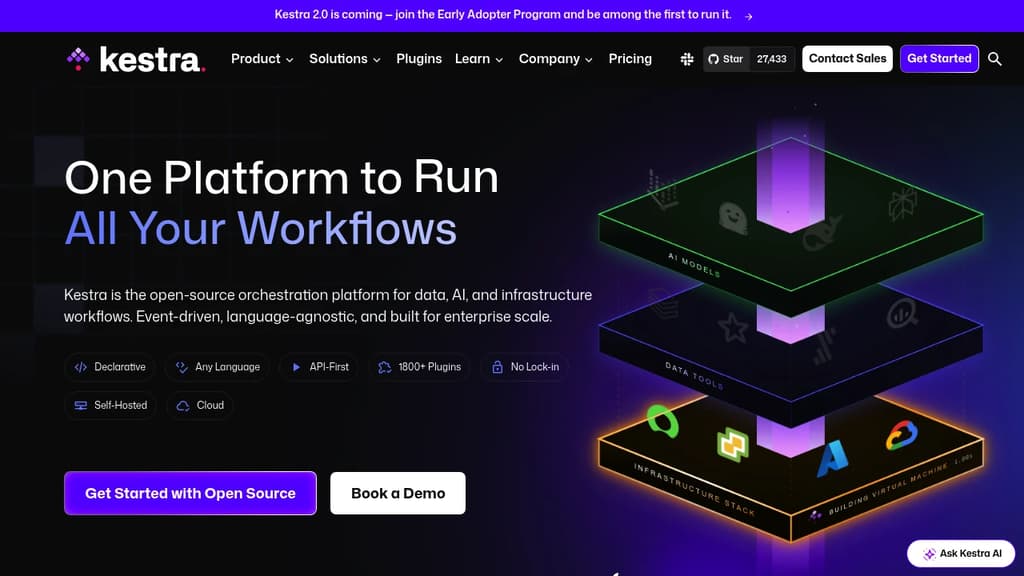
Kestra is a workflow orchestration platform built around a simple idea: one engine for every team. Data engineers, infrastructure teams, and AI practitioners often end up maintaining separate tools that don't talk to each other. Kestra replaces that fragmentation with a single, declarative platform where all workflows live, run, and get monitored together.
Workflows are written in YAML, which means they're version-controlled, reviewable, and deployable through standard CI/CD pipelines. You don't have to rewrite existing code. Tasks can run in Python, Bash, Node.js, Go, or containers, so teams keep their existing logic and just wire it into Kestra's orchestration layer.
Key capabilities:
- 1400+ plugins covering cloud providers, databases, messaging systems, data tools (dbt, Airbyte, Spark), CI/CD, and SaaS services
- Event-driven and scheduled triggers including cron, webhooks, and message queue events, all handled by the same engine
- Built-in governance with retries, timeouts, SLAs, RBAC, and audit logs baked in, not bolted on
- Dual interface where developers work in code and non-engineers use the UI, both staying in sync
- API-first design so executions and workflow management can be automated or integrated into other systems
- AI workflow support for orchestrating RAG pipelines, model retraining, evaluation, and agent workflows with full observability
Compared to tools like n8n or Temporal, Kestra leans heavily on the declarative YAML approach and cross-team scope. It's not aimed at a single persona. The platform is designed so analysts can build workflows themselves without waiting on engineering, as JP Morgan Chase's team demonstrated when processing billions of rows across thousands of weekly API pulls.
Deployment options include self-hosted on Docker or Kubernetes, an Enterprise Edition with SSO, multi-tenancy, and hybrid/air-gapped support, and a managed Cloud offering. The open-source version is free with no time limit. Over 250 workflow blueprints are available to get started without building from scratch.

Open-source data pipeline platform for effortless data integration, transformation, and orchestration using Python, SQL, and R.
Mage AI revolutionizes data engineering with its intuitive, powerful, and flexible platform. This open-source tool empowers data teams to build, preview, and deploy data pipelines with ease, offering a superior alternative to complex solutions like Airflow.
Key benefits include:
- Easy Developer Experience: Start locally with a single command or launch in your cloud using Terraform.
- Language Flexibility: Write code in Python, SQL, or R within the same pipeline for ultimate versatility.
- Built-in Best Practices: Modular, reusable, and testable code with data validations.
- Instant Feedback: Interactive notebook UI for immediate results and collaborative development.
- Data-Centric Approach: Version, partition, and catalog data produced by each code block.
- Scalability: Transform large datasets in your data warehouse or through native Spark integration.
- Simplified Deployment: Deploy to AWS, GCP, Azure, or DigitalOcean with just two commands.
- Comprehensive Observability: Built-in monitoring, alerting, and intuitive UI for operational excellence.
Mage AI streamlines the entire data pipeline process, from development to production, making it an indispensable tool for modern data teams seeking efficiency and scalability.

Single-binary workflow orchestrator that runs scheduled DAGs locally or over SSH, with retries, human tasks, a built-in Web UI, and file-based state storage.

Dagu is a workflow orchestration tool built for teams whose core work isn't orchestration itself. It runs as a single binary with no external database, no framework to manage, and no infrastructure to provision before you can schedule your first job. Workflows are defined in declarative YAML and can run locally, over SSH, or inside containers, without touching your existing scripts.
It's a practical alternative to heavier tools like Airflow when you need reliable scheduling and visibility but don't want to operate a separate data platform to get there. State is stored in local files, which means there's nothing to size, migrate, or scale separately.
Key capabilities:
- Cron scheduling with timezone support, catchup windows, overlap policies, and per-step retry policies
- Web UI with real-time monitoring, a visual DAG view, and execution history
- Distributed execution via a coordinator that dispatches tasks over gRPC to workers selected by labels (e.g.,
gpu=true) - Multiple executors including Docker, SSH, and HTTP out of the box
- Human tasks for approval steps or manual interventions inside automated workflows
- MCP integration so you can build and trigger workflows directly from AI coding tools like Claude, Cursor, or Copilot
- Notifications via email and webhooks, with lifecycle handlers and zombie detection
- Secret masking and per-DAG webhook tokens for secure automation
The same binary covers three deployment shapes: a single all-in-one server, temporary per-run workers provisioned by your platform, or a coordinator-and-workers setup for larger environments.
The community edition is free under GPLv3 and covers unlimited servers and workers. Paid licenses add SSO, RBAC, audit logging, incident routing, and priority support.

People are looking for alternatives to...
View all alternatives
Spotify

Claude Code

CapCut

Claude

Notion

Lovable
 Sent – Messaging Infrastructure for Developers. One API for SMS, WhatsApp, and RCS across 190+ countries.
 Stellar Hosted