Open Source LiveKit Alternatives
A curated collection of the 2 best open source alternatives to LiveKit.
The best open source alternative to LiveKit is Langflow. If that doesn't suit you, we've compiled a ranked list of other open source LiveKit alternatives to help you find a suitable replacement. Other interesting open source alternative to LiveKit is Dograh.
LiveKit alternatives are mainly AI Agent Platforms but may also be Low-Code/No-Code Platforms or LLM Application Frameworks. Browse these if you want a narrower list of alternatives or looking for a specific functionality of LiveKit.

Written by Piotr Kulpinski
Build, deploy, and iterate on AI agents, RAG applications, and MCP servers using a drag-and-drop visual interface backed by Python.
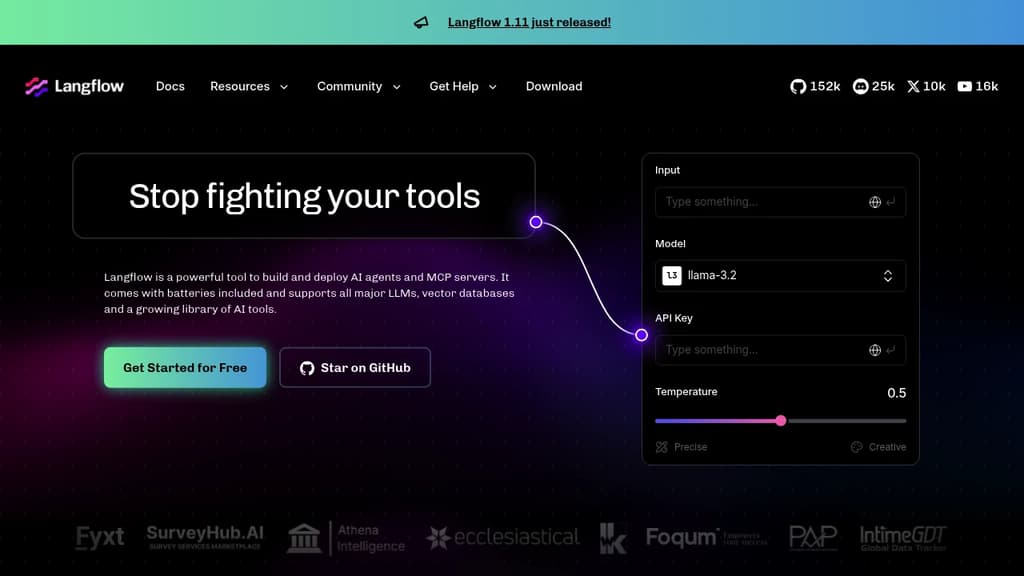
Langflow is a low-code platform for building AI agents and RAG applications visually. It targets developers and AI teams who want to move fast without writing boilerplate, while still having full access to the underlying Python when they need it. The visual canvas lets you wire together models, data sources, and tools by dragging components onto a flow, then deploy that flow as an API with minimal extra work.
The integration library is broad:
- LLMs: OpenAI, Anthropic, Mistral, Meta (Llama), Groq, NVIDIA, Amazon Bedrock, Ollama, HuggingFace, and more
- Vector stores: Pinecone, Milvus, Weaviate, Qdrant, Cassandra, Couchbase, Upstash, Vectara
- Data sources: Google Drive, Confluence, Notion, Gmail, GitHub, Slack, MongoDB, and dozens more
- Agent frameworks: LangChain, CrewAI, Composio
Flows are reusable and shareable. You can pick from a library of pre-built components, swap models mid-flow to compare outputs, and run single agents or coordinated fleets where each agent has access to your components as tools. Every flow exposes itself as an API endpoint, so connecting Langflow to an existing product is straightforward.
Python is always available under the hood. Any component can be customized with code, so the visual layer doesn't box you in. Teams that need observability can pair it with tools like Langfuse for tracing.
Deployment is flexible. Self-host it on your own infrastructure, or use the managed cloud option, which runs the same codebase as the open-source version. That parity matters: there's no feature gap to worry about when moving between environments.
Compared to alternatives like Flowise AI or Dify, Langflow leans into Python extensibility and a wide integration surface, making it a practical fit for teams building production-grade agents rather than quick demos.

Open-source voice agent platform that lets you plug in your own STT, LLM, and TTS models, deploy on-prem or in your VPC, and build agents via MCP or a visual workflow builder.
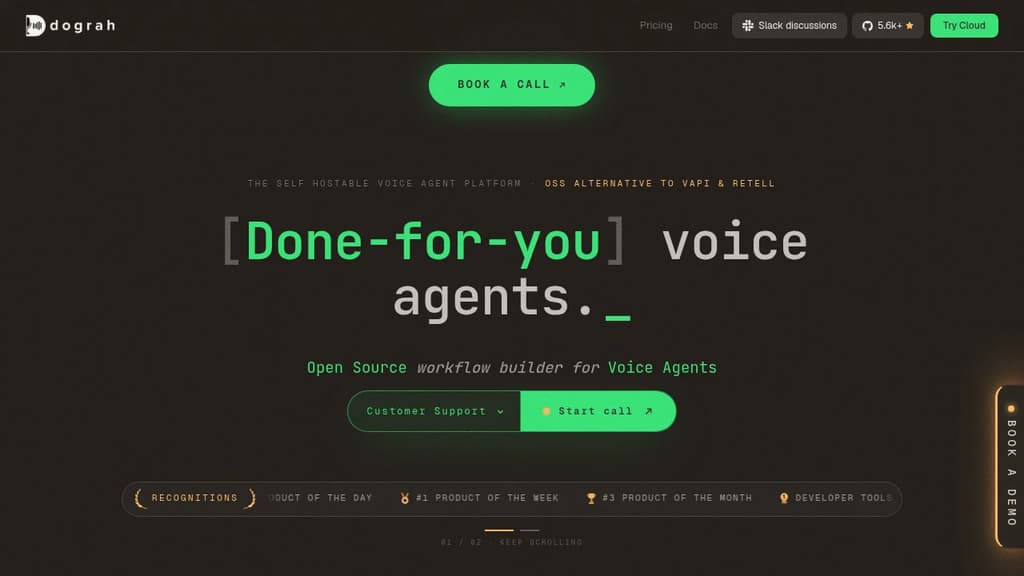
Dograh is a self-hostable voice agent platform built for teams that can't hand call recordings, transcripts, or customer PII to a third-party vendor. It's the open-source alternative to Vapi and Retell, licensed under BSD-2-Clause, and designed to run entirely within your own infrastructure perimeter.
The core idea is a modular pipeline you assemble yourself. Pick an inbound channel, a speech-to-text provider, an LLM, and a text-to-speech engine. Swap any node for a different provider, or skip the cascade entirely and run a speech-to-speech model like Gemini Flash Live or GPT Realtime for single-hop, audio-in/audio-out conversations. Lower latency, real interruption handling, no text round-trip.
Key capabilities:
- Bring your own models across STT (Whisper, Voxtral, Deepgram, AssemblyAI), LLM (OpenAI, Groq, Gemini, OpenRouter, Azure, AWS), and TTS (ElevenLabs, Cartesia, Kokoro, Chatterbox, your own voice clone weights)
- Telephony integrations with Twilio, Telnyx, Plivo, Vonage, Vobiz, Asterisk, and Cloudonix
- MCP server so Claude Code, Cursor, or any MCP-compatible agent runtime can spin up and configure voice agents without leaving the IDE
- Hybrid voice mode that mixes pre-recorded human clips with TTS in the same cloned voice, cutting costs up to 3x and reducing perceived latency
- On-prem or VPC deployment with fully air-gapped model serving, so no data crosses your boundary
- Observability via Langfuse integration
For regulated industries like healthtech, fintech, insurance, and government, the pitch is direct: your existing HIPAA, GDPR, and SOC 2 controls keep covering the data because Dograh never sees it. The code is auditable, so your security team can review every line before a call goes out. No vendor compliance review needed.
Compared to LiveKit or hosted platforms, Dograh's differentiator is the combination of a visual workflow builder, MCP-driven agent creation, and genuine data sovereignty, all in one stack you can fork and run yourself. Three deployment modes cover the range: self-host on your own servers, use their managed cloud, or have them operate the stack inside your VPC.

People are looking for alternatives to...
View all alternatives
Spotify

Claude Code

CapCut

Claude

Notion

Lovable
 Sent – Messaging Infrastructure for Developers. One API for SMS, WhatsApp, and RCS across 190+ countries.
 Sent
Sent