Open Source Dograh Alternatives
A curated collection of the 2 best open source alternatives to Dograh.
The best open source alternative to Dograh is Langflow. If that doesn't suit you, we've compiled a ranked list of other open source Dograh alternatives to help you find a suitable replacement. Other interesting open source alternative to Dograh is LiveKit.
Dograh alternatives are mainly AI Agent Platforms but may also be Low-Code/No-Code Platforms or LLM Application Frameworks. Browse these if you want a narrower list of alternatives or looking for a specific functionality of Dograh.

Written by Piotr Kulpinski


Build, deploy, and iterate on AI agents, RAG applications, and MCP servers using a drag-and-drop visual interface backed by Python.
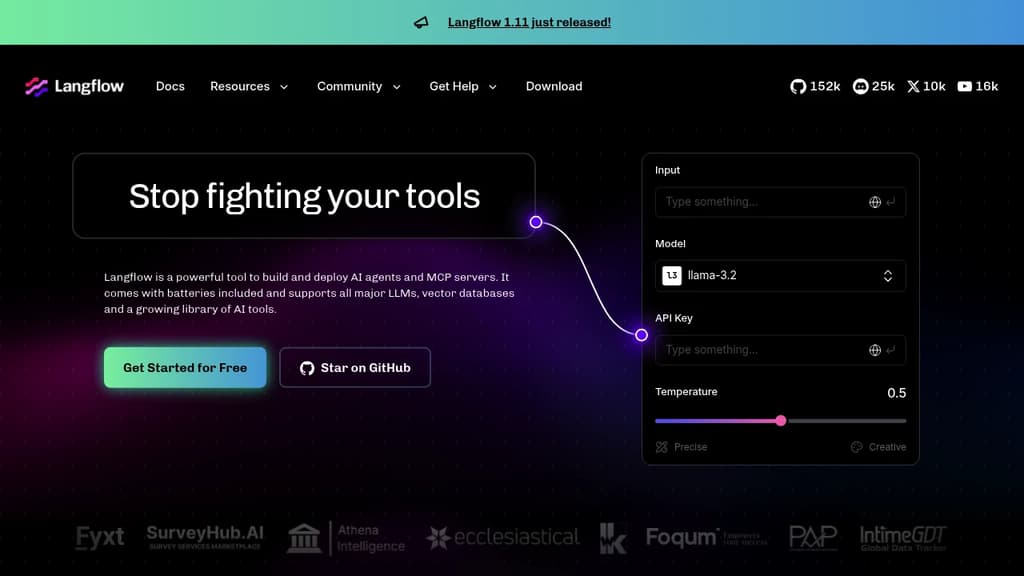
Langflow is a low-code platform for building AI agents and RAG applications visually. It targets developers and AI teams who want to move fast without writing boilerplate, while still having full access to the underlying Python when they need it. The visual canvas lets you wire together models, data sources, and tools by dragging components onto a flow, then deploy that flow as an API with minimal extra work.
The integration library is broad:
- LLMs: OpenAI, Anthropic, Mistral, Meta (Llama), Groq, NVIDIA, Amazon Bedrock, Ollama, HuggingFace, and more
- Vector stores: Pinecone, Milvus, Weaviate, Qdrant, Cassandra, Couchbase, Upstash, Vectara
- Data sources: Google Drive, Confluence, Notion, Gmail, GitHub, Slack, MongoDB, and dozens more
- Agent frameworks: LangChain, CrewAI, Composio
Flows are reusable and shareable. You can pick from a library of pre-built components, swap models mid-flow to compare outputs, and run single agents or coordinated fleets where each agent has access to your components as tools. Every flow exposes itself as an API endpoint, so connecting Langflow to an existing product is straightforward.
Python is always available under the hood. Any component can be customized with code, so the visual layer doesn't box you in. Teams that need observability can pair it with tools like Langfuse for tracing.
Deployment is flexible. Self-host it on your own infrastructure, or use the managed cloud option, which runs the same codebase as the open-source version. That parity matters: there's no feature gap to worry about when moving between environments.
Compared to alternatives like Flowise AI or Dify, Langflow leans into Python extensibility and a wide integration surface, making it a practical fit for teams building production-grade agents rather than quick demos.
Build, test, deploy, and scale voice and video AI agents with an open source framework, inference gateway, telephony integrations, and full observability.
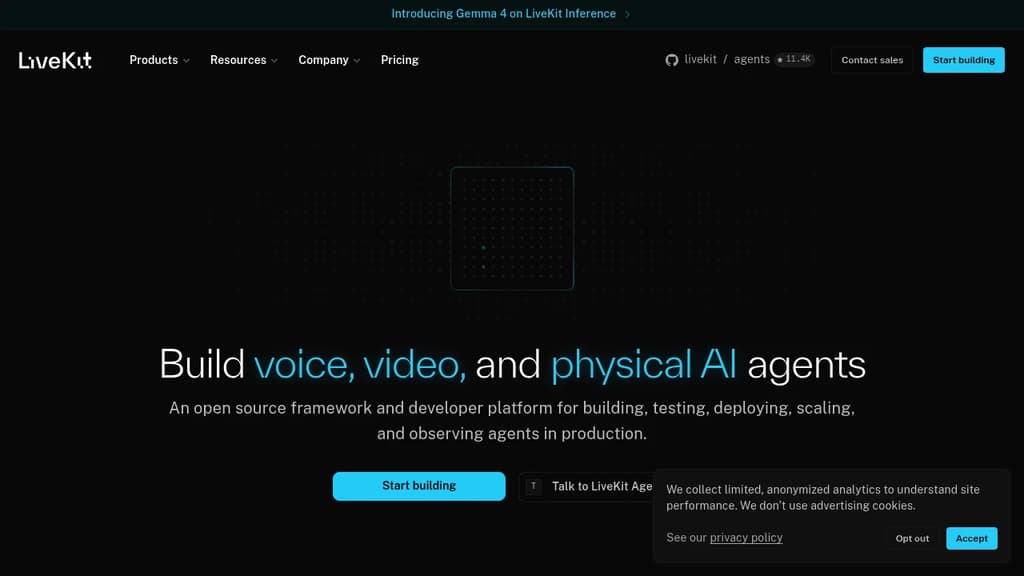
LiveKit is an open source framework and cloud platform for building AI agents that communicate through voice, video, or physical interfaces. It's aimed at developers who need production-grade infrastructure without assembling a custom stack from scratch. OpenAI built ChatGPT's Advanced Voice on it, and the platform handles over 2.5 billion calls annually.
The core idea is to cover the entire agent lifecycle in one place. You write agent logic, connect it to the speech and language models you choose, and deploy it without managing the underlying real-time infrastructure yourself. Automatic turn detection and interruption handling are built in, so agents respond naturally in conversation rather than waiting for rigid cues.
Key capabilities include:
- Open source agent framework for building and testing agents locally before deploying
- Inference gateway that connects to TTS, LLM, and STT providers (Deepgram, Google, Cartesia, and others) through a unified interface
- Telephony and SIP integrations so agents can handle phone calls alongside browser and app sessions
- Full-stack observability across every agent session, not just aggregate metrics
- LiveKit Cloud for deploying and scaling agents across regions globally, with SOC 2 Type 2, HIPAA, and GDPR compliance
LiveKit fits squarely in the AI agent platforms space but goes further than most by covering real-time media transport, not just LLM orchestration. That makes it relevant for robotics and video AI use cases, not just voice chatbots. Teams that have moved off homegrown WebSocket stacks cite the unified export interface across web and phone as a concrete reason to switch.
The self-hosted framework is free and open source. LiveKit Cloud adds managed scaling, telephony, and observability, with 1,000 free agent session minutes per month and no credit card required to start.

People are looking for alternatives to...
View all alternatives
Spotify

Claude Code

Claude

CapCut

Notion

Lovable
 Sent – Messaging Infrastructure for Developers. One API for SMS, WhatsApp, and RCS across 190+ countries.
 Sent
Sent