The best open source alternative to CopilotKit is Mem0. If that doesn't suit you, we've compiled a ranked list of other open source CopilotKit alternatives to help you find a suitable replacement. Other interesting open source alternatives to CopilotKit are: Agno, Langfuse, Supermemory, and Letta.
CopilotKit alternatives are mainly LLM Application Frameworks but may also be Data Platforms for AI or AI Agent Platforms. Browse these if you want a narrower list of alternatives or looking for a specific functionality of CopilotKit.
Adds persistent, searchable memory to AI agents and apps, so they remember user preferences and past interactions across sessions without pipeline changes.

Mem0 is a memory infrastructure layer built for AI agents and applications that need to retain context across sessions. Without something like this, every conversation starts from scratch, forcing developers to stuff redundant history into prompts or lose personalization entirely. Mem0 solves that by extracting, storing, and retrieving memories automatically as users interact.
The core idea is simple: you send messages to Mem0, it learns from them, and later retrieves the relevant context when needed. No boilerplate configuration required. It fits into existing agent architectures without restructuring your pipeline.
Key capabilities include:
Mem0 is particularly well-suited for products where personalization compounds over time: healthcare assistants that track patient history, customer support bots that remember past issues, or AI chat interfaces that need to feel consistent across sessions. It also works well as the memory backend for more complex agent frameworks that handle multi-step reasoning but lack native persistence.
Over 90,000 developers use it in production. The SDK supports Python and Node.js, and the managed API makes it easy to get started without self-hosting. For teams that need full control, self-hosted deployment is available with the same API surface.
Looking for open source alternatives to other popular services? Check out other posts in the alternatives series and openalternative.co, a directory of open source software with filters for tags and alternatives for easy browsing and discovery.
Open-source platform that enables developers to create, deploy and monitor AI agents with built-in memory, knowledge integration, and external tool connectivity.
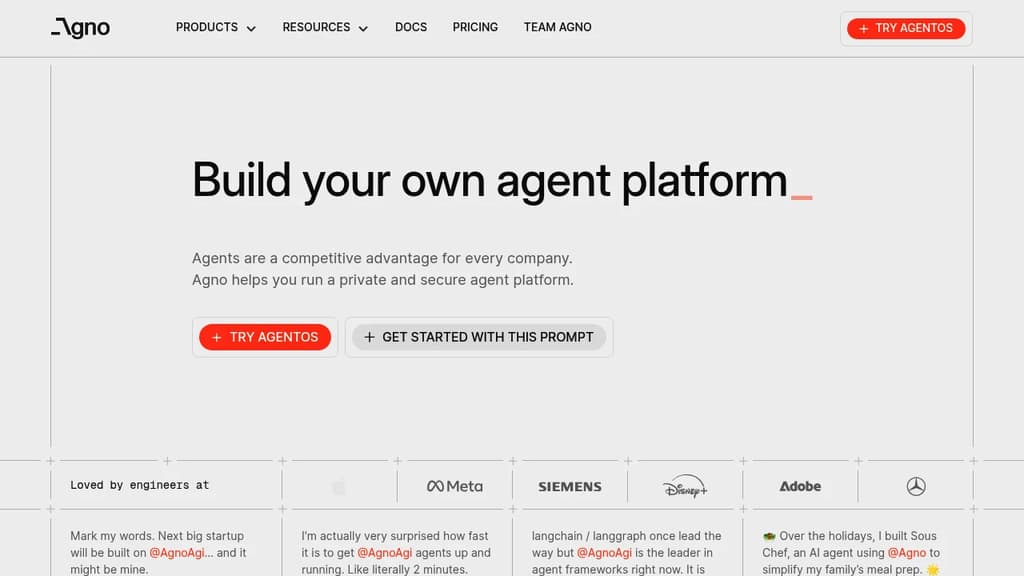
Agno is a powerful open-source platform for building production-ready AI agents. The platform stands out with its model-agnostic approach, allowing developers to use any LLM from providers like OpenAI, Anthropic, or open-source alternatives.
Key capabilities include:
The platform is designed for high performance and scalability, making it ideal for production environments. With Agno workspaces, teams can go from development to production quickly while maintaining full control over their infrastructure.
Langfuse provides tracing, evaluations, prompt management, and analytics to debug and improve LLM applications.

Langfuse is an open source LLM engineering platform designed to help teams build, debug, and improve AI-powered applications. With its comprehensive suite of tools, Langfuse empowers developers to gain deep insights into their LLM applications and optimize performance.
Key features of Langfuse include:
Tracing: Capture detailed production traces to quickly identify and resolve issues in your LLM applications. Visualize the entire request flow and pinpoint bottlenecks.
Evaluations: Collect user feedback, annotate data, and run custom evaluation functions to assess the quality and performance of your AI models.
Prompt Management: Collaboratively version and deploy prompts, with low-latency retrieval for production use. Streamline your prompt engineering workflow.
Analytics: Track key metrics like cost, latency, and quality to optimize your LLM application's performance and efficiency.
Playground: Test different prompts and models directly within the Langfuse UI, enabling rapid experimentation and iteration.
Datasets: Derive high-quality datasets from production data to fine-tune models and thoroughly test your LLM applications.
Langfuse integrates seamlessly with popular LLM frameworks and libraries, including LangChain, LlamaIndex, and OpenAI. It offers SDKs for Python and JavaScript/TypeScript, making it easy to incorporate into your existing workflow.
Built for teams of all sizes, Langfuse can be self-hosted or used as a cloud service. It's designed with enterprise-grade security in mind, offering SOC 2 Type II and ISO 27001 certifications for the cloud version.
By providing a comprehensive toolkit for LLM engineering, Langfuse helps teams build more reliable, efficient, and high-quality AI applications. Whether you're just starting with LLMs or scaling a complex AI system, Langfuse offers the observability and tools needed to succeed in the rapidly evolving field of AI engineering.
Add persistent memory to LLM apps with millisecond recall times. Store, retrieve, and personalize user data across sessions with enterprise-grade security.

Transform your AI applications with blazing-fast long-term memory that delivers sub-300ms recall times. Supermemory provides a universal memory API that works seamlessly across all LLM models and modalities.
Key benefits include:
The platform handles multimodal data ingestion from files, documents, chats, emails, and app streams with automatic cleaning and chunking. Advanced embeddings and graph-based enrichment create smart, interconnected memories that scale effortlessly.
Integration is simple - drop Supermemory into your existing stack with SDKs for OpenAI, Anthropic, AI SDK, and Cloudflare. Connect to popular platforms like Google Drive, Notion, and OneDrive to sync user context automatically.
Perfect for developers building personalized AI experiences, search engines, content libraries, and knowledge management systems. Start free with 1M tokens processed and 10K search queries, then scale as your memory becomes your competitive advantage.
Letta is an open-source platform for creating AI agents with built-in memory, reasoning, and support for thousands of tools.

Letta is an open-source platform that enables developers to build and deploy advanced AI agents.
Some key features include:
With its focus on memory management, extensive capabilities, and developer-friendly features, Letta aims to push the boundaries of what's possible with AI agents. Whether you're building prototypes or production-ready systems, Letta provides the tools and infrastructure to create more capable and context-aware AI assistants.
Open-source platform for LLM tracing, evaluation, and optimization. Features automatic instrumentation, prompt playground, and real-time AI application monitoring.

Open-source LLM tracing and evaluation platform designed for AI teams who need complete visibility into their applications. Built on OpenTelemetry standards, this platform offers vendor-agnostic monitoring without lock-in restrictions.
Key capabilities include:
The platform has gained significant traction with 2.5M+ monthly downloads, 8k+ GitHub stars, and adoption by top AI teams. Users praise its ability to identify root causes of problematic responses, debug LLM workflows, and integrate observability directly into development processes.
Completely self-hostable with no feature restrictions, making it ideal for teams requiring full control over their AI monitoring infrastructure while maintaining transparency in model decision-making.
Looking for open source alternatives to other popular services? Check out other posts in the alternatives series and openalternative.co, a directory of open source software with filters for tags and alternatives for easy browsing and discovery.
Laminar is an open-source platform that helps collect, understand, and utilize data for building high-quality LLM applications.

Laminar is an innovative, open-source platform designed to revolutionize the development of Large Language Model (LLM) products. It offers a comprehensive suite of tools for engineering best-in-class AI applications from first principles.
Key features and benefits:
Traces: Laminar provides powerful tracing capabilities, allowing developers to gain a clear picture of every step in their LLM application's execution. This feature simultaneously collects invaluable data that can be used for:
Zero-overhead observability: All traces are sent in the background via gRPC, ensuring minimal impact on performance. The platform supports tracing for both text and image models, with audio model support coming soon.
Online evaluations: Laminar enables the setup of LLM-as-a-judge or Python script evaluators to run on each received span. This approach to evaluation is more scalable than human labeling and particularly beneficial for smaller teams.
Dataset creation: Users can build datasets from their traces, which can be utilized in evaluations, fine-tuning, and prompt engineering.
Prompt chain management: Laminar goes beyond single prompts, allowing users to build and host complex chains, including mixtures of agents or self-reflecting LLM pipelines.
Open-source and self-hostable: The platform is fully open-source and easy to self-host, giving users complete control over their data and infrastructure.
Laminar empowers developers to create more robust, efficient, and effective LLM applications by providing a data-centric approach to AI engineering. Whether you're working on improving model performance, optimizing prompts, or scaling your AI solutions, Laminar offers the tools and insights needed to excel in the rapidly evolving field of AI engineering.