Open Source Cloudinary Alternatives
A curated collection of the 2 best open source alternatives to Cloudinary.
The best open source alternative to Cloudinary is imgproxy. If that doesn't suit you, we've compiled a ranked list of other open source Cloudinary alternatives to help you find a suitable replacement. Other interesting open source alternative to Cloudinary is Openinary.
Cloudinary alternatives are mainly Image Optimization & CDN Tools. Browse these if you want a narrower list of alternatives or looking for a specific functionality of Cloudinary.

Written by Piotr Kulpinski


Self-hosted image processing server that resizes, converts, and optimizes images on demand via URL parameters, with built-in security against common attack vectors.

imgproxy is a standalone server that processes images on demand. Instead of pre-generating every thumbnail, crop, or format variant, you encode the processing options directly in the URL and imgproxy handles the rest at request time. It runs on your own infrastructure, so you're not routing images through a third-party service or dealing with unpredictable SaaS pricing.
Used in production by Photobucket, eBay, Medium, Substack, and Miro, it's built for teams that need high throughput without sacrificing control. Substack reported cutting costs by roughly 90% after switching from a commercial image processing alternative.
Core open-source capabilities include:
- Format support: JPEG, PNG, GIF, WebP, AVIF, JPEG XL, and more
- Processing operations: resizing, cropping, rotating, watermarking, and filters
- Optimization: color profile and metadata stripping, PNG quantization
- Smart cropping: basic content-aware cropping and auto-quality by file size
- Security: URL signing to block denial-of-service attacks, image bomb detection, and HTTP header authorization
The Pro version adds object detection, advanced smart cropping, auto-quality by SSIM, GIF-to-MP4 conversion, SVG minification, video and PDF preview generation, and dynamic watermarking.
Security is treated as a first-class concern. imgproxy checks real image dimensions before processing begins, rejecting oversized or malformed files before they consume resources. Signed URLs mean attackers can't trigger arbitrary transformations to exhaust your server. If you've been looking at ImageKit or similar hosted services, imgproxy gives you comparable functionality without handing over your image storage to a third party.
For teams that want a self-hostable option with a more feature-complete open-source layer, Openinary is worth comparing. imgproxy's open-source edition is genuinely capable on its own, with the Pro tier reserved for more advanced use cases rather than gating basic functionality.

Upload, transform, and deliver images and videos via a REST API and URL parameters, using your own S3-compatible storage. Cloudinary-compatible syntax, no vendor lock-in.
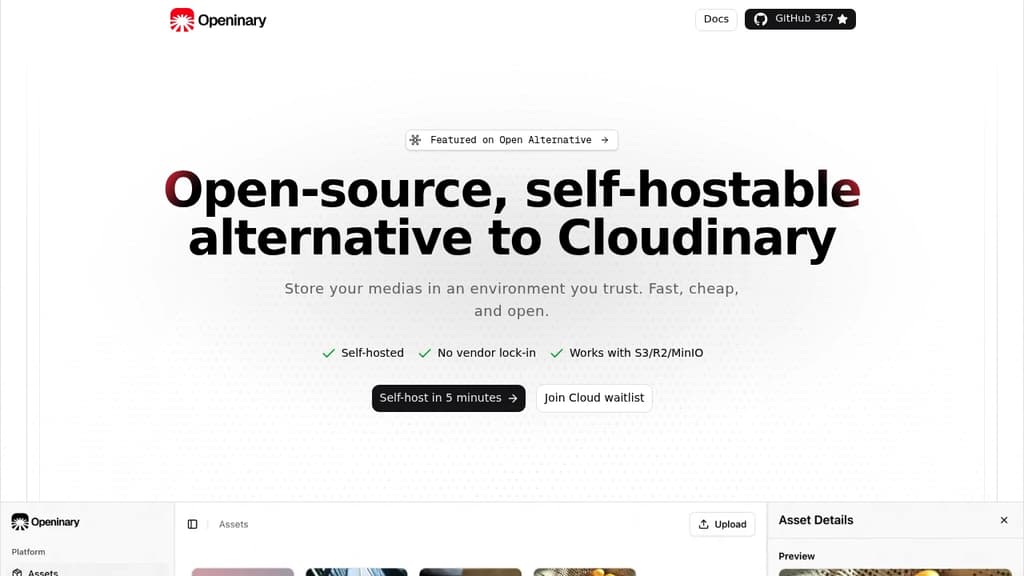
Openinary is a self-hostable media platform built as an open alternative to Cloudinary. It handles image and video uploads, on-the-fly transformations, and edge delivery, all from infrastructure you control. Teams tired of Cloudinary's pricing or vendor lock-in are the obvious audience, but it's equally useful for any project that needs media handling without handing over storage to a third party.
The core idea is simple: point Openinary at your existing S3-compatible storage and start uploading. No migration required.
- URL-based transformations let you resize, crop, convert formats, adjust quality, and transcode video by changing URL parameters. No code changes needed if you're already using Cloudinary's syntax.
- S3-compatible storage works with AWS S3, Cloudflare R2, MinIO, Google Cloud Storage, or any compatible provider.
- REST API uploads handle programmatic media ingestion, with SDKs available for Node.js, Next.js, Remix, Python, Go, and Rust.
- Edge delivery optimizes content for global performance without requiring a separate CDN setup.
- Media browser UI is included alongside the upload API, so you're not managing files blind.
The self-hosted version is free under the AGPL 3.0 license with no feature restrictions. Infrastructure costs are your only expense, typically a few dollars a month when paired with something like Cloudflare R2. A managed cloud option is also available in public alpha, with a free tier covering 1 GB of storage, 500 transformations, 15 minutes of video processing, and 25,000 CDN requests per month, no credit card required.
For teams migrating from Cloudinary specifically, the compatible transformation syntax means existing URLs and integrations can carry over without rewriting logic.

People are looking for alternatives to...
View all alternatives
Spotify

Claude Code

Claude

CapCut

Notion

Lovable
 Sent – Messaging Infrastructure for Developers. One API for SMS, WhatsApp, and RCS across 190+ countries.
 Openlane