Grida vs Silex
Learn how Grida and Silex differ in their key features, development activity, technology
stack and community adoption, so you can decide which of these low-code/no-code platforms is best for you.
Learn how Grida and Silex differ in their key features, development activity, technology stack and community adoption, so you can decide which of these low-code/no-code platforms is best for you.

Grida
Last 30 days
Last commit
4 days agoRepository age
6 yearsVersion
v0.0.24License
Apache-2.0Repository
gridaco/grida

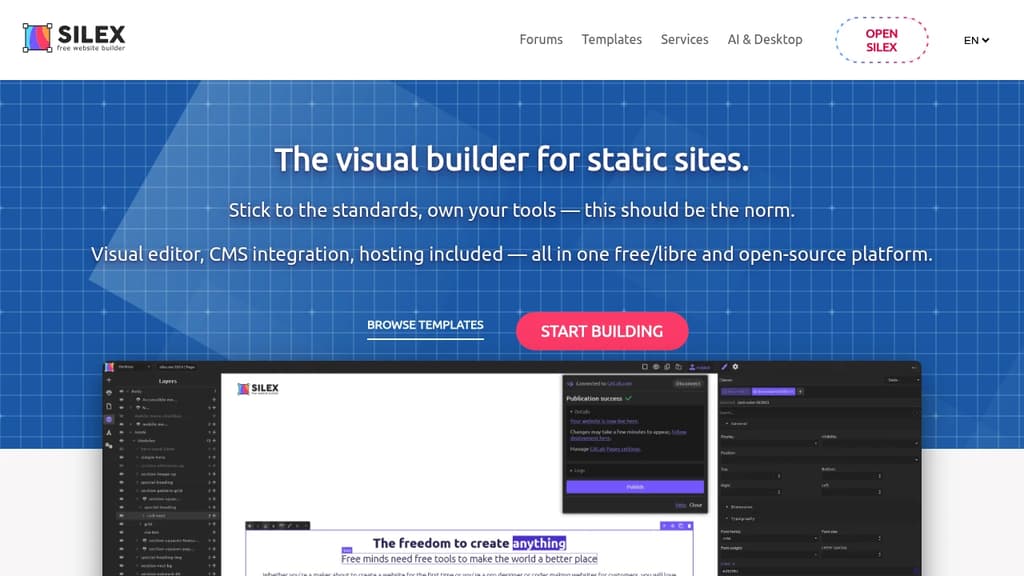
Silex
Last 30 days
Last commit
1 day agoRepository age
13 yearsVersion
v3.9.0License
AGPL-3.0Self-hosted
YesRepository
silexlabs/silex
Detailed Comparison
Silex appears to have several advantages over Grida, particularly in maturity and features. Consider your specific needs regarding popularity, growth, activity, technology, maturity, licensing and features when making your decision.
Silex appears to have several advantages over Grida, particularly in maturity and features. Consider your specific needs regarding popularity, growth, activity, technology, maturity, licensing and features when making your decision.
Community & Popularity
Both tools have similar popularity levels, with Grida having 2,688 stars and Silex having 3,015 stars on GitHub. In terms of developer contributions, Silex has 691 forks, indicating moderate developer engagement.
Growth Momentum
Grida and Silex are moving at much the same rate, adding 38 stars and adding 37 stars respectively over the last 30 days (+1.4% vs +1.2%). Neither is pulling away from the other on momentum alone.
Development Activity
Both projects show recent activity, with Grida last updated 4 days ago and Silex 1 day ago.
Technology Stack
Both tools share common technology foundations, being built with JavaScript. However, they differ in their additional technology choices: Grida uses CSS, Typescript, JSX, Python, Next.js, Rust while Silex leverages Bash.
Project Maturity
Silex has been in development longer, starting 13 years ago, compared to Grida which began 6 years ago. This 7.5-year head start suggests Silex may have more mature features and established processes.
Licensing
The projects use different licenses: Grida is licensed under Apache-2.0 while Silex uses AGPL-3.0. Consider the licensing requirements when choosing for your project.
Use Cases & Features
Both tools serve similar use cases in Low-Code/No-Code. However, they also have distinct specializations: Grida also focuses on UI/UX Design while Silex extends into Website Builders.
Hosting & Deployment
Silex provides self-hosting options for complete data control and customization, while Grida may be primarily cloud-based or require different deployment approaches.









 Openlane – Open-source, developer-first platform for automated compliance, risk management, and built-in Trust Center.