Open Source Profound Alternatives
A curated collection of the 5 best open source alternatives to Profound.
The best open source alternative to Profound is Elmo. If that doesn't suit you, we've compiled a ranked list of other open source Profound alternatives to help you find a suitable replacement. Other interesting open source alternatives to Profound are: Notra, Ansvisor, OneGlanse, and Canonry.
Profound alternatives are mainly AI Visibility Tracking but may also be SEO Tools. Browse these if you want a narrower list of alternatives or looking for a specific functionality of Profound.

Written by Piotr Kulpinski


Tracks how ChatGPT, Gemini, Claude, Perplexity, and other AI engines mention your brand, which competitors appear, and which sources get cited.
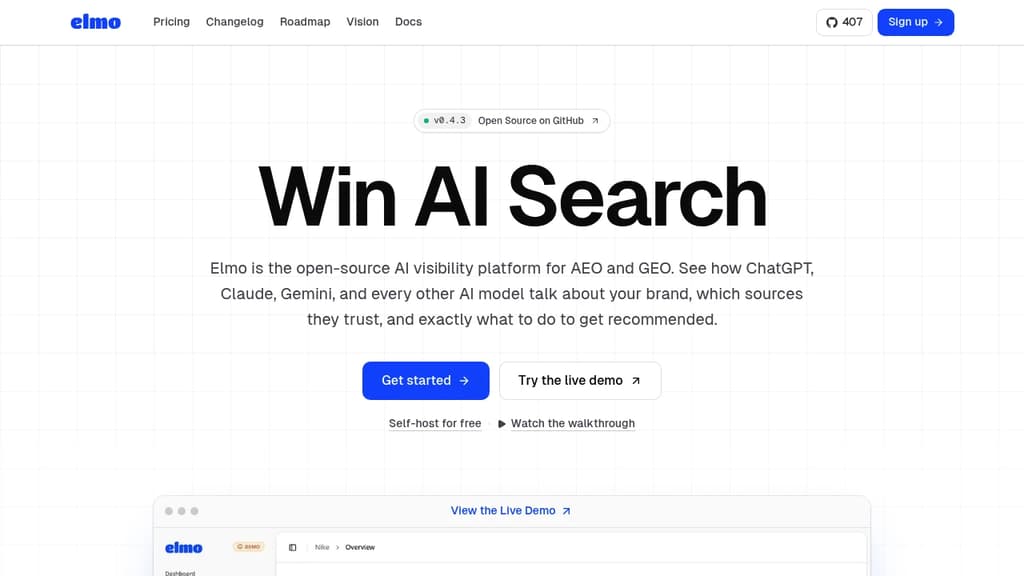
As AI answer engines replace traditional search for many buyers, knowing whether your brand gets mentioned in those answers matters. Elmo sits in the AI visibility tracking category and gives marketers a single dashboard to see how every major AI model talks about their brand, which competitors appear alongside them, and which URLs each model cites as sources.
It covers a wide range of models and surfaces:
- ChatGPT, Gemini, Claude, Perplexity, Copilot, AI Overviews, AI Mode scraped directly from the real consumer interfaces your customers use
- Grok, DeepSeek, Mistral, Qwen, and OpenRouter LLMs reached via direct API calls
- Share of voice calculated against competitors you define, updated up to four times daily
- Source tracking showing exactly which domains and URLs each model cites per prompt
- Prompt Wizard that suggests the questions your buyers are likely to ask, based on your site, competitors, and personas
- API and MCP access on every plan, so you can pull data into your own stack or agents
The setup flow is self-serve: point it at your site, review the suggested prompts, and Elmo starts sampling. It ranks improvement opportunities by impact and keeps you updated as visibility shifts. Unlimited seats are included on every plan, which makes it practical for agency teams and AEO consultancies tracking multiple brands.
Elmo is MIT-licensed and stores all data in Postgres. Self-hosting is free with your own infrastructure and API keys. Managed cloud plans start at $29/month, with white-label options available for agencies who want to offer AI visibility tracking under their own brand. Compared to tools like Otterly.AI or Peec AI, Elmo's self-host option and lower cloud pricing make it a practical choice for teams who want full data ownership without paying enterprise rates.

GEO tool that queries ChatGPT, Claude, Gemini, and Perplexity with your buyers' questions, then shows you who gets recommended and how to close the gap.
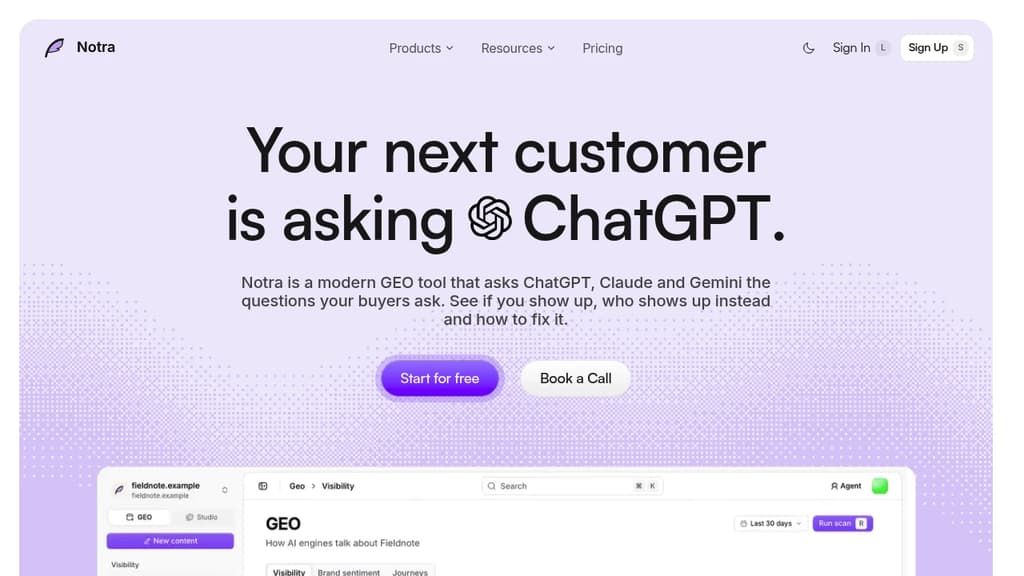
Notra is a Generative Engine Optimization (GEO) platform built for marketing teams and founders who want to know whether AI assistants recommend their brand when buyers ask for solutions. Instead of guessing, it runs your chosen prompts against ChatGPT, Claude, Gemini, and Perplexity with live web search enabled, then stores the full answers so you can see exactly what each engine said, where your brand appeared, and which competitors took the spots you didn't.
The dashboard tracks four core metrics:
- Mention rate by engine shows what percentage of scans included your brand, your average list position, and how both have shifted since the last run.
- Share of voice maps which brands get named when you don't, broken down per prompt, language, and engine. You add competitors and their common misspellings, and Notra handles the rest.
- AI traffic attribution separates crawler fetches from genuine citations and human referrals. A bot indexing your site for training isn't the same as an assistant citing your page while answering a buyer, and Notra labels them differently across 66 known AI agents.
- Content gaps surfaces the prompts where engines answer without mentioning you, ranked by how winnable each opportunity looks. Pick a gap and the built-in writer drafts a guide, listicle, or comparison using your brand identity, sitemap, and competitor data.
Every scan stores the complete engine response, not just a score. You can open any prompt, read the full answer, see which pages the engine cited, and even send a follow-up in the thread to test whether your recommendation survives a buyer pushing back.
Traffic tracking works without a script tag. It runs as middleware in Next.js, Nuxt, Astro, TanStack Start, or SvelteKit, and human traffic is dropped before anything is stored. Zero data retention is available as an add-on for teams with compliance requirements, restricting scans to model providers that support ZDR.
Plans are tiered by the number of AI answers tracked per month, starting at 2,000 on Starter and scaling to unlimited on Enterprise.

Monitors how your brand appears across ChatGPT, Perplexity, Google AI Overviews, and other AI platforms, then turns those insights into prioritized content and optimization actions.
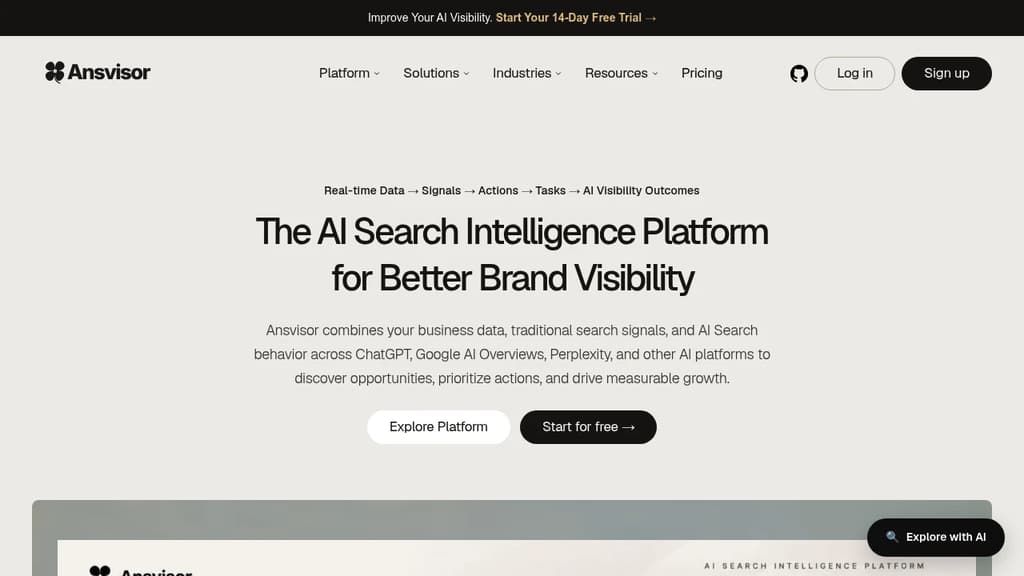
Ansvisor is an AI visibility tracking platform built for marketing, SEO, content, and brand teams who need to understand how their brand shows up in AI-generated answers. As AI search engines handle billions of queries daily, appearing in those answers matters as much as ranking in traditional search. Ansvisor connects that gap between conventional search data and AI-specific behavior.
It monitors brand mentions, citations, and visibility scores across ChatGPT, Google AI Overviews, Google AI Mode, Gemini, Claude, Perplexity, and Microsoft Copilot. You can track competitor performance on the same platforms, identify which prompts and topics are driving AI-referred traffic, and measure how visibility changes over time.
Key capabilities include:
- Prompt Intelligence: Tracks the specific prompts and questions where your brand does or doesn't appear, surfacing gaps worth acting on.
- Opportunity Discovery: Finds high-value topics across AI and traditional search data where your brand could gain citations or mentions.
- Action Center: Converts visibility data into prioritized briefs and content workflows your team can execute directly.
- Traffic Attribution: Connects AI visibility metrics to actual site traffic and business outcomes, so you can see what's driving real results.
- Competitor Tracking: Monitors how rivals appear across the same AI platforms, including citation frequency and mention sentiment.
Unlike tools that only report on visibility, Ansvisor is built around an end-to-end workflow: Analytics → Opportunities → Actions. That makes it useful beyond SEO specialists. Brand managers, PR teams, agencies, and executives can all work from the same data. Compared to alternatives like Otterly.AI, AthenaHQ, or Profound, Ansvisor's open-source foundation means teams can self-host the platform at no cost, audit its data handling, and extend it for custom workflows.
It's built by 50+ GitHub contributors and available as a self-hosted deployment or via Ansvisor Cloud with a 14-day free trial on paid plans.

Runs prompts through ChatGPT, Perplexity, Gemini, Claude, and Google AI Overview interfaces via browser automation, then analyzes captured responses and citations with a model endpoint you configure.
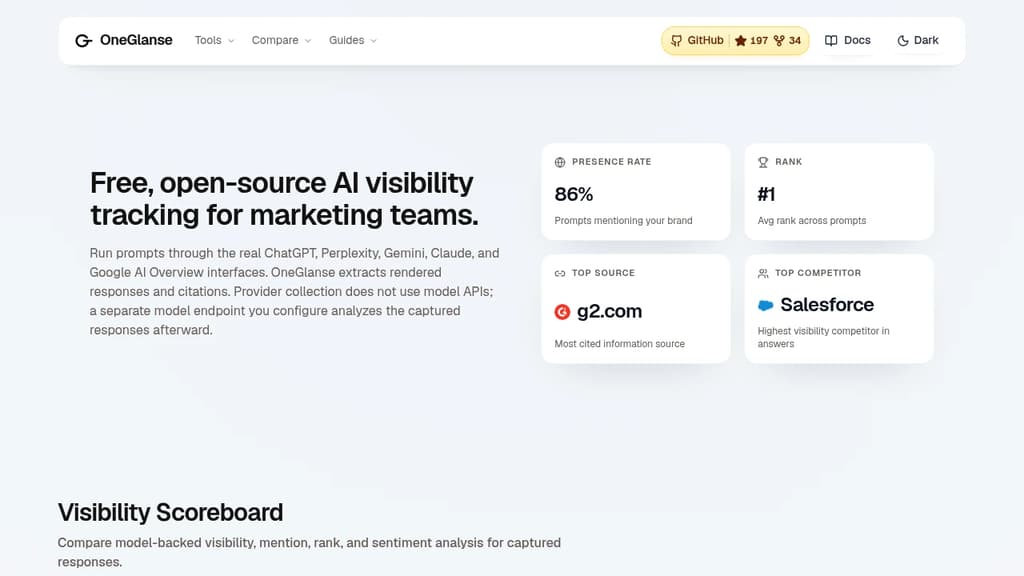
OneGlanse is built for marketing teams who want to know how their brand appears in AI-generated answers across the major AI products. It's a self-hostable, MIT-licensed tool for AI visibility tracking, sometimes called GEO (Generative Engine Optimization), covering ChatGPT, Perplexity, Gemini, Claude, and Google AI Overview.
The core approach sets it apart from API-based trackers. Collection uses browser automation against the actual product interfaces, not provider APIs. That distinction matters because product interfaces and their underlying APIs can return different wording, ordering, and citations. What you capture is what a real user would see.
After collection, captured response text is sent to a model endpoint you configure (OpenAI, Anthropic, or a compatible endpoint) for analysis. Scores for visibility, rank, sentiment, and recommendation strength are model-backed interpretations of that sampled text, not official measurements from the AI products.
Key capabilities:
- Visibility scoreboard: Compare presence rate, average rank, mention count, and sentiment across competitors in one view.
- Citation tracking: Inspect which domains and URLs appear in captured answers, how often, and across which providers.
- AI Perception analysis: Surface recurring themes, key claims, and differentiators that the analysis model finds in captured responses.
- Multi-provider prompt runs: Submit one prompt set across all five supported interfaces and compare results side by side.
- ClickHouse analytics: Query raw captured responses, citations, and analysis data directly.
Everything runs in infrastructure you control. In local mode, all data stays on your machine. In self-host mode, you deploy the web app, worker, queue, and data services yourself. No subscription, no usage fee. Provider accounts, model API usage, and hosting are your own costs.
For teams already tracking CRM performance or running competitive research, OneGlanse adds a layer that shows how brand narratives are forming inside AI answers before those narratives harden. Alternatives like Otterly.AI or Peec AI exist in this space, but OneGlanse's browser-based collection and fully auditable codebase make it a credible choice for teams that can't send prompt data to a third-party platform.

Tracks how often AI tools like ChatGPT, Claude, and Perplexity mention or cite your brand, then fixes the gaps through AEO strategy and content work.
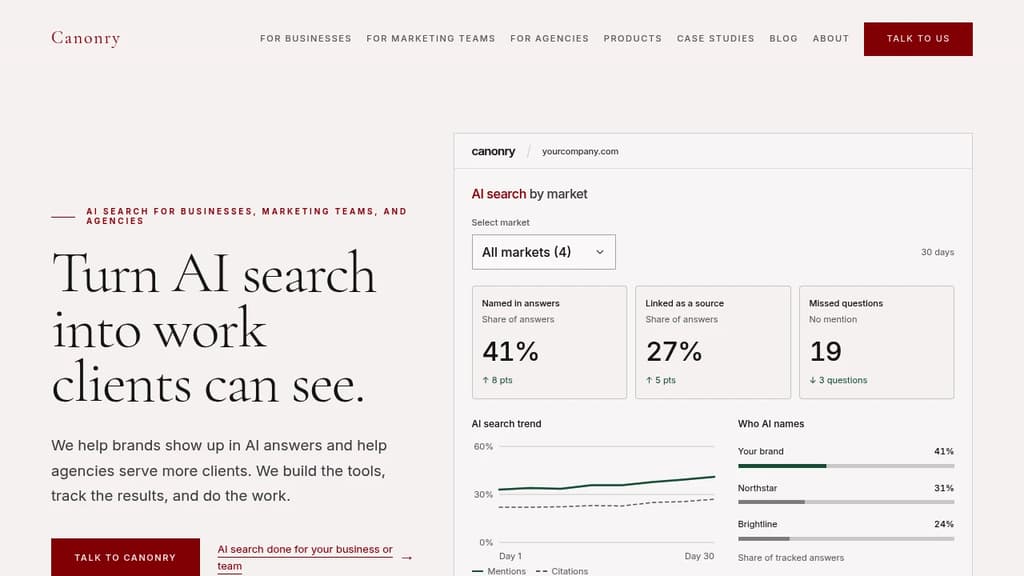
Canonry is an AI visibility tracking platform built for businesses, marketing teams, and agencies that want to show up when AI tools answer buyer questions. It combines measurement with hands-on work: tracking which AI tools mention your brand, which competitors they name instead, and then addressing the gaps through Answer Engine Optimization (AEO).
The platform monitors ChatGPT, Claude, Gemini, Perplexity, Copilot, Grok, Meta AI, and DeepSeek. Scheduled checks record whether each tool names your brand, cites your site, or leaves you out entirely, alongside the competitors it surfaces. Server logs track AI bot visits and traffic from people who follow AI-generated links, giving you both answer-level and traffic-level data.
Canonry offers four distinct products:
- Canonry Custom tracks AI search results for each location or market under a single domain, useful for franchise teams and multi-market brands.
- Canonry Embedded lets agencies add a client's AI visibility report to their existing portal via a single iframe, with no SDK or private keys required.
- White-label AEO puts Canonry's team behind an agency's brand, handling research, fixes, tracking, and client reports while the agency owns the client relationship.
- Canonry Managed is a fully done-for-you service for businesses and marketing teams, covering AEO strategy, content, structured data, business detail consistency, and reporting.
The AEO work itself goes beyond adding schema markup. It covers structured data (JSON-LD for business info, services, and FAQs), consistent business details across third-party sources like Google Business Profile and Wikipedia, bot access configuration, and content that directly answers buyer questions. Canonry also offers a free site check covering 16 on-site factors.
For agencies running paid search, Canonry Ads (private beta) surfaces buyer questions, competing brands AI names, and ideas for ChatGPT Ads tests, while leaving strategy and spend decisions with the advertiser. Tools like Otterly.AI, Peec AI, and AthenaHQ occupy similar ground, but Canonry pairs tracking with a managed service layer that handles the actual optimization work.

People are looking for alternatives to...
View all alternatives
Spotify

Claude Code

Claude

CapCut
Notion

Lovable
 Sent – Messaging Infrastructure for Developers. One API for SMS, WhatsApp, and RCS across 190+ countries.

 Openlane