Open Source Segment Alternatives
A curated collection of the 5 best open source alternatives to Segment.
The best open source alternative to Segment is Cube. If that doesn't suit you, we've compiled a ranked list of other open source Segment alternatives to help you find a suitable replacement. Other interesting open source alternatives to Segment are: CocoIndex, CloudQuery, Jitsu, and Trench.
Segment alternatives are mainly ETL & Data Integration Tools but may also be Semantic Layer Platforms or Product Analytics. Browse these if you want a narrower list of alternatives or looking for a specific functionality of Segment.

Written by Piotr Kulpinski


Cube is a universal semantic layer that connects data sources to analytics tools, providing consistent definitions and fast queries.
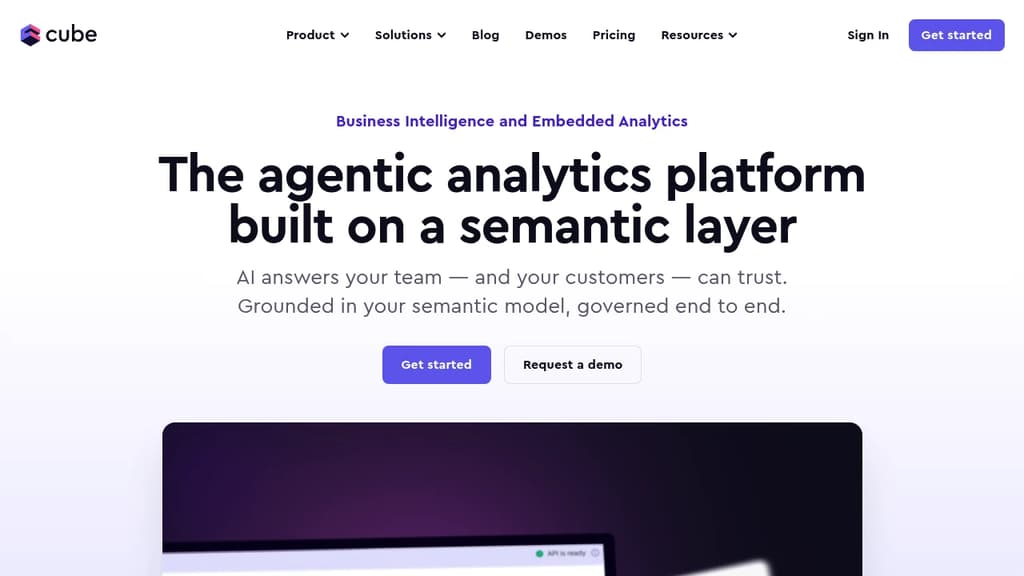
Cube is an open-source universal semantic layer that acts as a bridge between your data sources and analytics tools. It provides a centralized place to define data models, metrics, and access controls that can be used consistently across your entire data stack.
Key benefits of Cube:
- Unified data modeling: Define your metrics, dimensions, and business logic once in Cube and reuse them across all your BI tools, dashboards, and data apps. This ensures consistency and saves time.
- Powerful caching and pre-aggregations: Cube optimizes query performance with intelligent caching and pre-aggregation strategies, delivering fast analytics even on large datasets.
- Flexible API options: Access your data through REST, GraphQL, SQL, or MDX APIs. This allows you to integrate Cube with virtually any front-end tool or custom application.
- Fine-grained access control: Implement row-level and column-level security policies directly in your semantic layer, ensuring data governance across all connected tools.
- Multi-database support: Connect to popular databases and data warehouses like Postgres, MySQL, BigQuery, Snowflake, and more.
- Developer-friendly: Built with a code-first approach, Cube integrates seamlessly into modern data engineering workflows with features like version control and CI/CD support.
By centralizing data definitions and optimizing query performance, Cube helps data teams deliver more consistent, faster, and secure analytics experiences across their organization.

Open-source ETL framework built in Rust for AI workloads. Features incremental processing, data lineage, and observability tools for semantic search and RAG applications.
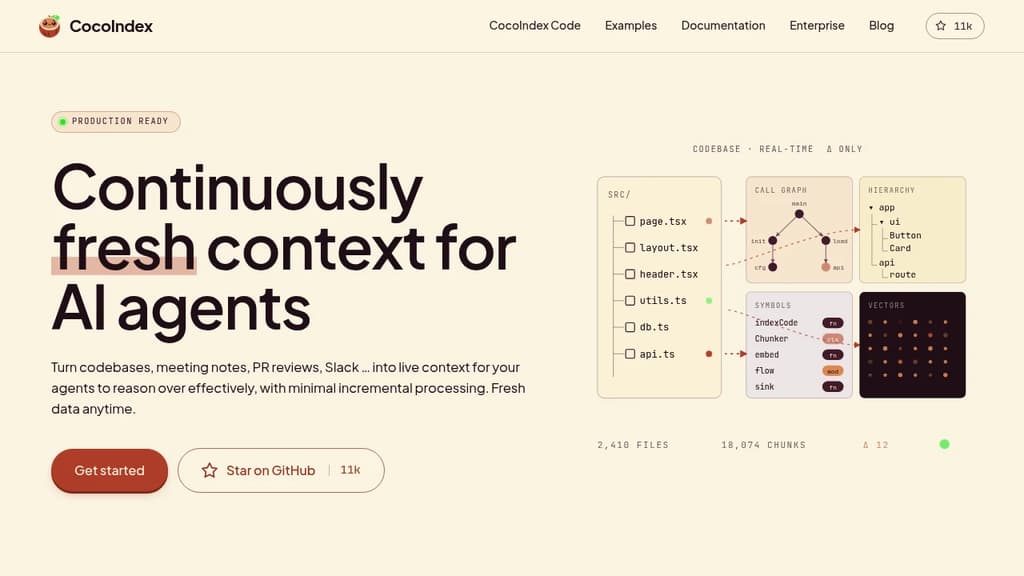
Transform your data for AI workloads with exceptional performance and developer velocity. CocoIndex is an open-source ETL framework with a Rust-powered core engine, designed specifically for modern AI applications including semantic search, RAG, and knowledge graphs.
Key advantages:
- Minimal code required - Get started with just ~100 lines of Python using declarative dataflow syntax
- Incremental processing - Automatic recomputation optimization that only processes necessary portions while reusing cached results
- Native building blocks - Standardized interfaces for sources, targets, and transformations with 1-line component switching
- Single source of truth - Define once, run in multiple modes: batch, live updates, or fast preview runs
CocoInsight companion tool provides best-in-class data lineage and observability, helping you understand your pipeline step-by-step without requiring deep data expertise. This significantly boosts developer velocity and lowers barriers to data engineering.
Production-ready from day zero with automatic schema management, cloud-native architecture, and enterprise features including VPC deployments, guaranteed SLA, and data governance. Available as open-source (Apache 2.0) for self-hosting, with free personal use options and enterprise support tiers.

CloudQuery is an open-source ELT platform that enables easy data integration from hundreds of cloud and security tools to any destination.
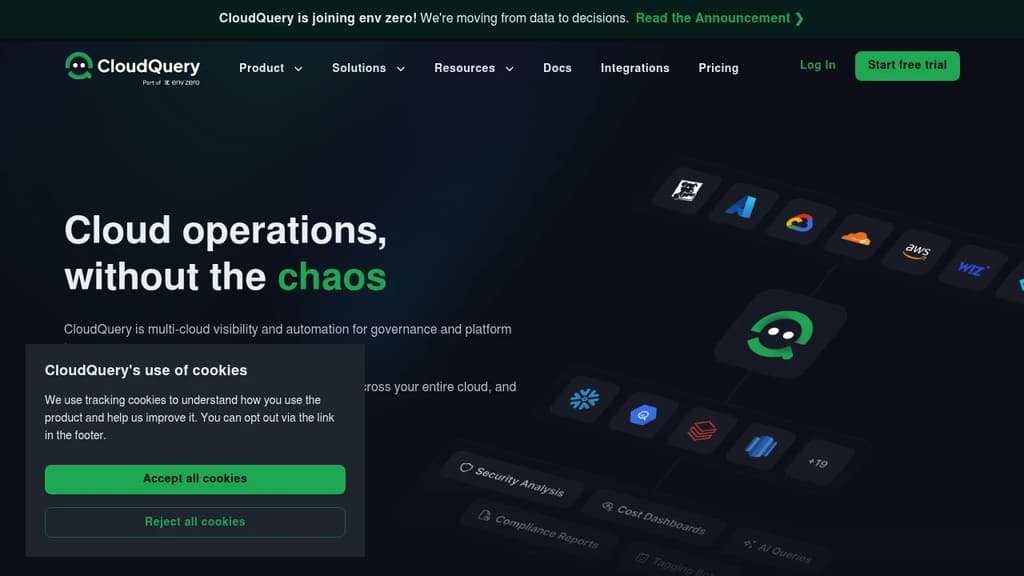
CloudQuery is a powerful open-source ELT (Extract, Load, Transform) platform designed for simplicity, performance, and extensibility. It allows users to easily sync data from hundreds of cloud and security tools to any destination.
Key features and benefits:
- Wide range of integrations: CloudQuery supports hundreds of source plugins, including major cloud providers (AWS, GCP, Azure), security tools, and more.
- Flexible destinations: Data can be loaded into various destinations, including databases, data warehouses, and analytics platforms.
- High performance: Native connectors and columnar data streaming protocol ensure low memory footprint and increased performance.
- Simplicity and portability: The CloudQuery CLI and connectors have zero external dependencies, making it easy to run locally, in the cloud, or embedded in orchestrators.
- Open-source SDK: Developers can write custom connectors in any language using the CloudQuery SDK, which provides built-in scheduling, rate-limiting, transformation, and documentation capabilities.
- Versatile use cases: CloudQuery can be used for cloud infrastructure and security analysis, database migration, engineering analytics, and more.
CloudQuery's architecture makes it ideal for businesses looking to centralize their data from various sources, enabling better decision-making, improved security posture, and streamlined operations. Whether you're a cloud team, product manager, or developer, CloudQuery offers a flexible solution for your data integration needs.

Collect, transform, and sync data across your entire infrastructure with a flexible, code-based approach to data integration.
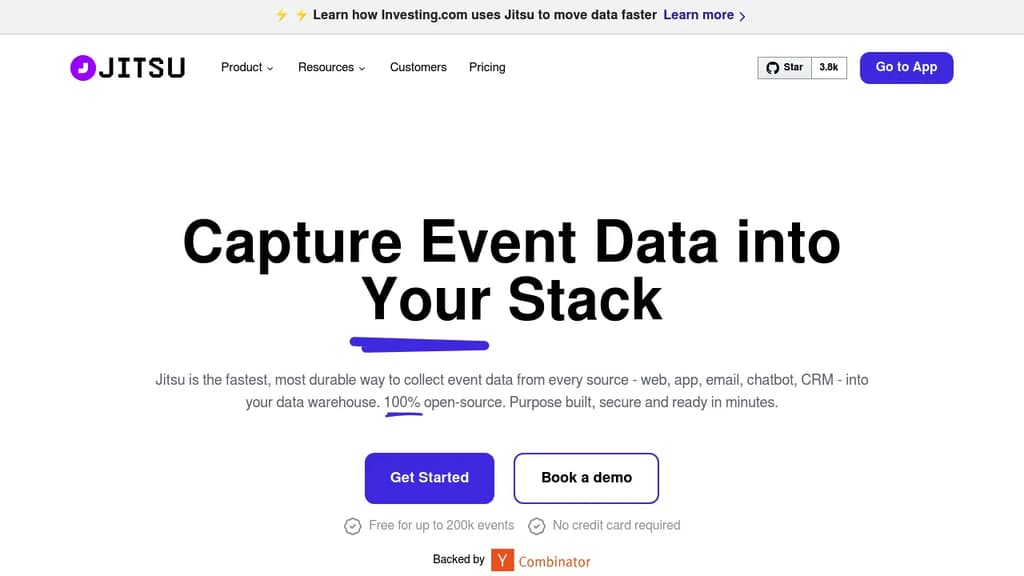
Jitsu is a powerful, open-source data integration platform designed for modern data stacks. It enables seamless data collection, transformation, and synchronization across your entire infrastructure.
Key benefits of Jitsu include:
- Flexibility: Build custom data pipelines using JavaScript, allowing for complex transformations and business logic implementation.
- Real-time capabilities: Stream data in real-time to your data warehouse or analytics tools, ensuring up-to-date insights.
- Wide range of integrations: Connect to popular data sources, destinations, and tools out-of-the-box, with easy extensibility for custom integrations.
- Data privacy and security: Self-host Jitsu for complete control over your data, ensuring compliance with privacy regulations.
- Cost-effective: Reduce data integration costs with an efficient, open-source solution that scales with your needs.
- Community-driven: Benefit from a growing ecosystem of contributors and users, constantly improving and expanding the platform.
Jitsu empowers data teams to take control of their data flows, enabling faster decision-making and more efficient data operations. Whether you're dealing with event tracking, customer data, or complex ETL processes, Jitsu provides the tools and flexibility to handle your data integration needs effectively.

Open source analytics platform built on ClickHouse and Kafka, offering high-speed event tracking and real-time querying capabilities.
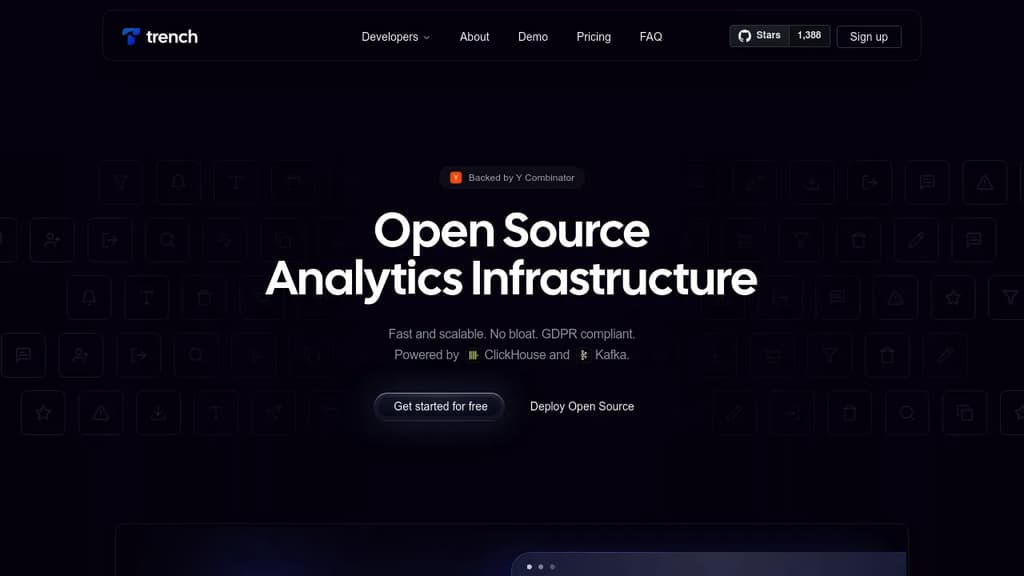
Trench is an open-source analytics infrastructure that combines the power of ClickHouse and Kafka to deliver fast, scalable event tracking solutions. Built for high performance and compliance, Trench offers:
- Massive throughput: Track thousands of events per second on a single node with Kafka.
- Lightning-fast queries: Query data in real-time using SQL or REST.
- GDPR compliance: Built with privacy and data protection in mind.
- Segment compatibility: Compliant with Segment specification, supporting industry-standard event types.
- Flexible deployment: Available as a single production-ready Docker image or as a managed cloud service.
- Data portability: Send data anywhere with throttled webhooks.
Trench is backed by Y Combinator and maintained by a team with experience at scale from companies like LinkedIn, Microsoft, and Discord.
Whether you choose to self-host or use Trench Cloud, you can set up powerful, scalable tracking in less than 15 minutes.
Key features of Trench Cloud:
- Serverless, fully-managed with zero ops
- Autoscaling resources
- High availability with 99.99% SLA
- Private networking
- Priority support
For those preferring self-hosting, Trench Open Source offers:
- MIT License
- Self-hosting on any cloud provider
- Cloud-native architecture
- No usage limits
- Community support

People are looking for alternatives to...
View all alternatives
Claude Code

Spotify

CapCut

Claude

Notion

Lovable
 CodeRabbit – The leading AI Code Review platform. Ship better quality code in 50% less time, with 90% fewer bugs.
 Sent
Sent